

Lightspeed Review 2026
Lightspeed charges a monthly fee for using someone else's card processor. Its own help center says so. Everything else on the page is a footnote to that.

Our Verdict
3.1
Based on our independent review
60+ hours of research
Ease of Use
3.4/5
Pricing & Value
2.5/5
Features & Add-ons
4.5/5
Customer Support
3.2/5
Setup Time
3.5/5
Pricing Transparency
2.3/5
Privacy & Data
3.5/5
Best For: Established retailers with massive, complex inventories and multiple store locations.
True Year 1 Cost: $1,068
Year 2+ (renewal): $1,068
Top Advantages
- Matrix inventory handles 1,000s of SKUs with size, colour and material variants, plus automated purchase orders. Best inventory engine we tested.
- Multi location stock, transfers and per location reports are on the $149 Core plan, not sold as add ons.
- Onboarding and professional service options are ticked for all 3 plans on the pricing grid. The NuORDER catalog holds 5 million plus products.
$109/mo · 14-day free trial, no card required
In This Article
How We Tested Lightspeed
We ran Lightspeed Retail's 14 day trial and tested the inventory and reporting tools. Then we re-read the pricing page, the trial page, the payments page and the Lightspeed Payments FAQ on 4 September 2026. Trustpilot re-read the same day, 3.9 from 2,508 reviews. Every plan price comes from the grid.
Lightspeed Overview
What Is Lightspeed POS?
Lightspeed Retail is a cloud point of sale from Lightspeed Commerce, a Canadian company. It is built around inventory. 3 paid plans, $89, $149 and $289 a month on annual billing. Card present processing at 1.5% on every plan through Lightspeed Payments. The pricing page notes that prices reflect the X-Series product and that service fees can vary by industry.
Who Should Use Lightspeed?
Retailers with deep inventory. A bike shop tracking 1,000s of parts by brand and size. An apparel store with colour and size variants. A chain with 3 locations moving stock between them. If you carry a few hundred SKUs or sell mostly online, you will pay for tools you never open.
How Pricing Works
Basic is $89 a month on annual billing or $109 monthly. Core is $149 or $179. Plus is $289 or $339. Lightspeed's own toggle says annual saves up to 18%. Every plan includes 1 register. Extra locations and registers are priced on top. The trial is 14 days with no credit card, per Lightspeed's trial page.
What Lightspeed Actually Costs
True Cost Analysis
Starting Monthly Price
$109
Annual Plan
$1,068
If paid annually
Basic billed annually is $89 a month, $1,068 a year. Lightspeed Payments is 1.5% card present on every plan. Hardware is sold separately. Terminals must come from Lightspeed. Keep another processor and a monthly fee applies that Lightspeed does not publish.
Lightspeed Pricing Plans
See live pricing →Basic
$109/mo
- 1 register included
- Lightspeed Payments at 1.5% card present
- Inventory management and NuORDER catalog
- Basic eCommerce
- 24/7 chat support
Core
$179/mo
- Everything in Basic
- In store and online loyalty
- Advanced sales, staff and inventory reports
- Accounting, ecommerce and marketing integrations
- Mobile scanner app
- 24/7 chat support
Plus
$339/mo
- Everything in Core
- Forecasting, order recommendations and custom reporting
- API access and workflows
- Custom user roles and SSO
- 24/7 phone support
Lightspeed Pros and Cons
Pros
- Matrix inventory handles 1,000s of SKUs with size, colour and material variants, plus automated purchase orders. Best inventory engine we tested.
- Multi location stock, transfers and per location reports are on the $149 Core plan, not sold as add ons.
- Onboarding and professional service options are ticked for all 3 plans on the pricing grid. The NuORDER catalog holds 5 million plus products.
- 1.5% card present processing on every plan, printed on the pricing grid rather than hidden in a quote.
Cons
- No free plan. $89 a month on annual billing is the floor, $109 month to month.
- Lightspeed's own Payments FAQ says merchants using another processor are charged a monthly third party processing fee. The amount is not published.
- 24/7 phone support is a Plus plan feature at $289 a month. Basic and Core get 24/7 chat.
- Trustpilot fell to 3.9 from 2,508 reviews on 4 September 2026, down from 4.2 on our July read.
- Hardware is sold separately and payment terminals must come from Lightspeed. Its Payments FAQ says third party terminals are not supported.
Upsell Pressure & Hidden Fees
Transparency Check, We Documented Every Upsell
The biggest cost on this page is not on the pricing page. Lightspeed's Payments FAQ says merchants using a non Lightspeed processor are charged a monthly third party processing fee, and tells you to apply for Lightspeed Payments before your notice period ends to avoid it. The figure is not published. Ask for it in writing before you sign. Beyond that, extra registers and locations are priced on top of the base plan, terminals must be bought from Lightspeed, and monthly billing costs up to 18% more than annual by Lightspeed's own toggle. A $15 chargeback fee is the one fee its payments page names outright.
Pricing Transparency Score
2.3/5
5 = Fully transparent pricing · 1 = Heavy upsell pressure
What Real Customers Say
Reddit / Community Sentiment
Not re-read this run. The measured signal is Trustpilot, 3.9 from 2,508 reviews on 4 September 2026, down from 4.2 on our July read. The pattern in the 1 star reviews is billing and reaching support after the sale. The 5 star reviews name onboarding staff.
Is Lightspeed Right for You?
Best For These Founders
Sporting Goods and Bike Shops
1,000s of parts across brands and sizes. Matrix inventory is the reason to pay $89 a month.
Multi Location Retailers
Stock transfers and per location reports on the $149 Core plan. Each extra location is priced on top.
Apparel Boutiques
Size and colour variants by the 100, with reorder points per location.
Consider Alternatives If…
You sell mostly online. Lightspeed eCommerce is marked Basic on the Basic plan and Shopify POS is the stronger fit.
You want to keep your current card processor. The monthly third party fee is real and unpublished.
You want a phone line on the $89 plan. Phone support starts at $289.
What The Pricing Grid Says
Lightspeed's retail pricing page carries 3 plans. Basic at $89, Core at $149, Plus at $289, all per month on annual billing. Flip the toggle to monthly and the page data reads $109, $179 and $339. Lightspeed says annual saves up to 18%. Every plan includes 1 register. The page adds 1 line worth reading twice, prices reflect Lightspeed Retail X-Series and service fees may vary by industry.
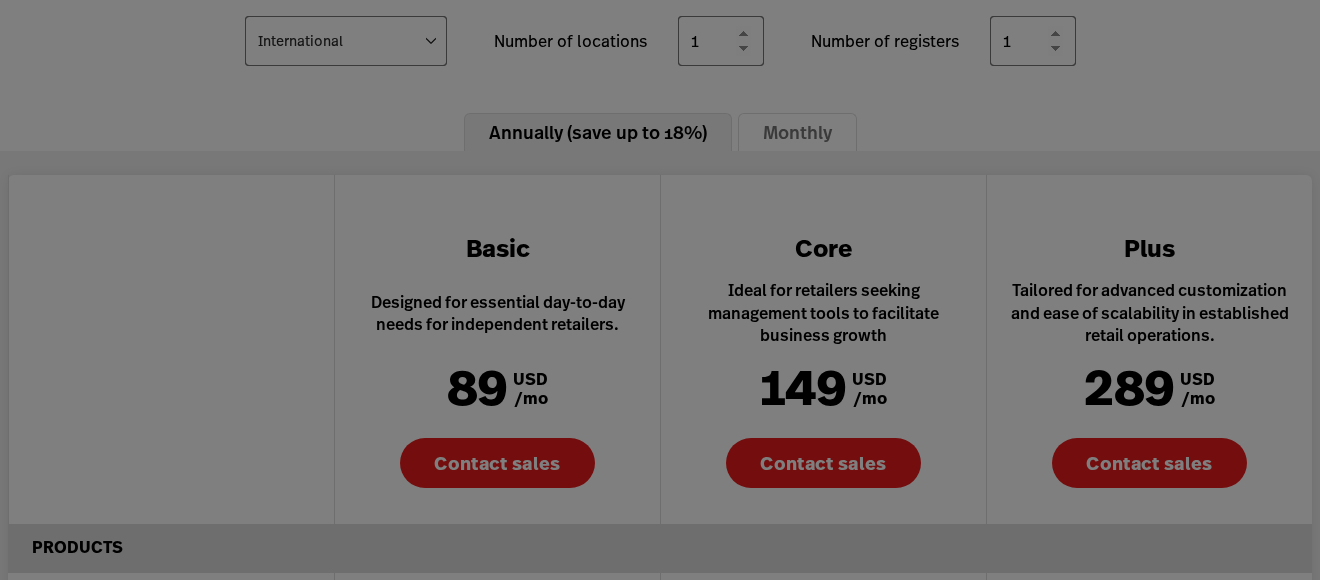
| Plan | Annual billing | Monthly billing | Phone support | API |
|---|---|---|---|---|
| Basic | $89 a month | $109 a month | No, chat | No |
| Core | $149 a month | $179 a month | No, chat | No |
| Plus | $289 a month | $339 a month | Yes, 24/7 | Yes |
Basic on annual billing is $1,068 a year in software before hardware or processing. Card present processing is 1.5% on all 3 plans. A store running $30,000 a month through the card reader pays about $450 a month in processing on top. That is our arithmetic on Lightspeed's rate.
The Fee For Keeping Your Own Processor
This is the cost that surprises people. Lightspeed's Payments FAQ says merchants using a non Lightspeed processor will be charged a monthly third party processing fee. To avoid it, you apply for Lightspeed Payments before your notice period ends. The FAQ does not print the fee. The pricing page does not either.
So the rule is simple. If you want to keep your current processor, get the monthly figure in writing from the sales account manager before you sign. The same FAQ says terminals must be bought from Lightspeed and third party terminals are not supported, so budget the hardware too.
Inventory Is The Reason To Pay
We added products with size, colour and material variants. The matrix handled them cleanly. Reorder points per location, automated purchase orders, stock transfers between stores. The pricing grid lists the NuORDER catalog on every plan, 5 million plus products to speed up import, and PO sync with it. Advanced reports, loyalty and the mobile scanner app start at Core. Forecasting, custom reporting, API access and workflows are Plus only.
eCommerce is marked Basic on the Basic plan and full on Core and Plus. It worked in our test. It felt thinner than a dedicated storefront. If online is most of your revenue, read our Shopify POS review first.
Setup And Support
The trial is 14 days with no credit card, per Lightspeed's trial page. Onboarding and professional service options are ticked for all 3 plans on the grid. The learning curve is real. A catalog import needs careful SKU mapping, and a migration from a simpler system takes hours, not minutes.
Support is 24/7 chat on every plan. 24/7 phone is a Plus feature. The Payments FAQ tells merchants to contact support by chat or phone for payment problems. Trustpilot sits at 3.9 from 2,508 reviews on 4 September 2026, down from 4.2 in July, and the negative reviews cluster on billing and on reaching someone after the sale.
How Lightspeed Compares
Square is the usual pick for a single shop with simple stock. Toast is built for restaurants. Shopify POS is the pick if you are online first and adding a store. Lightspeed's edge over all 3 is inventory depth, matrix variants, purchase order automation, the NuORDER catalog and multi location transfers.
Final Verdict
Lightspeed is the strongest POS we have tested for deep, variant heavy inventory across several stores. Matrix inventory, purchase order automation and stock transfers are the reasons to pay. The price is $89 a month on annual billing, 1.5% on card present sales, and a monthly fee if you keep another processor that Lightspeed's own FAQ confirms and does not price. Phone support starts at $289. Trustpilot is 3.9 from 2,508 reviews. Buy it for the inventory. Get the processor fee in writing first.
By Eliot Reynolds, Editor, StartupOwl
Frequently Asked Questions
This review reflects independent, first-hand testing by the StartupOwl team. Affiliate relationships never influence our ratings or recommendations. Read our editorial policy →
About the Author
Editor, StartupOwl
Eliot leads StartupOwl's state data research. He maintains the site's fifty state records of LLC filing fees, annual costs, processing times, and small business grant programs, checking each figure against the state office that publishes it and logging the date it was verified. Based in New Jersey, he has spent his working life in and around small businesses, and he writes for the founder who wants the real number rather than the advertised one. Every figure under his byline traces to a named source, and when a state proves a number wrong, the correction is published, not buried.
Was this article helpful?



Questions about Lightspeed
No comments yet. Ask the first question and a member of our team will answer.
Leave a comment