
Marketing Budget for Small Business: How Much to Spend and Where to Spend It
The SBA recommends 7-8% of revenue for marketing. Learn how to set your small business marketing budget, allocate across channels, and avoid wasting money.

In This Article
- Key Takeaways
- Step-by-Step
- Cost Breakdown
- Why Your Marketing Budget Is the Single Most Important Number in Your Business
- How to Build Your Marketing Budget in 5 Steps
- The Best Free and Low-Cost Marketing Tools to Stretch Your Budget
- 5 Marketing Budget Mistakes That Waste Thousands of Dollars
- What to Do Right Now
- FAQ
$0–$5,000
Est. Cost
60 minutes
Timeline
5
Total Steps
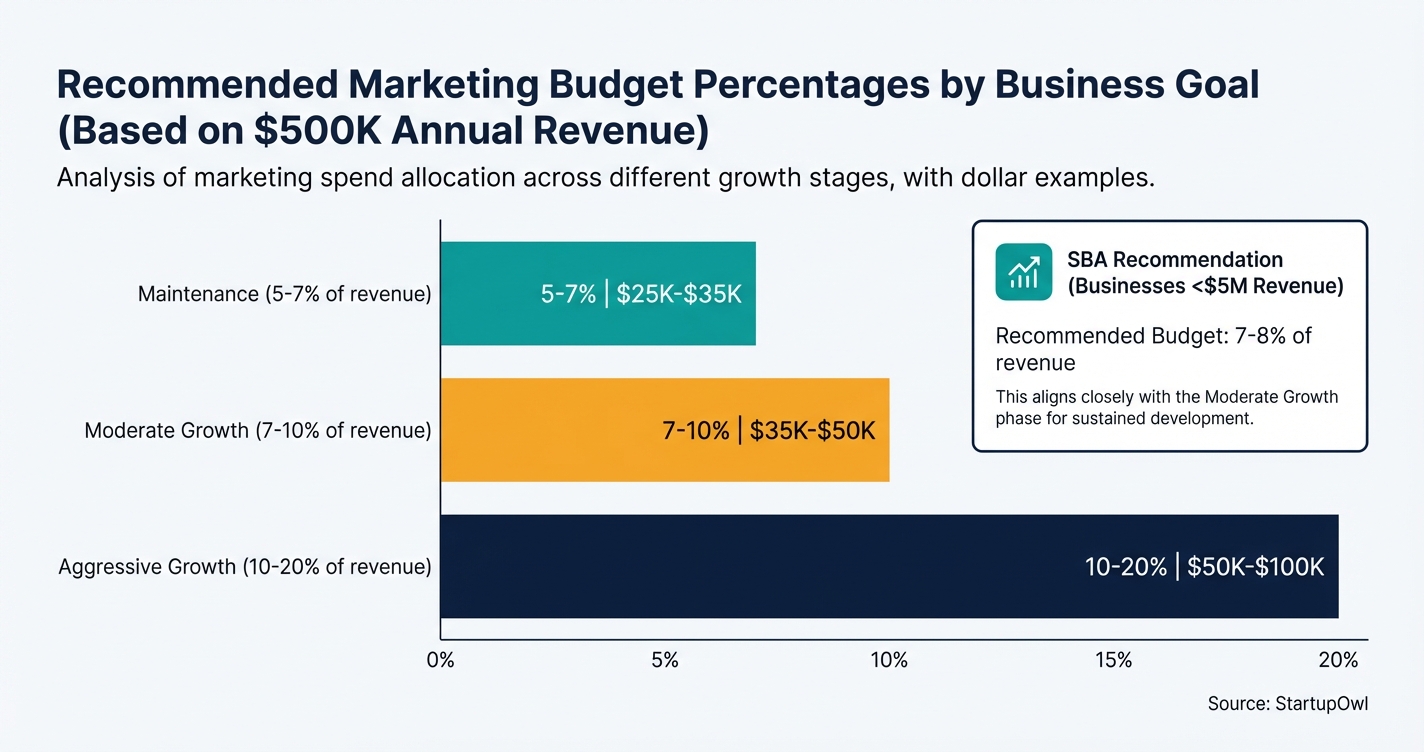
The U.S. Small Business Administration recommends that businesses earning under $5 million per year spend 7-8% of gross revenue on marketing, according to SBA.gov. Gartner's 2026 CMO Spend Survey confirms that the average company spends 7.7% of revenue on marketing (as of 2026). If your revenue is $500,000, that translates to $35,000-$40,000 per year, or roughly $3,000-$3,300 per month.
Yet 41% of small businesses spend less than $500 per month on advertising (Taradel, 2026). That gap between the recommended spend and what most businesses actually invest is exactly where opportunity lives. This guide helps you figure out the right number for your business, then shows you where every dollar should go.
If you have not built your overall strategy yet, start with our small business marketing plan guide first, then come back here to attach real numbers to it.
Why Your Marketing Budget Is the Single Most Important Number in Your Business
Small businesses with a documented marketing plan are 6.7 times more likely to report marketing success than those flying blind, according to recent survey data. A marketing budget turns that plan into reality by forcing you to make hard choices about where to invest and what to skip.
The math behind marketing budgets is straightforward. You need to know three numbers: your customer acquisition cost (CAC), your customer lifetime value (LTV), and your breakeven point. If it costs you $50 to acquire a customer who spends $500 over their lifetime, your marketing budget practically writes itself. If you are spending $200 to acquire that same customer, you have a problem no amount of budgeting can fix.
Acquiring a new customer costs approximately 5x more than retaining an existing one. That single stat should shape how you allocate your budget. If you are putting 90% of your marketing dollars into acquisition and 0% into retention, you are leaving money on the table. Your budget needs to cover both.
How to Build Your Marketing Budget in 5 Steps
Below is a step-by-step process to set your marketing budget, choose your channels, and track results. Each step includes real costs and timelines so you can move from reading to doing in one sitting.
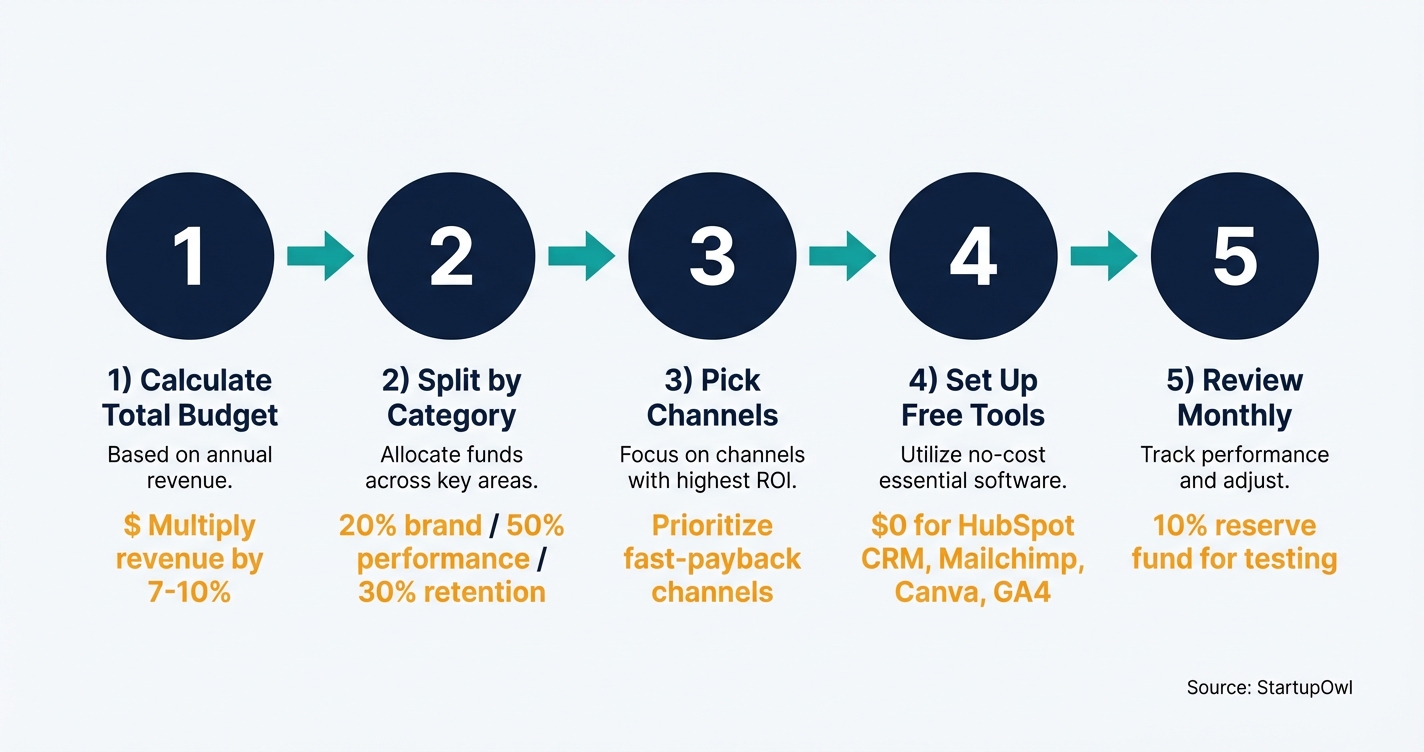
Step 1: Calculate your total marketing budget from revenue. Multiply your gross annual revenue by 0.07 for a maintenance budget or 0.10 for a growth budget. A $300,000/year business should allocate $21,000-$30,000 annually ($1,750-$2,500/month). New businesses with no revenue should set a fixed monthly amount they can sustain for at least 6 months. The minimum to drive sustainable growth is about $3,000/month invested wisely, based on industry benchmarks.
Step 2: Split your budget into three categories. Use the brand/performance/retention framework. A practical starting split for most small businesses: 20% brand (social media, content, sponsorships), 50% performance (Google Ads, local SEO, email campaigns), and 30% retention (email nurture, loyalty programs, customer success). Adjust based on your stage: pre-revenue businesses should put 60-70% into performance.
Step 3: Pick channels based on payback speed. Google Ads for small business can generate leads within days. Email marketing averages $36 for every $1 spent (Litmus, 2026). SEO and content take 3-6 months but compound over time. A sample $3,000/month allocation: $1,200 paid search, $750 content and SEO, $450 email, $300 social, $300 reserve.
Step 4: Set up free tools before spending on ads. HubSpot's free CRM covers up to 1,000 contacts (as of 2026, per HubSpot). Mailchimp's free plan supports 500 contacts and 1,000 emails/month (as of 2026, per Mailchimp). Canva Free gives you 2 million+ templates and 5 GB of storage. Install Google Analytics 4 and Google Search Console (both free) to track everything. See our ConvertKit vs Mailchimp comparison if you are choosing between email platforms.
Step 5: Review and reallocate monthly. Compare spend vs. results per channel on the first of every month. Among businesses that increased their marketing spend, 88% reported stable or improved sales (Taradel, 2026). Keep a 10% reserve for testing new ideas each quarter. If a test works, fold it into the main budget. If it does not, you have protected your core spending.
What Each Marketing Channel Actually Costs
| Type / Provider | Rate | Notes |
|---|---|---|
| Email marketing (Mailchimp) | $0-$20/mo | Free for 500 contacts; Essentials $13/mo, Standard $20/mo |
| Google Ads (search) | $500-$5,000/mo | Avg CPC $5.26 (2026); minimum $1,000/mo for useful data |
| CRM (HubSpot) | $0-$15/mo | Free for 1,000 contacts; Starter $15/seat/mo billed annually |
| Design (Canva) | $0-$13/mo | Free plan with 2M+ templates; Pro $12.99/mo or $119.99/yr |
| SEO tools (Semrush/Ahrefs) | $0-$130/mo | Free limited features; paid from $99-$130/mo |
| Social media management | $0-$99/mo | Buffer free for 3 channels; paid plans $5-$99/mo |
| Freelancer (design or copy) | $200-$2,000/mo | Fiverr from $5/task; experienced freelancers $50-$150/hr |
| Total typical monthly spend | $1,500-$5,000/mo | For a business earning $300K-$1M/yr (7-10% of revenue) |
The Best Free and Low-Cost Marketing Tools to Stretch Your Budget
You can run a legitimate marketing operation for under $100/month in software costs when you are just starting out. Here are the tools that give you the most value at the lowest price.
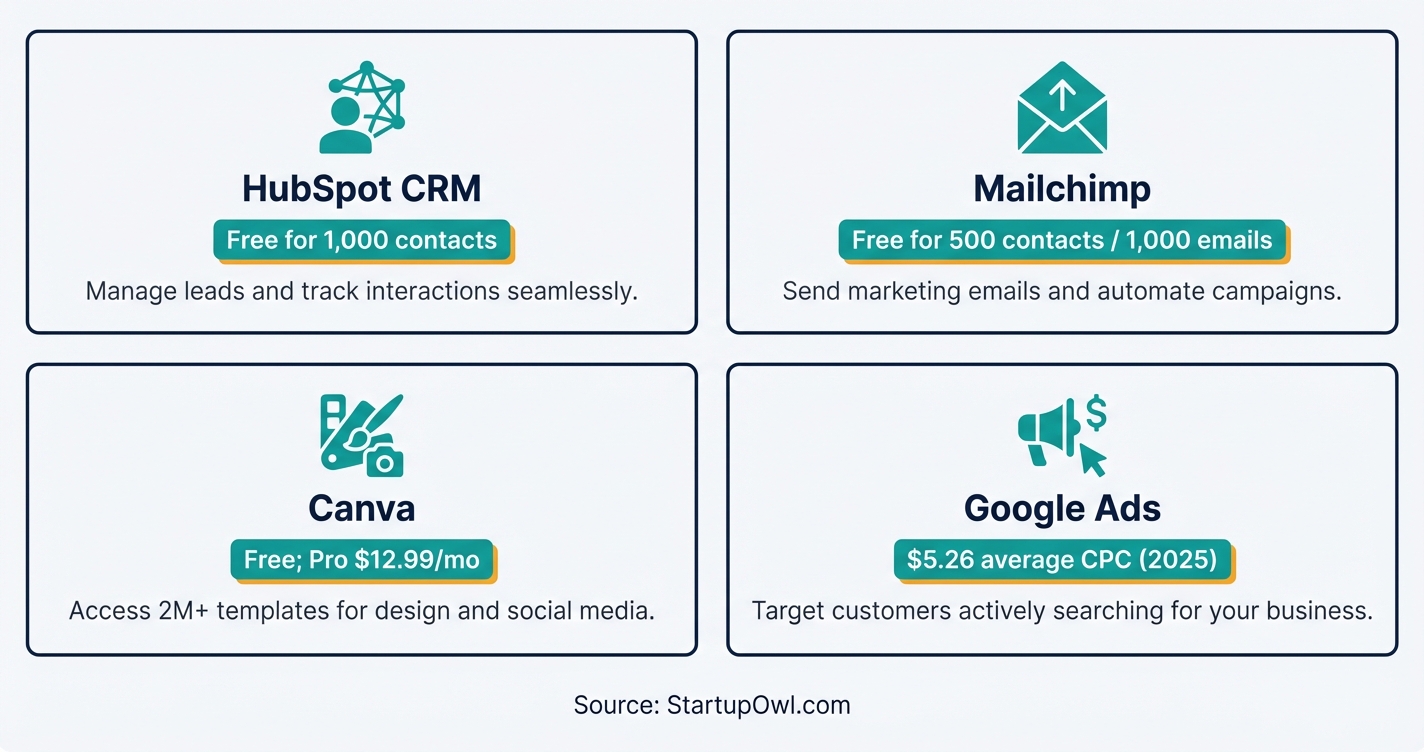
HubSpot CRM (Free) tracks your contacts, deals, and sales pipeline without charging you a cent. The free plan includes up to 1,000 contacts, basic deal tracking, and email integration (as of 2026, per HubSpot). When you outgrow it, the Starter plan is $15/seat/month billed annually and bundles marketing, sales, and service tools. For more CRM options, see our CRM for startups guide.
Mailchimp (Free / $13/mo) handles email marketing for most small businesses. The free plan covers 500 contacts and 1,000 emails/month (as of 2026, per Mailchimp). The Essentials plan at $13/month gives you 5,000 email sends, A/B testing, and 24/7 support. Email marketing returns an average $36 for every $1 spent (Litmus, 2026), making it the single highest-ROI channel you can invest in.
Canva (Free / $12.99/mo) replaces expensive graphic design software. The free plan includes 2 million+ templates, 5 GB storage, and a drag-and-drop editor (as of 2026, per Canva). Canva Pro at $12.99/month (or $119.99/year) adds 100 million+ premium assets, background remover, and brand kit features.
Google Ads gives you instant access to people searching for what you sell. The average cost per click is $5.26 across all industries (WordStream, 2026, per WordStream), but restaurants pay as low as $2.05/click while legal services run $8.58/click. Most small businesses spend between $1,000 and $10,000/month. Read our Google Ads for small business guide before launching your first campaign.
Use our pricing calculator to figure out what you can charge, and our free marketing plan template to document your strategy before you start spending.
5 Marketing Budget Mistakes That Waste Thousands of Dollars
1. Spending $0 and expecting organic growth to happen. About 65% of small businesses struggle with budget limitations or lack of time for marketing (Constant Contact, 2024). Spending nothing is not a strategy. Even $500/month allocated to email and one paid channel beats zero.
2. Dumping your entire budget into paid ads with no tracking. The average Google Ads conversion rate is 7.52% in 2026, which means 92 out of 100 clicks do not convert (WordStream, 2026). Without Google Analytics, conversion tracking, and defined KPIs, you are guessing. Set up tracking before you spend your first dollar on ads.
3. Ignoring email marketing because it feels old-fashioned. Email returns $36 for every $1 spent. Social media does not come close. If you are spending $2,000/month on Instagram ads and $0 on email, flip that ratio. Build your list with every customer interaction and use tools like ChatGPT for small business to draft email sequences faster.
4. Cutting marketing spend when sales slow down. This triggers a vicious cycle: fewer sales lead to budget cuts, which lead to even fewer sales. Among businesses that increased their marketing spend, 88% reported stable or improved results. Marketing is an investment, not a luxury expense you can toggle off.
5. Spreading your budget across too many channels. Trying to be on every social platform, run Google Ads, do SEO, manage email, and attend events with a $1,500/month budget means each channel gets so little funding it cannot perform. Focus on 2-3 channels and execute them well. You can check out our guerrilla marketing ideas guide for creative tactics that cost very little.
Quick Budget Formula for Any Revenue Level
Take your annual gross revenue, multiply by 0.08, and divide by 12. That is your monthly marketing budget. For a $250,000/year business: $250,000 × 0.08 = $20,000 ÷ 12 = $1,667/month. For a $1,000,000/year business: $1,000,000 × 0.08 = $80,000 ÷ 12 = $6,667/month. Adjust up or down based on your growth goals and profit margins.
What to Do Right Now
Open a spreadsheet, calculate 7-8% of your last 12 months of revenue, and write that number down. That is your annual marketing budget. Divide by 12 for your monthly number. Then use the channel allocation breakdown from Step 3 above to assign every dollar a job.
If you are starting from scratch, sign up for HubSpot's free CRM, create a Mailchimp free account, and grab our free marketing plan template. Those three actions cost you nothing and set up the foundation for every marketing dollar you will spend going forward. Then check out our guide on building a brand and our social media content calendar to keep your execution on track.
Step-by-Step Process
- 1
Calculate your total marketing budget from revenue
Start with your gross annual revenue and multiply by 0.07 (7%) for maintenance or 0.10 (10%) for growth. If you earn $300,000/year, that gives you $21,000-$30,000 annually (or about $1,750-$2,500/month). If you are a brand-new business with no revenue yet, set a fixed monthly number you can sustain for at least 6 months without stress.
Businesses in competitive markets or early-stage growth should push toward 10-15% of revenue. SaaS companies routinely spend 15-25% of revenue on marketing. Your number depends on your margins, your growth goals, and how aggressive your competitors are.
Tips
- Use a simple spreadsheet to track your monthly revenue and tie your budget to that number
- If margins are below 10%, start at 5% and increase as profitability improves
- Include all marketing costs in this number: tools, ads, freelancers, and your own time at an hourly rate
Common Mistakes
- Setting $0 for marketing and expecting word-of-mouth to carry the business
- Using net profit instead of gross revenue, which underestimates what you need
- 2
Split your budget across three spend categories
Divide your marketing budget into three buckets: brand investment (visibility and trust), performance spend (direct lead generation and sales), and lifecycle and retention (keeping existing customers). A common starting split is 20% brand, 50% performance, 30% retention, but you can adjust based on business stage.
If you are pre-revenue or under 6 months old, flip this: put 60-70% into performance channels that drive immediate leads (paid search, local SEO, direct outreach) and 10-20% into brand. You need cash flow before you need awareness.
Tips
- Performance spend should always have measurable KPIs tied to it (cost per lead, cost per sale)
- Do not skip retention: acquiring a new customer costs roughly 5x more than keeping one you already have
Common Mistakes
- Putting 100% of budget into paid ads with nothing allocated for email, content, or retention
- 3
Pick your marketing channels based on payback speed
Rank every channel by how quickly it generates revenue. Google Ads and email marketing typically pay back within weeks. SEO and content marketing take 3-6 months to gain traction but compound over time. Social media is slow for direct sales but useful for brand awareness.
A solid default allocation for a small business spending $3,000/month looks like this: $1,200 on paid search or social ads, $750 on content and SEO, $450 on email marketing tools and list building, $300 on social media, and $300 as a test/reserve fund.
Tips
- Start with 2-3 channels maximum; spreading thin across 6+ channels wastes money
- Email marketing returns an average of $36 for every $1 spent, so prioritize building your list early
- Track customer acquisition cost (CAC) for each channel monthly
Common Mistakes
- Chasing TikTok or the latest trend before building a website and email list
- Ignoring Google Ads because of sticker shock without calculating cost per lead
- 4
Set up free and low-cost tools before spending on ads
Before you spend a dollar on advertising, lock in your free marketing infrastructure. HubSpot's free CRM gives you up to 1,000 contacts and basic deal tracking. Mailchimp's free plan supports up to 500 contacts and 1,000 emails/month (as of 2026). Canva Free provides access to over 2 million templates and 5 GB of storage for all your graphics.
Install Google Analytics 4 on your website and set up Google Search Console to track organic performance. These are completely free and give you the data you need to know which channels are working.
Tips
- Start with free plans and only upgrade when you hit a specific limit, not because a feature looks nice
- Mailchimp's Essentials plan at $13/month covers 500 contacts and 5,000 emails if you outgrow the free tier
Common Mistakes
- Paying for premium marketing tools in month one when free tiers cover your needs for 3-6 months
- 5
Review and reallocate your budget monthly
Set a calendar reminder to review your marketing spend on the first of every month. Compare what you spent per channel against the leads or sales each channel generated. Double down on what is working and cut what is not. 88% of small businesses that increased their marketing spend reported stable or improved sales, according to a 2026 Taradel survey.
Keep a 10% reserve in your budget for testing. Use it to try one new channel or tactic per quarter. If the test works, fold it into your main budget. If it does not, you have not risked your core marketing engine.
Tips
- Create a simple spreadsheet with columns for channel, spend, leads, sales, and cost per lead
- Give each new channel at least 60-90 days before cutting it; some channels need time to optimize
Common Mistakes
- Reviewing spend only once per quarter or year, missing months of wasted budget
- Cutting a channel after 2 weeks because it did not produce instant results
Cost Breakdown
| Item | Cost Range | Notes |
|---|---|---|
| Email marketing (Mailchimp Essentials) | $0-$20/month | Free up to 500 contacts; Essentials at $13/mo for 500 contacts and 5,000 sends |
| Google Ads (paid search) | $500-$5,000/month | Average CPC of $5.26 in 2026; budget at least $1,000/mo for meaningful data |
| CRM software (HubSpot) | $0-$15/month | Free CRM with 1,000 contacts; Starter at $15/seat/month billed annually |
| Design tools (Canva) | $0-$13/month | Free plan with 2M+ templates; Pro at $12.99/month or $119.99/year |
| SEO tools (Semrush or Ahrefs) | $0-$130/month | Limited free features; paid plans start around $99-$130/month |
| Social media management | $0-$99/month | Buffer free plan for 3 channels; paid plans from $5-$99/month depending on needs |
| Freelance help (design, copywriting) | $200-$2,000/month | Varies widely; Fiverr starts at $5/task, experienced freelancers charge $50-$150/hour |
Frequently Asked Questions
The SBA recommends 7-8% of gross revenue for businesses under $5 million in annual revenue. For a business earning $500,000/year, that is $2,917-$3,333/month. If you are in growth mode, push that to 10-15% of revenue.
Email marketing delivers the highest ROI at $36 for every $1 spent (Litmus, 2026). You can start for free with Mailchimp (up to 500 contacts) and see results within weeks. Pair it with basic local SEO for a strong low-cost foundation.
The average cost per click across all industries is $5.26 in 2026 (WordStream). Most small businesses spend $1,000-$10,000/month. Your actual CPC depends on your industry: restaurants pay around $2.05/click while legal services average $8.58/click.
If your budget is under $3,000/month, do it yourself using free tools and our guides. Businesses that blend in-house marketing with external professional services report 2.5x more marketing success than those relying only on internal efforts. Consider a freelancer or small agency once you have a proven channel worth scaling.
Most small businesses now put 53-72% of their marketing budget into digital channels, with the rest going to traditional (print, events, direct mail). If you sell locally, keep some budget for community sponsorships or direct mail. If you sell online, digital should be 80-100% of your spend.
Install Google Analytics 4 (free) and use UTM parameters on every link you share. Track cost per lead and cost per sale for each channel monthly. HubSpot's free CRM can tie leads back to their source. Use a simple spreadsheet with columns for channel, spend, leads, and revenue if you want to keep it basic.
Some links on this page are affiliate links. If you sign up for a service through them, we may earn a commission at no extra cost to you. This does not influence our rankings.
Sources & References
- U.S. Small Business Administration: How to Get the Most From Your Marketing Budget
- Gartner 2026 CMO Spend Survey (via Consultus Digital)
- WordStream 2026 Google Ads Benchmarks
- Mailchimp Pricing Plans (2026)
- HubSpot Free CRM Pricing
- Canva Pricing Plans
- Litmus: The ROI of Email Marketing (2026)
- Revenue Memo: Small Business Marketing Budget Statistics (2026)
- PostcardMania: 143 Small Business Marketing Statistics (2026)
- WebFX: How Much Should a Company Spend on Marketing?
About the Author
Editor, StartupOwl
Eliot leads StartupOwl's state data research. He maintains the site's fifty state records of LLC filing fees, annual costs, processing times, and small business grant programs, checking each figure against the state office that publishes it and logging the date it was verified. Based in New Jersey, he has spent his working life in and around small businesses, and he writes for the founder who wants the real number rather than the advertised one. Every figure under his byline traces to a named source, and when a state proves a number wrong, the correction is published, not buried.
Was this article helpful?
Questions about Marketing Budget for Small Business
No comments yet. Ask the first question and a member of our team will answer.
Leave a comment