
Customer Acquisition Strategies for Small Business, 9 Tactics That Work
Nine customer acquisition channels for small business, ranked by cost. Google clicks average $5.42, Facebook $0.70. Real budgets and timelines.

In This Article
$0–$2,000
Est. Cost
30 days
Timeline
12
Total Steps
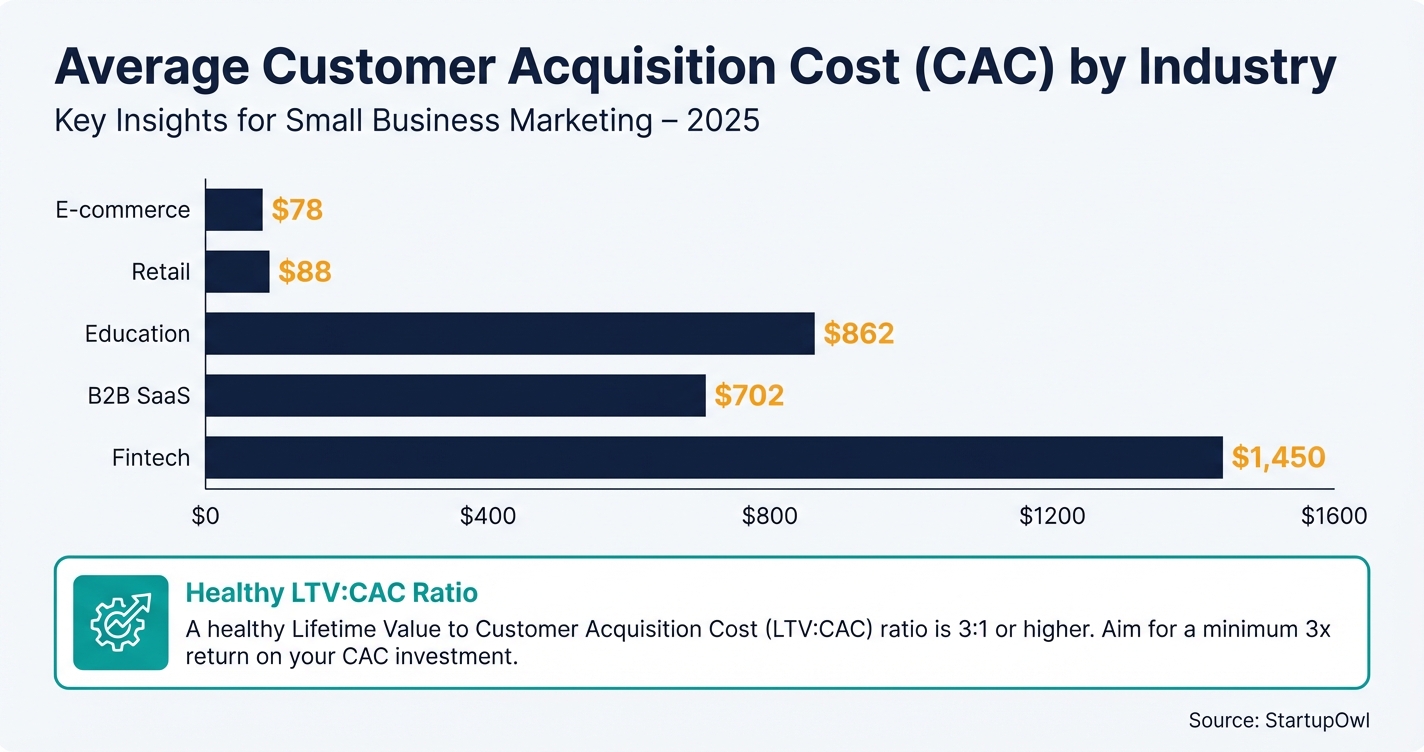
Clicks keep getting dearer. A Google search click costs $5.42 on average in 2026, more than double the $2.32 it cost ten years ago, according to WordStream's study of 13,474 US campaigns. The average e-commerce brand spends roughly $78 to land one customer, and B2B software companies often pay $702 or more. Spending without measuring is how founders end up there.
A big budget is not the fix. Referred buyers convert 3 to 5 times faster than paid leads, a Facebook traffic click still averages $0.70, and HubSpot's CRM costs nothing. This guide ranks nine acquisition channels by cost and by how long each takes to pay off, starting with the free ones.
Why Customer Acquisition Costs Are Rising (and What You Can Do About It)
Search ads have roughly doubled in price. WordStream's 2026 report puts the average Google Ads click at $5.42 against $2.32 in 2016, with an average cost per lead of $66.69. The drivers are more advertisers bidding, privacy rules that blunt targeting (Apple's ATT, GDPR), and the same attention sold to more brands.
That report carries good news too. Cost per lead fell in 2026 for the first time since before 2020, and conversion rates rose in 87 percent of industries. The winners are not the biggest spenders. They track cost per customer by channel, keep the channels returning at least $3 for every $1, and treat referrals, search, and email as core rather than afterthoughts.
If you have not set out your channels and budget yet, start with a small business marketing plan. Then work down the nine channels below.
9 Customer Acquisition Channels Ranked by Cost
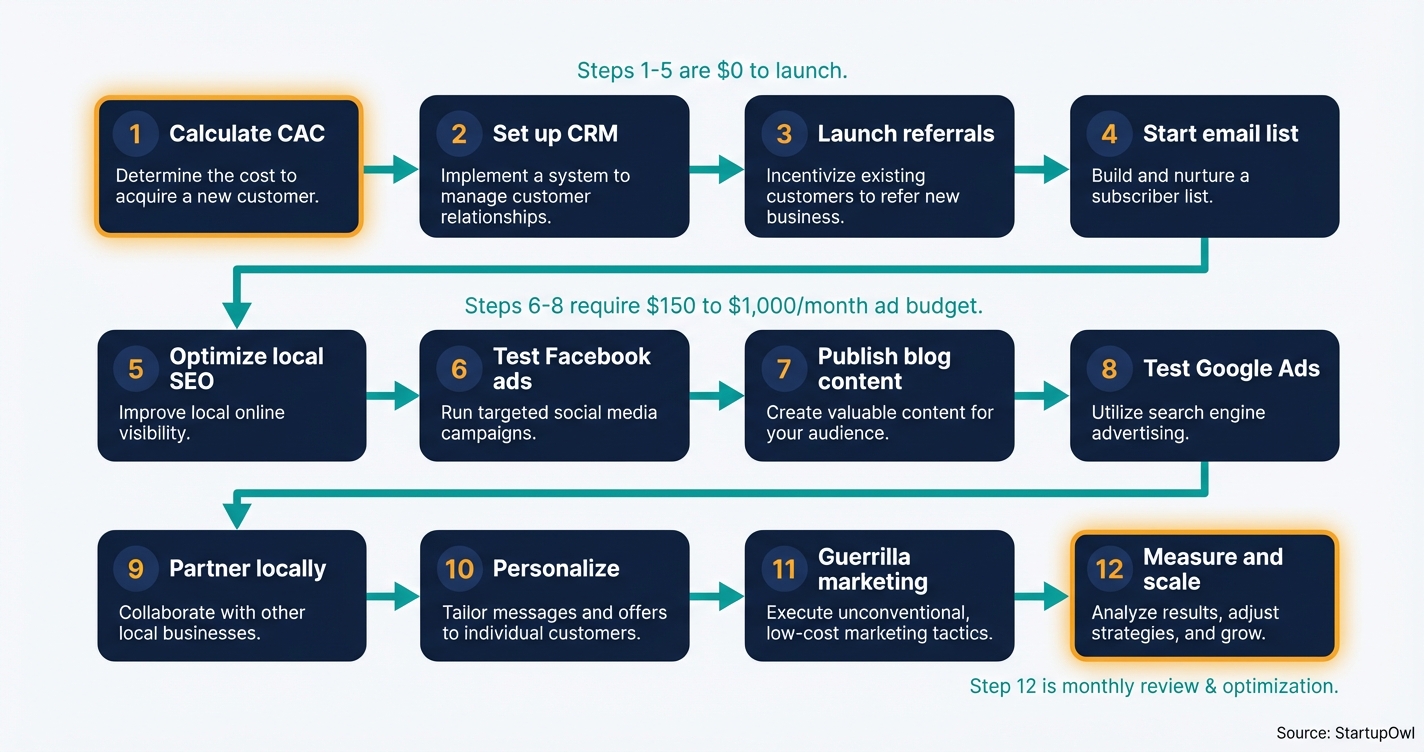
These nine channels reach people who have never heard of you. They run cheapest first. You can start at the top on a $0 budget, and each one carries a cost range and an honest wait before the first customer arrives. Three more steps sit in the process below, working out your CAC, setting up a CRM, and reviewing the numbers monthly, and those make the nine measurable.
1. Turn happy customers into referrers
Referred buyers convert 3 to 5 times faster than paid leads and carry 16 to 25 percent more lifetime value, per ReferralCandy's benchmarks. Start manual. Offer both sides the same discount code, ask within a week of a five star review, and log every redemption in your CRM so you learn what a referral is worth. ReferralCandy automates the loop from $59 a month plus 3.5 percent of referred sales, which only pays once the manual version already works.
Cost, free by hand, $59 a month to automate. First result, days, if you have roughly 50 satisfied customers to ask.
2. Build an email list you own
You own this one. No algorithm can take it away. Mailchimp's free plan holds 250 contacts and sends up to 500 emails a month, and Essentials starts at $13 a month when you outgrow it. Put one lead magnet behind a signup form, then send something useful weekly instead of only when you want a sale.
Cost, free to $13 a month. First result, 2 to 6 weeks, and it compounds after that.
3. Claim and finish your Google Business Profile
For anyone serving a local area, this is the best free hour on the list. Fill every field, hours, services, attributes, a plain description, then add at least ten photos of the place, the team, and the work. Ask every satisfied customer for a review. The local pack weighs review volume and recency alongside distance, which is the part you can control. Our local SEO guide has the full checklist.
Cost, $0. First result, 2 to 8 weeks for local pack visibility.
4. Co-market with a business that shares your customers
Find a business your buyers already use that does not compete with you. A florist and a wedding photographer. A gym and a meal prep kitchen. Run one joint giveaway or swap a flyer stack, give each partner a unique discount code so you can count what they send, and only agree a standing referral fee once the code proves the traffic is real.
Cost, $0 to $100 for printed material. First result, 1 to 4 weeks.
5. Publish one search focused post a week
Content is the slowest channel here. It is also the cheapest per customer once it lands. Write for questions your buyers type, not topics you find interesting, and target terms with 100 to 1,000 monthly searches where the pages ranking today are thin. Expect 8 to 16 weeks before a post ranks, which is why the first one goes up this week.
Cost, $0 if you write it, $200 to $500 a post for a freelancer. First result, 8 to 16 weeks.
6. Convert more of the traffic you already have
Buying more visitors is the expensive route. Segmenting your list, testing one headline at a time, and showing first time visitors a relevant offer all lift conversion without raising spend. Brands running advanced personalization report 20 percent higher lifetime value and 15 percent lower acquisition cost, per Segment's research. Fix the page before you fund the ad.
Cost, $0 to $50 a month for popup and testing tools. First result, 1 to 2 weeks.
7. Run one guerrilla campaign for name recognition
Not every channel is a screen. Sidewalk chalk, a pop up demo, a sponsored school event, or a packaging insert worth photographing can get a neighborhood talking for the price of materials. Give people a way to act, a short URL or a QR code, or the attention goes nowhere. Our guerrilla marketing ideas page collects campaigns you can run under $100.
Cost, $0 to $200. First result, 1 to 3 weeks, mostly as searches for your name.
8. Test your message with Meta traffic ads
Meta is the cheap testing ground. Facebook traffic campaigns averaged $0.70 a click in the latest LocaliQ and WordStream study, down from $0.77 the year before. That is about 87 percent cheaper than a Google search click. Spend $5 to $10 a day for a week across three variations, cut the losers on day three, then carry the winning message into every other channel.
Cost, $150 to $300 a month to test properly. First result, 7 days.
9. Buy high intent clicks with Google Ads
Google costs the most here. It is also the only channel where someone is already searching for what you sell. The average click ran $5.42 across industries in WordStream's 2026 report, 8.18 percent of clicks converted, and legal services paid $9.87 a click. Start at $500 a month with 10 to 15 exact and phrase match keywords, and get conversion tracking live first. Our Google Ads guide covers the build.
Cost, $500 to $1,000 a month to learn anything. First result, 30 days.
Pick one free channel and one paid. Run both for 30 days, then compare cost per customer. Setup instructions, tools, and the mistakes to avoid for all twelve steps are in the step by step process below.
What Each Acquisition Channel Actually Costs
| Type / Provider | Rate | Notes |
|---|---|---|
| Google Ads (Search) | $5.42 avg CPC | 8.18% average conversion rate, $66.69 average cost per lead. Legal services hit $9.87 a click. |
| Facebook Ads (Traffic) | $0.70 avg CPC | Cheapest way to test a message. Lower intent than search. |
| Facebook Ads (Leads) | $1.92 avg CPC | Lead form ads, $27.66 average cost per lead. Better quality than traffic clicks. |
| Email Marketing (Mailchimp) | $0 to $13/mo | Free plan covers 250 contacts and 500 sends a month. Essentials from $13/mo. |
| Referral Program (ReferralCandy) | $59/mo + 3.5% | You pay when referrals produce actual sales. |
| CRM (HubSpot Free) | $0 | Contacts, deals, pipeline, and reporting on the free tier. Starter from $20/mo. |
| Local SEO (Google Business Profile) | $0 | Free to set up. Restaurants pay $2.05 a click on paid search for comparison. |
| Content Marketing (DIY Blog) | $0 to $500/post | Free if you write it. Posts take 8 to 16 weeks to rank. |
The Best Tools for Small Business Customer Acquisition
You do not need a dozen tools. Start with a CRM, an email platform, and one paid traffic channel. Everything else can wait.
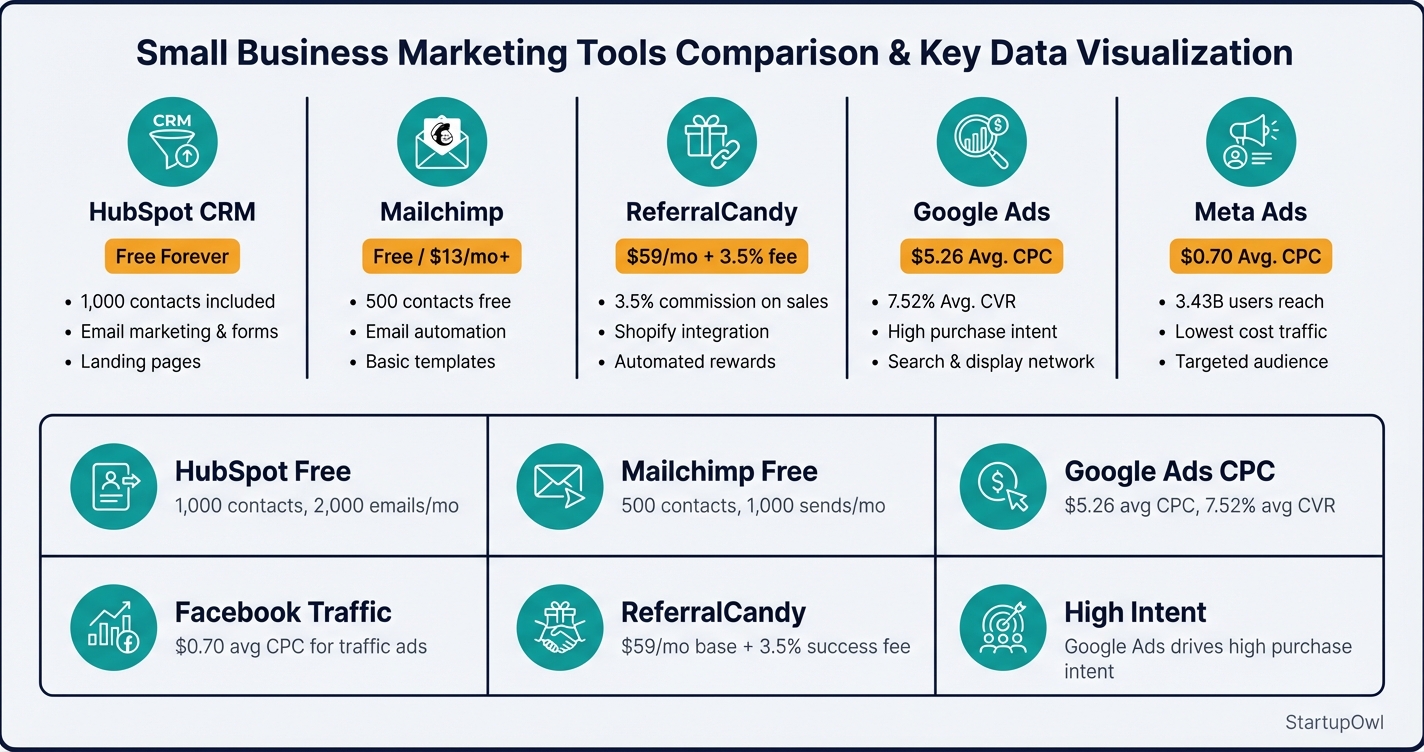
HubSpot CRM (Free) is free forever. It carries contact management, one deal pipeline, marketing email, basic landing pages, live chat, and reporting dashboards, with published free tier caps around 1,000 marketing contacts, 2,000 marketing emails a month, and 2 users. Most founders do not outgrow that in year one. The Starter plan begins at $20/month per hub. See our CRM for startups guide for the alternatives.
Mailchimp gives you a free plan for 250 contacts and a maximum of 500 sends a month. That tier shrank. Essentials at $13/month adds A/B testing, 24/7 support, and a 10x monthly send cap, and Standard at $20/month adds predictive segmentation and a 12x cap. For a head to head, read ConvertKit vs Mailchimp.
ReferralCandy starts at $59/month plus a 3.5% success fee on referred sales. It plugs into Shopify, WooCommerce, and BigCommerce. Setup is quick. You can have a branded referral campaign running the same afternoon, which is why it is worth trying only after a manual offer has proved people will share.
Google Ads is where high intent search traffic lives. It is not cheap. The average click cost $5.42 in 2026, though less competitive niches sit well below that, down at $1.63 in arts and entertainment. Start at $500/month so the campaign has data to work with. See our Google Ads for small business guide.
Meta Ads is the cheapest way to test paid traffic. Clicks are cheap here. Traffic campaign clicks average $0.70, roughly 87% less than Google search. Use Facebook and Instagram to find the message that works, then take that message to search where the buyers already are.
The $0 Starter Stack for Customer Acquisition
You can build a working acquisition system for nothing. HubSpot's free CRM handles contacts, deals, and pipeline. Mailchimp's free plan covers 250 contacts and 500 sends a month. Google Business Profile covers local search. A manual referral offer with unique discount codes covers word of mouth. That is lead capture, email, local visibility, and referrals without a tool bill.
5 Customer Acquisition Mistakes That Drain Your Budget
1. Spending on ads before tracking conversions. If you cannot see which clicks became customers, every optimization you make is a guess. Set up conversion tracking first. WordStream's own account study found that adding a single negative keyword can triple a campaign's conversion rate, and you only find that keyword by reading the data.
2. Ignoring free channels in favor of paid. Email, search, and referrals feel slow, so founders skip them. They are slower. They also compound, and you own the audience at the end instead of renting it back every month.
3. Spreading your budget across too many channels. Running Google, Facebook, TikTok, LinkedIn, and direct mail on $1,000 a month means none of them collect enough data to improve. Pick one or two paid channels and one or two free ones. Go deep first.
4. Not comparing acquisition cost to lifetime value. A $50 cost per customer is good if that customer spends $300. It is a slow bleed if they spend $60 once. Always measure the two together.
5. Treating acquisition as separate from retention. Every customer you keep is one you do not have to buy again. A small lift in repeat purchases lowers how much new traffic you need, which is the cheapest CAC reduction available to you.
Your Next Move
Work out your CAC today. That is total marketing spend divided by new customers. Then set up a free CRM, pick one free channel (referrals, Google Business Profile, or email) and one paid channel (Meta traffic ads are the cheapest test). Give each 30 days, then put the next dollar behind whichever came in cheaper.
If you want a structure to fill in, grab our free marketing plan template and complete the acquisition section using the costs above. To check your margins can carry that spend, try our pricing calculator and read up on cost-plus pricing. Measuring beats spending.
Step-by-Step Process
- 1
Calculate your current customer acquisition cost
Take your total marketing and sales spend from last month and divide it by the number of new customers you acquired. If you spent $2,000 and gained 20 customers, your CAC is $100. Write this number down because every tactic you try needs to beat it.
A healthy LTV-to-CAC ratio is 3:1 or higher, meaning you earn at least $3 for every $1 you spend on acquisition. If your ratio is below that, you are likely unprofitable on the first purchase and need to either reduce CAC or improve retention.
Tips
- Include staff time and tool costs in your total spend, not just ad dollars
- Track organic CAC and paid CAC separately so you know which channels actually perform
Common Mistakes
- Ignoring the cost of your own time when calculating total marketing spend
- Comparing your CAC to a different industry's benchmark instead of your own
- 2
Set up a free CRM to track every lead
You cannot improve what you do not measure. HubSpot's free CRM gives you up to 1,000 contacts, 2,000 marketing emails per month, basic landing pages, and deal pipeline tracking for up to 2 users with no time limit, as of 2026. That is enough to run a real acquisition operation for the first 6 to 12 months.
If you need more seats or contacts, the Starter plan begins at $20/month. Alternatives like Zoho CRM offer a free tier with up to 3 users but cap you at 3 email campaigns per month. Pick the one that matches your team size and go.
Tips
- Import existing contacts from spreadsheets or email before you do anything else
- Create deal stages that match your actual sales process (inquiry, quote sent, won, lost)
Common Mistakes
- Paying for a CRM before you have more than a few hundred contacts
- 3
Launch a referral program for existing customers
Referred customers convert 3 to 5x faster than paid leads and deliver 16 to 25% higher lifetime value, according to ReferralCandy's 2024 benchmarks. If you already have happy customers, this is your lowest-cost acquisition channel by far.
ReferralCandy starts at $59/month plus a 3.5% commission on referred sales. For a simpler setup, create a manual referral offer (10% off for both referrer and friend) using a unique discount code in your email tool. Track redemptions in your CRM.
Tips
- Ask for referrals within 7 days of a positive customer interaction or 5-star review
- Make the reward valuable enough to motivate sharing (10 to 20% off, store credit, or a free add-on)
- Test double-sided incentives where both the referrer and the friend get a reward
Common Mistakes
- Launching a referral program before you have at least 50 satisfied customers to seed it
- Making the referral process too complicated with multi-step forms
- 4
Start an email list and send weekly value
Mailchimp's free plan holds up to 250 contacts and sends a maximum of 500 emails a month, capped at 250 a day. That covers a brand new list. When you outgrow it, the Essentials plan starts at $13/month.
Your email list is yours. No algorithm update changes it under you. Build a simple lead magnet (a checklist, a template, a discount code), put the signup form on every page, and send something worth opening every week.
Tips
- Write subject lines under 50 characters with a specific benefit or number
- Send a welcome email within 5 minutes of signup to set expectations and deliver your lead magnet
Common Mistakes
- Buying an email list instead of building your own (this violates CAN-SPAM and tanks deliverability)
- Sending only promotional emails with no educational or entertaining content
- 5
Optimize your Google Business Profile for local search
If you serve customers in a specific area, your Google Business Profile is free and often the first thing people see. Complete every field: business hours, photos, services, attributes, and a detailed description with your location and service keywords. Ask every happy customer for a Google review.
Local keywords have lower competition and higher conversion rates than national keywords. A restaurant averaging $2.05 CPC on Google Ads can often get free clicks from local pack results with a well-optimized profile. See our local SEO guide for the full setup checklist.
Tips
- Add at least 10 high-quality photos including your storefront, team, and products
- Post weekly updates to your Google Business Profile (events, offers, new products)
Common Mistakes
- Leaving your business description blank or stuffing it with keywords instead of writing naturally
- 6
Run a small Facebook traffic campaign to test messaging
Meta clicks are cheap. Facebook traffic campaigns averaged $0.70 CPC in the latest LocaliQ and WordStream study, down from $0.77 the year before. That is roughly 87% cheaper than the $5.42 average on Google search, which makes Meta the most affordable way to test messages, offers, and audiences.
Start small. Run $5 to $10/day for 7 days with 2 to 3 ad variations, each with a different headline, image, and call to action. Use broad targeting and measure clicks through to your landing page. Kill the losers after 3 days and scale what works.
Tips
- Use Advantage+ placement to let Meta find the cheapest impressions across Facebook and Instagram
- Test video (even simple phone-recorded) against static images because video often gets 20 to 30% lower CPC
Common Mistakes
- Setting a $500+ daily budget before you have a proven offer and landing page
- Over-narrowing your audience below 50,000 people which drives up CPC
- 7
Publish one SEO-optimized blog post per week
Content marketing is a slower burn than paid ads, but it compounds. Inbound-focused businesses reduce cost per lead by 61% compared to outbound. Target long-tail keywords that your ideal customers actually search for, and write posts that answer their questions better than what currently ranks.
You do not need a content team. Use ChatGPT for small business to draft outlines and first drafts, then add your personal experience, data, and examples. Aim for 1,200 to 2,000 words per post, include internal links, and add a clear call to action at the end. Most posts take 8 to 16 weeks to rank, so start now.
Tips
- Target keywords with search volume between 100 and 1,000 and low to medium competition
- Add a lead magnet or email signup form to every blog post
Common Mistakes
- Writing about topics you find interesting instead of topics your customers are searching for
- 8
Test Google Ads with a tight keyword list
Search clicks are not cheap. The average cost per click in Google Ads was $5.42 in WordStream's 2026 report, from $1.63 in arts and entertainment to $9.87 for legal services. The average conversion rate is 8.18%, so roughly 1 in 12 clicks becomes a lead, at an average cost per lead of $66.69.
Keep the keyword list tight. Start with $500 to $1,000/month and 10 to 15 high intent keywords, exact match and phrase match only, never broad match, and add negative keywords every week. See our Google Ads for small business guide for the campaign setup.
Tips
- Start with high-intent keywords that include words like 'buy,' 'near me,' 'hire,' or 'pricing'
- Set up conversion tracking before you spend a single dollar so you can measure actual leads, not just clicks
- Review the search terms report weekly and add irrelevant terms as negative keywords
Common Mistakes
- Using only broad match keywords which burns through budget on irrelevant searches
- Sending ad traffic to your homepage instead of a dedicated landing page with a clear offer
- 9
Partner with a complementary local business
Co-marketing partnerships cost nothing except your time. Find a business that serves the same customers but is not a direct competitor (a wedding photographer partnering with a florist, or a gym partnering with a meal prep service). Cross-promote each other's email lists, social accounts, or in-store signage.
Start simple: do a joint giveaway on Instagram, swap flyers at your locations, or co-host a free workshop. Measure how many new customers each partner sends. If it works, formalize the arrangement with a standing referral fee or reciprocal discount.
$0 to $100 (for printed materials or event costs) 1 to 2 weeks to identify and pitch a partner google.comTips
- Pitch partnerships to businesses with a similar-sized audience so the value exchange feels fair
- Track results with a unique discount code or landing page URL per partner
Common Mistakes
- Partnering with a business whose audience does not overlap with your ideal customer profile
- 10
Use personalization to convert more of the traffic you already have
Brands using advanced personalization achieve 20% higher lifetime value and 15% lower acquisition costs, according to Segment's 2024 research. Before you spend more on traffic, fix the conversion rate on your existing pages first.
Start with these high-impact changes: add a personalized popup for first-time visitors offering a lead magnet, segment your email list by purchase history or interest, and use dynamic content blocks in your emails. Even basic personalization (using the subscriber's first name and recommending relevant products) can lift click rates by 10 to 15%.
Tips
- Segment your email list into at least 3 groups (new subscribers, active buyers, inactive) and write different messages for each
- A/B test your landing page headline and call to action before increasing ad spend
Common Mistakes
- Over-personalizing to the point of feeling creepy (use first name and relevant product recs, not browsing history callouts)
- 11
Build a simple guerrilla marketing campaign for brand awareness
Not every acquisition tactic requires a screen. Guerrilla marketing (unexpected, creative, low-cost promotional stunts) can generate outsized word-of-mouth for local businesses. Think sidewalk chalk, community event sponsorships, pop-up demos, or creative packaging inserts.
Check out our guerrilla marketing ideas for 15+ campaigns you can run for under $100. The goal is not direct sales but getting people talking and searching for your brand name, which you then capture with your website, Google profile, and email list.
Tips
- Always include a clear call to action (website URL, QR code, or discount code) in any guerrilla effort
- Document everything with photos and video for social media content
Common Mistakes
- Running a creative stunt that gets attention but gives people no way to find or contact your business
- 12
Measure results and double down on what works
After 30 days of running multiple channels, review your CAC by channel. You will likely find that 1 to 2 channels generate most of your profitable customers. Cut or reduce spend on channels with a CAC above your target, and increase investment in the winners.
Track three numbers monthly: CAC by channel, LTV-to-CAC ratio, and payback period (months to recoup your acquisition cost). Use your CRM's reporting dashboard to pull these. Build this into a small business marketing plan so your team stays focused on what actually moves the needle.
Tips
- Set a monthly reminder to review acquisition metrics on the same day each month
- Benchmark this month's CAC against your own last three months, not another industry's average
Common Mistakes
- Splitting your budget equally across all channels instead of concentrating on proven winners
Cost Breakdown
| Item | Cost Range | Notes |
|---|---|---|
| CRM (HubSpot Free) | $0 to $20/month | Free tier caps around 1,000 marketing contacts and 2,000 emails/month. Starter at $20/mo. |
| Email marketing (Mailchimp) | $0 to $13/month | Free plan covers 250 contacts and 500 sends a month. Essentials starts at $13/mo. |
| Referral program (ReferralCandy) | $59 to $499+/month | $59/mo base plus 3.5% commission on referral sales. |
| Facebook Ads (traffic) | $150 to $500/month | Average CPC of $0.70. Start with $5 to $10/day. |
| Google Ads (search) | $500 to $2,000/month | Average CPC of $5.42 in 2026. Minimum about $500/mo for meaningful data. |
| Content marketing (DIY) | $0 to $500/post | Free if you write yourself. $200 to $500 per post for freelancers. |
| Local SEO (Google Business Profile) | $0 | Completely free. Takes 2 to 3 hours to set up properly. |
| Guerrilla marketing | $0 to $200 | Materials cost only. High creativity, low budget. |
Frequently Asked Questions
Aim to earn at least $3 back for every $1 you spend acquiring a customer. The number itself varies by industry. E-commerce brands average roughly $78 per customer and B2B software companies around $702. If a customer spends $300 with you over their lifetime, keep acquisition under $100 and you have room to grow.
Referrals win on cost. A referred buyer converts 3 to 5 times faster and costs you only the reward, usually 10 to 20 percent off one order. Organic search is the other cheap channel, though it is slower. For paid traffic, Facebook traffic campaigns average $0.70 a click, the cheapest way to test a message before you spend on search.
Budget at least $500 to $1,000 a month. Less than that starves it. A campaign needs volume before it can improve. The average click cost $5.42 in 2026, so $500 buys roughly 92 clicks, and at the 8.18 percent average conversion rate that is about 7 leads a month. Below $500 most campaigns never gather enough signal.
They do different jobs. Google Ads reaches people already searching for what you sell, at a $5.42 average click. Facebook Ads is cheaper for awareness and message testing, at $0.70 a traffic click. Run both if the budget allows. If you must pick one, choose Google when people search for your product and Facebook when you have to create the demand.
Most search focused posts take 8 to 16 weeks to rank and bring traffic. The payoff is that the cost per lead keeps falling while a paid channel's does not. After 6 to 12 months of weekly publishing, content is often the largest source of free recurring leads a small business has. Start before you need it.
Yes, and it is free. HubSpot's CRM costs nothing and handles contacts, deals, and a pipeline. The sooner every lead lands in one place, the sooner you can see which channel produced it. Founders who wait until they hold hundreds of leads lose months of data they could have used to cut acquisition cost.
Some links on this page are affiliate links. If you sign up for a service through them, we may earn a commission at no extra cost to you. This does not influence our rankings.
Sources & References
About the Author
Editor, StartupOwl
Eliot leads StartupOwl's state data research. He maintains the site's fifty state records of LLC filing fees, annual costs, processing times, and small business grant programs, checking each figure against the state office that publishes it and logging the date it was verified. Based in New Jersey, he has spent his working life in and around small businesses, and he writes for the founder who wants the real number rather than the advertised one. Every figure under his byline traces to a named source, and when a state proves a number wrong, the correction is published, not buried.
Was this article helpful?
Questions about Customer Acquisition Strategies for Small Business, 9 Tactics That Work
No comments yet. Ask the first question and a member of our team will answer.
Leave a comment