
How to Pitch Investors: Deck Structure, Key Metrics and Common Mistakes to Avoid
Learn how to pitch investors with a 10-15 slide deck that wins meetings. Covers key metrics, deck costs ($0-$5,000+), the 3:44 review window and common pitch mistakes.

In This Article
- Key Takeaways
- Step-by-Step
- Cost Breakdown
- What a Pitch Deck Actually Does (and Does Not Do)
- Who Qualifies to Raise Equity Funding (and From Whom)
- How to Build and Deliver Your Pitch Deck Step by Step
- What It Costs to Build a Pitch Deck in 2026
- Top Pitch Deck Tools and Services for Startups
- What to Do If Equity Fundraising Is Not the Right Fit
- 5 Pitch Deck Mistakes That Kill Your Fundraise
- FAQ
$0–$15,000
Est. Cost
4 weeks
Timeline
6
Total Steps
This guide breaks down the exact slide sequence, the metrics investors scan for by stage, what a winning deck costs, and the mistakes that get your email archived. Whether you are building your first pre-seed deck or refining a pitch for a $2M-$5M seed round, every recommendation here is backed by real investor behavior data.
Not every business needs the pitch. Revenue based funders approve on sales data, not decks. Our tested RBF ranking covers them.
What a Pitch Deck Actually Does (and Does Not Do)
A pitch deck is not your business plan. It is a 10-15 slide visual story designed to earn a second conversation. Investors sift through hundreds of opportunities every month and use your deck as a rapid filtering tool to decide whether your startup is worth a closer look.
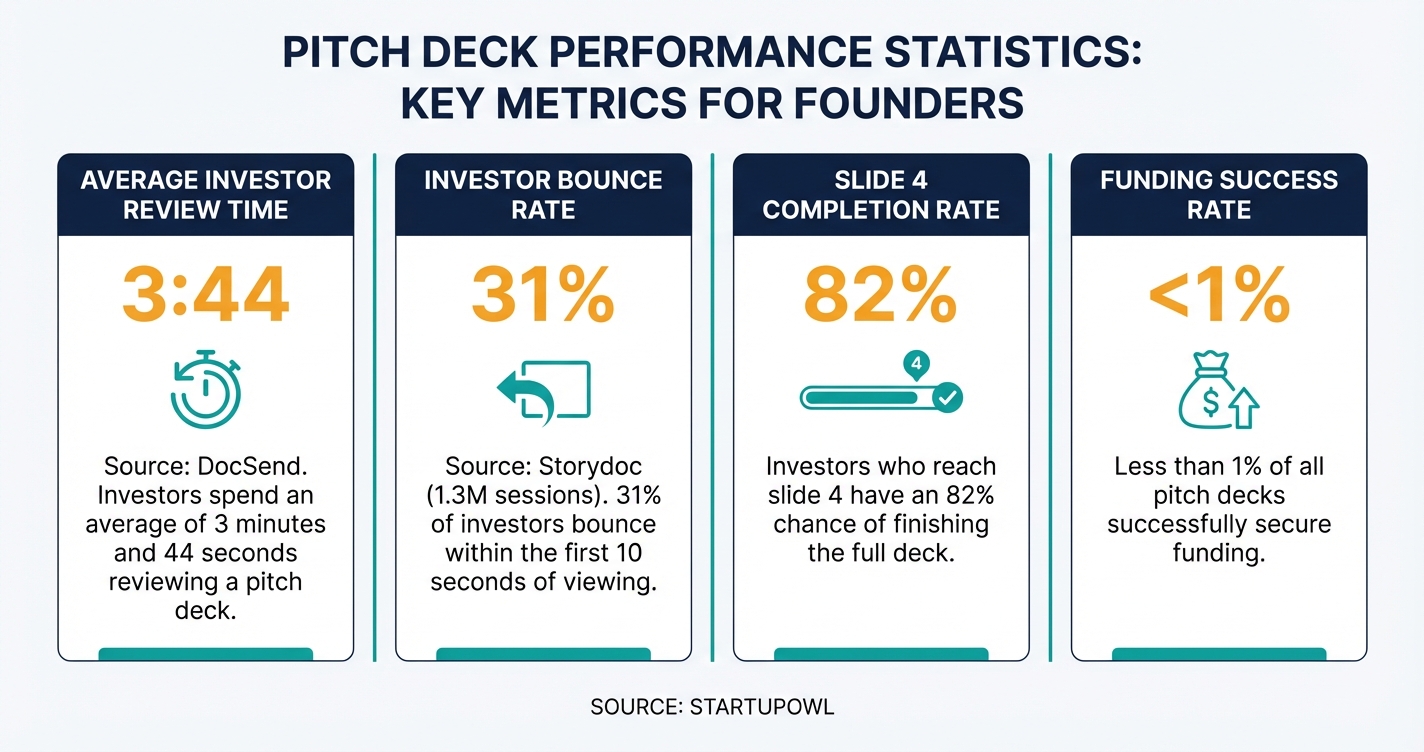
The goal is to communicate your problem, solution, traction, and team clearly enough in 20-40 seconds that an investor decides you are worth more time. According to Storydoc's analysis of over 1.3 million real investor sessions, 82% of investors who reach slide 4 finish the entire presentation. That means your real battle happens in those first three slides.
Around 89% of venture capitalists expect a pitch deck during fundraising, according to a National Venture Capital Association survey. If you are raising from VCs or angel investors, having a polished deck is not optional. It is the price of entry.
Who Qualifies to Raise Equity Funding (and From Whom)
Any startup can pitch investors, but the investors who can write you a check are governed by SEC rules. Under SEC Regulation D, most private securities offerings are limited to accredited investors. To qualify, an individual needs a net worth over $1 million (excluding primary residence) or annual income exceeding $200,000 ($300,000 jointly with a spouse) for the prior two years.
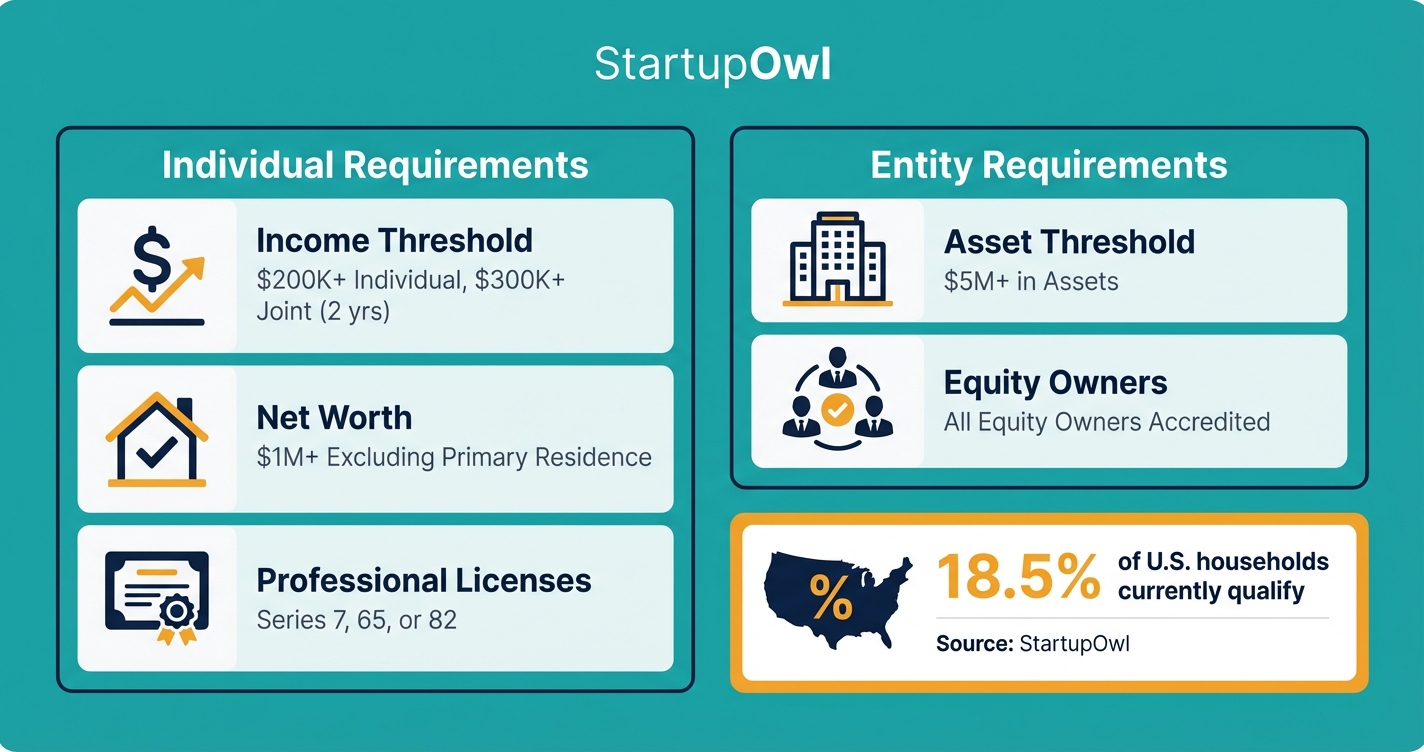
As of 2026, approximately 18.5% of U.S. households qualify as accredited investors, up from just 1.8% in 1983. Holders of Series 7, Series 65, or Series 82 licenses also qualify. Congress is actively considering legislation (the Equal Opportunity for All Investors Act of 2026) that would allow individuals to qualify by passing an SEC-administered financial knowledge test.
If you want to raise from non-accredited investors, equity crowdfunding platforms like Republic and Wefunder operate under Regulation CF, allowing you to raise up to $5M per year from the general public. For a deeper look at non-dilutive options, explore small business grants or microloans for small business.
How to Build and Deliver Your Pitch Deck Step by Step
The most successful decks follow a proven 10-15 slide structure that flows from macro to micro. Here is the slide-by-slide framework used by Y Combinator alumni, Sequoia-backed founders, and the decks that actually close rounds.
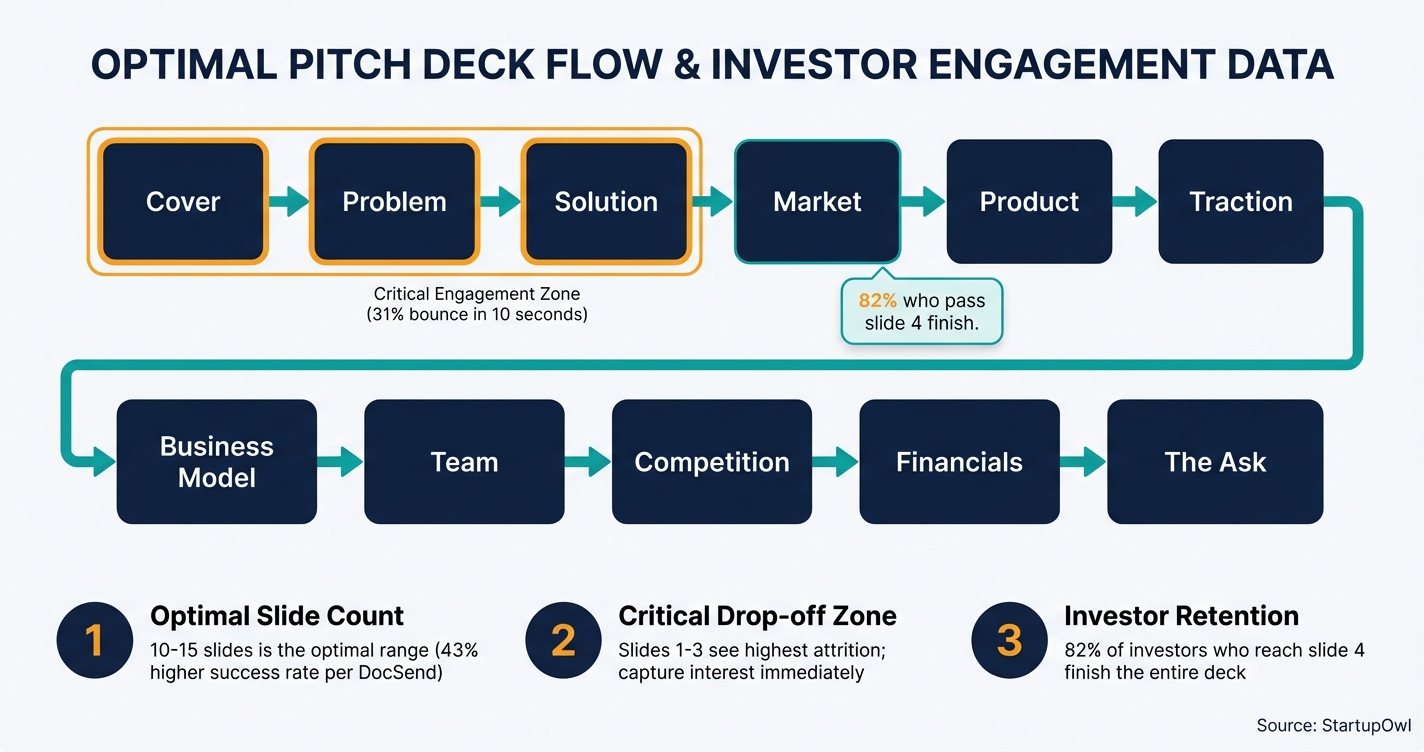
Slide 1 (Cover). Company name, one-line tagline, and your contact information. Keep it clean. Slide 2 (Problem). Define the pain point with data, not opinions. Use a statistic or customer quote that makes the problem feel urgent and financially significant. Slide 3 (Solution). Show how your product solves it and why your approach is different. Include a product screenshot or demo GIF rather than a text description.
Slide 4 (Market Size). Present TAM, SAM, and SOM with validated bottom-up data. In 2026, investors expect detailed segmentation rather than speculative top-down estimates. Slide 5 (Product/Demo). A mockup or live demo is far more effective than descriptive text. Slide 6 (Traction). This slide often determines whether investors continue the conversation. Show revenue growth, user engagement, or pilot agreements with specific numbers and timelines.
Slide 7 (Business Model). Clearly explain how you make money. Subscription, marketplace, enterprise contracts, or platform economics must be easy to understand in 10 seconds. Slide 8 (Team). Highlight relevant experience, domain expertise, and logos from past companies or universities. Slide 9 (Competition). Show your unfair advantage using a positioning map, not a feature-comparison checklist.
Slide 10 (Financials). Present a realistic 3-5 year model with revenue streams, cost breakdowns, and break-even points. Only 58% of successful decks include financials, but investors increasingly demand them for seed rounds and above. Slide 11 (The Ask). State the exact amount, use-of-funds breakdown, and what milestones the capital unlocks. Tie every dollar to a growth outcome.
The Slide 4 Rule
Storydoc's analysis of 1.3 million investor sessions found that 82% of investors who reach slide 4 finish the entire deck. Front-load your strongest content (traction, team credentials, or a compelling demo) into slides 1-3 to get past the critical drop-off point.
What It Costs to Build a Pitch Deck in 2026
Pitch deck costs range from $0 to $50,000 depending on whether you go DIY, hire a freelancer, or engage a full-service agency. For a standard 10-15 slide deck, freelance rates typically fall between $500 and $3,000. Professional agencies specializing in pitch decks charge $3,000 to $15,000, with premium firms going up to $50,000 for full-service engagements including strategy, copywriting, and financial modeling.
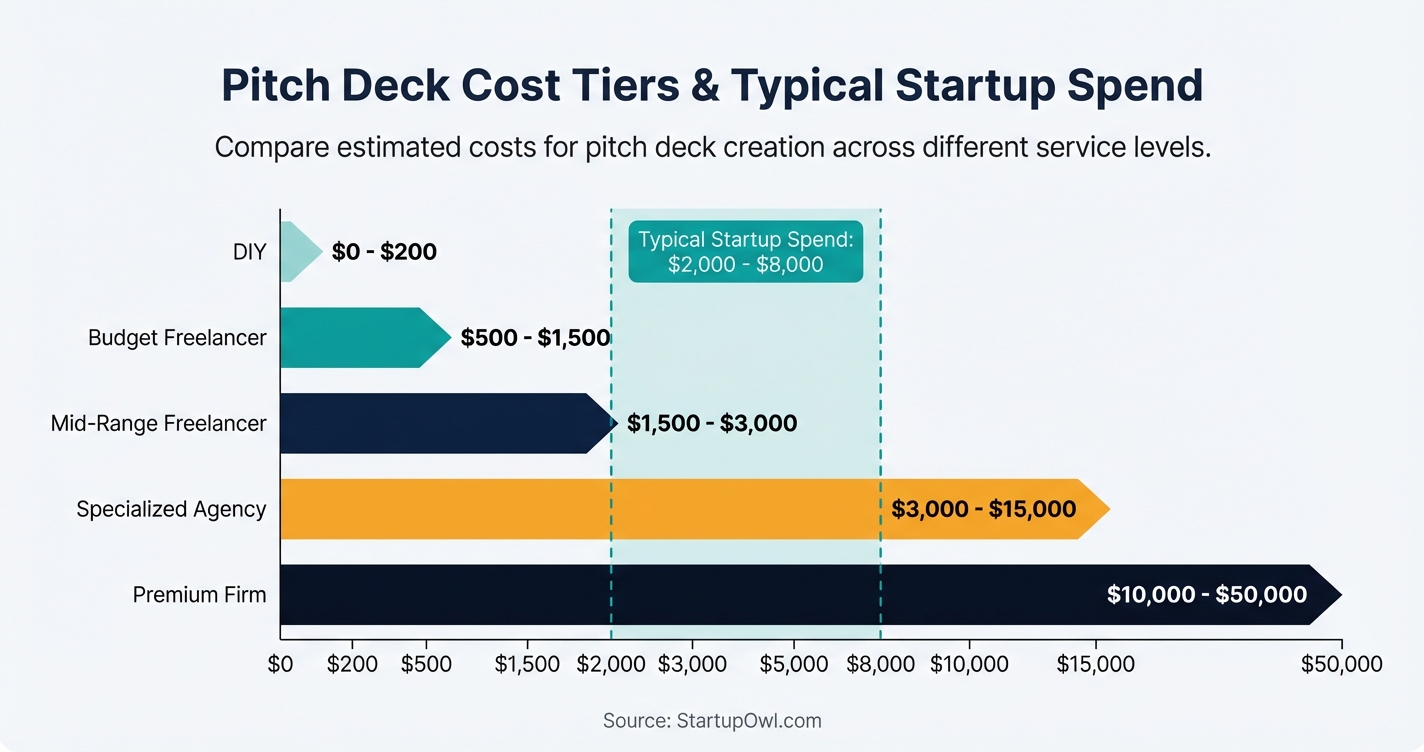
Freelance designers on platforms like Upwork and Fiverr charge $50-$200 per hour, with most pitch deck projects requiring 20-30 hours of work. DIY templates from Canva or Google Slides cost $0-$200 and work well for very early-stage founders preparing for friends-and-family or initial angel investor conversations.
A practical budget rule: allocate roughly 0.2-0.8% of your target raise to deck creation. If you are raising a $3M seed round, spending $2,000-$8,000 on professional design is a reasonable investment. Research from Superside shows startups with professionally designed decks have a 50% higher chance of investment compared to those with less polished presentations.
Pitch Deck Cost Breakdown by Provider Type
| Type / Provider | Rate | Notes |
|---|---|---|
| DIY (Canva, Google Slides, templates) | $0-$200 | Best for pre-seed, internal decks, or founders with design skills. Turnaround: 1-3 days. |
| Budget freelancer (Fiverr, Upwork) | $500-$1,500 | Less experienced designers. Quality varies widely. Turnaround: 5-10 days. |
| Mid-range freelancer (startup experience) | $1,500-$3,000 | Specialized in pitch decks with funded portfolio. Turnaround: 7-14 days. |
| Premium freelancer (strategic input) | $3,000-$5,000 | Design plus narrative and positioning guidance. Turnaround: 10-14 days. |
| Specialized agency (Slidebean, DeckWorks) | $3,000-$15,000 | Full-service: research, content, design, 2-3 revisions. Turnaround: 14-21 days. |
| Premium consulting firm | $10,000-$50,000 | Brand messaging, investor targeting, financial modeling. Best for Series A+. Turnaround: 21-45 days. |
Top Pitch Deck Tools and Services for Startups
Slidebean offers an all-in-one fundraising platform with AI-powered deck creation, 120+ templates modeled after decks that actually closed rounds (like Airbnb and Uber), and integrated investor CRM tools. Pricing starts at $22/month (annual) for the Pro plan with 2 seats included. It is the strongest option for founders who want design automation plus financial modeling templates.
Beautiful.ai uses "Smart Slides" technology that automatically formats slides as you add content. It is ideal if you lack design skills but want a professional-looking deck fast. Canva remains the most popular free option, with hundreds of pitch deck templates and an intuitive drag-and-drop editor. For funded startups, Pitch (pitch.com) offers collaborative editing and presentation analytics.
DocSend and Papermark handle the analytics side, tracking which investors open your deck, how long they spend per slide, and whether they forward it to partners. Papermark analyzed over 3,000 pitch decks across 8 million data points in 2024-2026. If you need professional help, DeckWorks offers pitch deck packages starting at $2,999 for 15 slides with 2 revisions.
For founders exploring non-equity paths, compare best small business loans or a business line of credit as alternatives that preserve your equity.
What to Do If Equity Fundraising Is Not the Right Fit
Not every business needs (or should take) outside equity. Giving up 10-25% ownership per round adds up fast across multiple raises. If you have revenue, consider bootstrapping with profits or using non-dilutive capital first.
SBA loans offer rates starting around 10.5-14.5% for the 7(a) program as of 2026 and go up to $5 million without giving up any equity. An SBA microloan provides up to $50,000 for early-stage businesses. Small business grants offer truly free capital with no repayment or dilution, though competition is fierce.
Revenue-based financing and invoice factoring let you access capital tied to your existing revenue without fixed monthly payments or equity dilution. A merchant cash advance can fund short-term needs quickly, but expect effective rates of 20-40% higher than traditional loans. For building long-term credit capacity, start with how to build business credit and explore best business credit cards for everyday expenses.
5 Pitch Deck Mistakes That Kill Your Fundraise
1. Overloading the first 3 slides with too much detail. This is the number-one mistake new founders make. Storydoc data shows 31% of investors bounce within 10 seconds and another 15% leave within the first minute. Your opening slides need a clear hook (traction, a shocking market stat, or a compelling product visual), not paragraphs of background context.
2. Using a vague or missing business model slide. Investors need a simple, clear understanding of how you generate revenue. If they cannot explain your monetization to their partners in one sentence, your deck is not working. Subscription, marketplace, enterprise licensing, or advertising: name it clearly and show early pricing validation.
3. Presenting speculative financial projections. VCs in 2026-2026 are highly skeptical of hockey-stick projections unsupported by actual customer behavior. Ground every revenue forecast in tested pricing models and real user data. A conservative model with defensible assumptions is far more persuasive than an aggressive forecast.
4. Ignoring design quality. Cluttered formatting and inconsistent design signal a disorganized thinker. Your deck does not need to cost $10,000, but it does need clean layouts, consistent typography, and professional data visualizations. Design communicates competence, and in a competitive market, it becomes a credibility signal at every stage.
5. Omitting contact information. Decks get forwarded between colleagues, partners, and analysts at VC firms. If your deck lands on the desk of a senior partner without your name, email, and phone number on it, you have lost the opportunity. Include contact details on both your cover slide and your closing slide.
Plan for a Longer Fundraise Than You Expect
According to DocSend, 37% of successful founders close a seed round in 1-6 weeks, 32% take 7-18 weeks, and the rest take 19+ weeks. Budget at least 3-6 months for the full fundraising process. Start engaging investors while you still have at least 6 months of cash runway so you negotiate from strength, not desperation.
Step-by-Step Process
- 1
Research your target investors and build a pipeline
Before you open a single slide template, identify 30-50 investors who actively fund companies at your stage and in your sector. Sort them by check size, sector focus, and whether they lead rounds or follow. According to DocSend data, it takes an average of 39 investor meetings to close a seed round, so you need pipeline volume.
Use tools like Crunchbase, Signal by NFX, or Visible.vc to filter investors by stage, geography, and industry. Warm introductions convert dramatically better than cold emails, so map your network connections to each target investor before reaching out.
Tips
- Rank each investor by strategic value (not just check size) including expertise, connections, and portfolio companies.
- Track every investor interaction in a simple CRM or spreadsheet with status, last contact date, and next steps.
- Start relationship-building 3-6 months before you actually need funding to avoid looking desperate.
Common Mistakes
- Pitching investors who do not invest at your stage or in your industry, wasting weeks of valuable time.
- Relying entirely on cold outreach instead of securing warm introductions through mutual connections.
- 2
Structure your pitch deck in 10-15 slides
The standard investor deck contains 10-15 slides. DocSend research shows that decks with 11-20 slides are 43% more successful at raising funds. Guy Kawasaki's 10/20/30 rule (10 slides, 20 minutes, 30-point font minimum) remains the most referenced framework.
Your slide sequence should follow this proven order: cover, problem, solution, market size (TAM/SAM/SOM), product or demo, traction, business model, team, competition, financials, and the ask. If you are raising a pre-seed round, you can trim to 10 slides and lean into the problem and founder-market fit rather than detailed financials.
$0 (DIY) to $500-$5,000 (freelancer or agency) 1-2 weeks for content; 1 week for design slidebean.comTips
- Place your strongest traction metric (revenue, waitlist, pilot agreements) within the first 3 slides because 82% of investors who reach slide 4 finish the entire deck.
- Use one key number per slide as the headline rather than burying data in body text.
- Include a product demo screenshot or short GIF rather than text descriptions of your product.
Common Mistakes
- Cramming too much detail into early slides, causing 31% of investors to bounce within 10 seconds.
- Using vague market sizing with top-down TAM estimates instead of bottom-up validated data.
- 3
Define your key metrics by stage and industry
The metrics investors care about depend entirely on your stage. At pre-seed, focus on problem validation: even 500 engaged waitlist users or 2 signed pilot agreements can be compelling. At seed, investors expect measurable traction: revenue growth, customer acquisition cost (CAC), lifetime value (LTV), and churn rates.
For SaaS companies raising a seed round, the bar in 2026 is roughly $1M-$2M ARR with strong month-over-month growth. VCs now focus heavily on capital efficiency and a clear path to profitability rather than growth at any cost. Pre-revenue startups should present validation signals such as letters of intent, beta usage statistics, or partnership commitments.
Tips
- If pre-revenue, show evidence of demand: waitlists, LOIs, or pilot results are more persuasive than projected revenue.
- Always include unit economics (CAC, LTV, LTV/CAC ratio) if you have paying customers.
- Benchmark your metrics against public data from Carta, Crunchbase, or PitchBook to show investors where you stand.
Common Mistakes
- Presenting hockey-stick revenue projections without grounding them in actual customer behavior or validated pricing.
- Hiding weak metrics instead of addressing them transparently; investors will find them during diligence.
- 4
Define your ask with a clear use-of-funds breakdown
Your "ask" slide needs a specific dollar amount and exactly what that capital unlocks. In 2026, the median pre-seed SAFE raise is approximately $700,000, while U.S. SaaS seed rounds average $2.5M-$3.2M. Your ask should give you 18-36 months of runway to reach the milestones required for your next round.
Break the allocation into clear categories: product development, sales and marketing, hiring, and operations. VCs in 2026 and 2026 focus intensely on capital efficiency, so showing a disciplined allocation plan tied to milestones reinforces that your vision and execution are aligned. If you are exploring angel investors, your ask may be smaller but still needs the same specificity.
Tips
- Tie each spending category directly to a growth milestone (for example, hiring 3 engineers to launch V2 by Q3).
- Plan for 36+ months of runway if raising seed, since 39% of companies now take 3+ years to reach Series A.
- Always state the amount in U.S. dollar terms (not a range) so investors can calculate their check size.
Common Mistakes
- Asking for a vague range instead of a specific number, which signals you have not done the financial planning.
- Underestimating burn rate and planning only 12-18 months of runway when Series A timelines have extended to 2-3+ years.
- 5
Practice your delivery and refine based on feedback
Successful founders invest an average of 18 hours fine-tuning their pitch before presenting to real investors, according to Harvard Business Review. Your spoken pitch should complement (not repeat) your slides. Practice the full presentation in under 20 minutes and leave at least 10 minutes for Q&A.
Start by pitching to founders who have raised before, advisors, or investors you are not targeting first. Collect honest feedback on slide clarity, your energy, and the questions that keep coming up. Incorporate that feedback into both your deck and your verbal narrative before approaching your top-tier targets.
$0 (peer feedback) to $2,000-$5,000 (pitch coaching) 1-2 weeks of practice before first real pitch Y CombinatorTips
- Record yourself pitching on video and watch it back to catch filler words, unclear explanations, and pacing issues.
- Prepare clear, concise answers for the 10 most common investor objections (market size, competition, team gaps).
- Pitch your weakest-fit investors first to collect real-world feedback before meeting your top targets.
Common Mistakes
- Reading directly from slides instead of telling a natural story that builds investor confidence in you as a founder.
- Skipping practice because the deck 'speaks for itself' when delivery accounts for a significant share of the funding decision.
- 6
Send your deck and manage the investor follow-up process
After a strong meeting, send a follow-up email within 24 hours with your deck attached as a PDF (not a link that can break). Include a 2-3 sentence recap, your specific ask, and a clear next step. Remember that decks get forwarded between partners at VC firms, so every slide must stand alone without your verbal explanation.
Track who opens your deck and how long they spend on each slide using tools like Papermark or DocSend. If an investor viewed your deck for 5+ minutes, that is a strong engagement signal worth a prompt follow-up. If you are also exploring debt options, check our business loans for startups guide as a complementary funding path.
$0-$45/month for deck tracking tools Ongoing through closing (typically 6-18 weeks for seed rounds) docsend.comTips
- Always include your contact details on the last slide since decks get forwarded to other partners and analysts.
- Follow up once per week; more than that feels pushy, less than that signals low urgency.
- Create a one-page executive summary version for investors who prefer a quick scan before the full deck.
Common Mistakes
- Sending a 40-slide deck as a follow-up instead of the clean 10-15 slide version, overwhelming busy investors.
- Failing to track deck engagement and missing warm signals from interested investors.
Cost Breakdown
| Item | Cost Range | Notes |
|---|---|---|
| DIY pitch deck (templates and free tools) | $0-$200 | Uses Canva, Google Slides, or Keynote. Best for very early pre-seed or internal versions. |
| Freelance pitch deck designer | $500-$5,000 | Rates vary from $50-$200/hour. Mid-range freelancers with startup experience charge $1,500-$3,000. |
| Specialized pitch deck agency | $3,000-$15,000 | Includes strategy, copywriting, design, and financial modeling. Agencies like Slidebean, DeckWorks, or Superside. |
| Premium pitch consulting firm | $10,000-$50,000 | Full-service including brand messaging, market research, and investor targeting. Best for Series A+ rounds. |
| Deck analytics tools (DocSend, Papermark) | $0-$45/month | Track investor engagement, slide-by-slide view time, and forwarding activity. |
| Pitch coaching | $500-$5,000 | 1-on-1 coaching from experienced fundraisers. Some accelerators include this free (Y Combinator, Techstars). |
Frequently Asked Questions
The sweet spot is 10-15 slides. DocSend research shows decks with 11-20 slides are 43% more successful at raising funds. Guy Kawasaki's 10/20/30 rule (10 slides, 20 minutes, 30-point font) remains the gold standard. If you are pre-seed, lean toward 10 slides; for seed or Series A, 12-15 slides give you room for traction data and financials.
The average is 3 minutes and 44 seconds, according to a DocSend study confirmed by Harvard Business School research. Storydoc's 2026 analysis of 1.3 million sessions found that 31% of readers bounce within 10 seconds and 82% who reach slide 4 finish the entire deck. Your first 3 slides carry almost all the weight.
Expect to pay $500-$3,000 for a freelance designer and $3,000-$15,000 for a specialized agency. DIY options using Canva or Google Slides cost $0-$200. Most startups raising a seed round spend $2,000-$8,000 on professional deck design, which works out to roughly 0.2-0.8% of the target raise amount.
For SaaS seed rounds, investors want to see revenue growth, CAC, LTV, and churn rates. The current Series A bar is roughly $2M-$3M+ ARR with efficient growth. Pre-revenue startups should show validation signals like pilot agreements, signed LOIs, beta usage stats, or a waitlist of 500+ engaged users.
The average seed round takes approximately 12.5 weeks to close. According to DocSend, 37% of successful founders close in 1-6 weeks, 32% take 7-18 weeks, and the remainder take 19+ weeks. Expect to have about 39 investor meetings on average before closing. Plan to start fundraising at least 6 months before you need the capital.
A SAFE (Simple Agreement for Future Equity) is a convertible instrument that grants investors the right to claim equity at a future funding round, typically Series A. In Q3 2026, SAFEs accounted for 92% of all pre-priced pre-seed rounds, according to Carta data. SAFEs are popular because they avoid the complexity and legal costs of a priced round while delaying valuation discussions.
At pre-seed, founders typically give up 10-15% equity on a median raise of approximately $700,000. At seed, dilution ranges from 12-15% on median rounds of $2.5M-$3.2M for U.S. SaaS companies in 2026. Cumulative dilution across multiple rounds adds up fast, so planning your cap table from day one is critical.
Not for investors, but a pitch deck is still useful for recruiting co-founders, attracting key hires, and pitching strategic partners or enterprise customers. If you plan to raise capital later, building a deck early forces you to clarify your story. You can create a solid version for $0 using free templates from Slidebean, Canva, or Y Combinator's library.
This content is for informational purposes only and does not constitute financial, legal, or tax advice. Business financing terms, rates, and eligibility vary by lender, credit profile, and business characteristics. Consult a licensed financial advisor or CPA before making borrowing decisions. Funding round sizes, valuations, and dilution percentages reflect industry averages as of 2026-2026 and may change without notice.
Sources & References
- The State of Pitch Deck Presentations in 2026 (Storydoc)
- Pitch Deck Statistics: 22 Must Know Facts (Pitch Deck Creators)
- How to Create a Winning Investor Pitch Deck in 2026 (Whitepage)
- What VCs Actually Want to See in 2026 (AlterSquare)
- SEC Accredited Investor Definition
- State of Pre-Seed Q3 2026 (Carta)
- 2026 Pre-Seed Funding Benchmarks (Metal)
- US SaaS Seed-Round Benchmarks 2026 (Metal)
- How VC Pitch Decks Really Work in 2026 (Funding Blueprint)
- Pitch Deck Metrics Report 2024-2026 (Papermark)
- Pitch Deck Cost Pricing Guide (Spectup)
- A Guide to Raising Seed Funding in 2026 (Failory)
- Startup Funding Stages (Visible.vc)
- Seed to Series A Timeline Data (SaaStr / Carta)
About the Author
Editor, StartupOwl
Eliot leads StartupOwl's state data research. He maintains the site's fifty state records of LLC filing fees, annual costs, processing times, and small business grant programs, checking each figure against the state office that publishes it and logging the date it was verified. Based in New Jersey, he has spent his working life in and around small businesses, and he writes for the founder who wants the real number rather than the advertised one. Every figure under his byline traces to a named source, and when a state proves a number wrong, the correction is published, not buried.
Was this article helpful?
Questions about How to Pitch Investors
No comments yet. Ask the first question and a member of our team will answer.
Leave a comment