
Crowdfunding for Business: Rewards vs. Equity Crowdfunding and How to Run a Successful Campaign
Crowdfunding for business costs 5-8% in platform fees for rewards campaigns and 6-12% for equity raises. Compare Kickstarter, Wefunder, and Republic fees.

In This Article
- Key Takeaways
- Step-by-Step
- Cost Breakdown
- What Business Crowdfunding Is and When to Use It
- Who Qualifies for Business Crowdfunding
- How to Launch a Successful Crowdfunding Campaign
- The True Cost of Crowdfunding Your Business
- Top Crowdfunding Platforms for Business
- What to Do If Crowdfunding Is Not the Right Fit
- 5 Crowdfunding Mistakes That Cost You Real Money
- FAQ
$0–$50,000
Est. Cost
90 days
Timeline
5
Total Steps
Crowdfunding lets you raise capital from hundreds (or thousands) of individual backers instead of a single bank or investor. On rewards platforms like Kickstarter, the average campaign raises about $8,150, while equity crowdfunding campaigns under Reg CF average $368,000 per successful raise as of 2024. The catch is knowing which model fits your business and how much it will actually cost you.
You have two distinct paths. Rewards-based crowdfunding lets you pre-sell a product to backers for roughly 8% in combined fees and zero equity dilution. Equity crowdfunding sells ownership shares in your company for 6-12% in platform fees plus legal costs, but gives you access to much larger capital pools (up to $5 million under SEC Regulation CF).
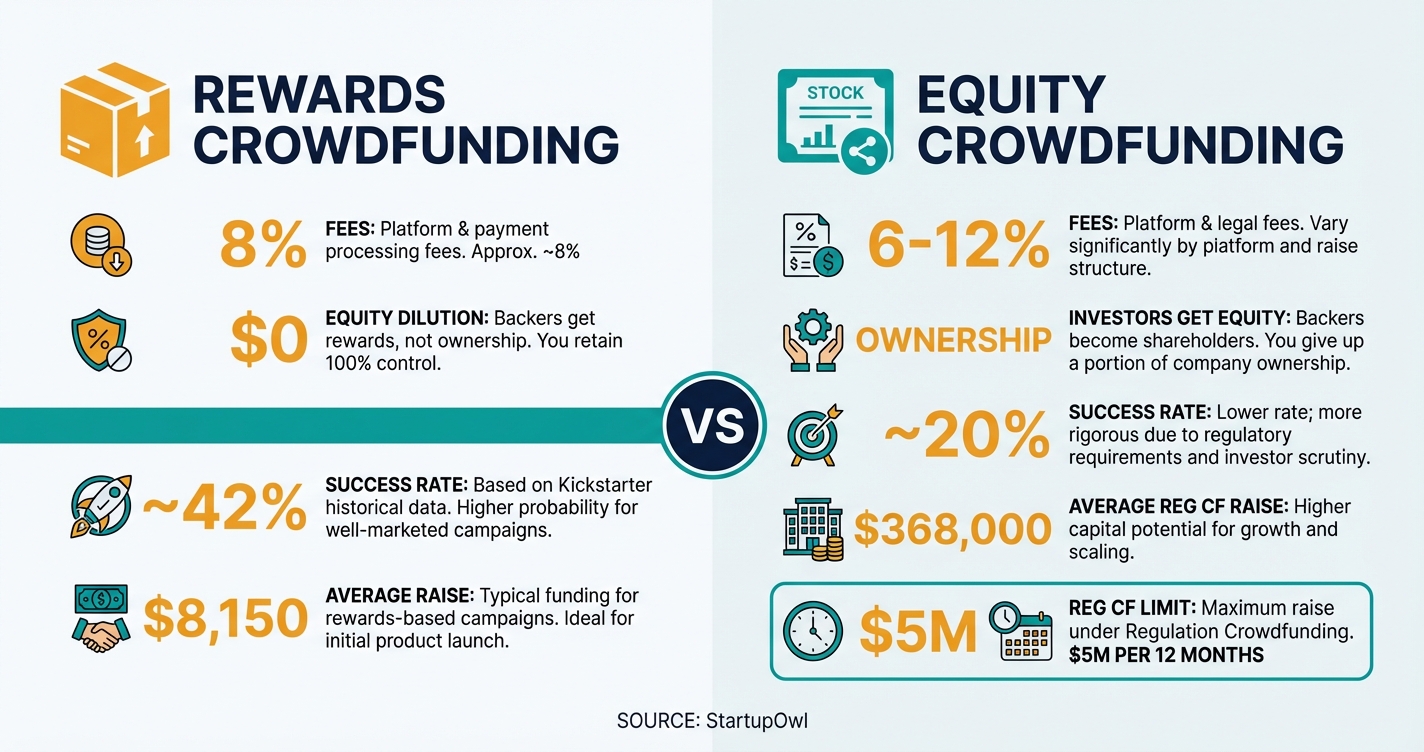
This guide covers both models side by side, with real platform fees, success rate data, and a step-by-step campaign launch plan. If you are still exploring other business loans for startups, crowdfunding may be the option that does not require a credit score or collateral.
What Business Crowdfunding Is and When to Use It
Crowdfunding for business is a method of raising capital from a large number of individual contributors through an online platform. Rewards-based crowdfunding gives backers a product, promotional item, or early access in exchange for their pledge. Equity crowdfunding gives investors actual ownership shares in your company in exchange for capital.
Rewards platforms like Kickstarter and Indiegogo work best for physical product launches where you want to validate market demand. Once rewards are delivered, you have no further obligation to those backers. Your relationship ends, and you keep full ownership of your company.
Equity platforms like Wefunder, Republic, and StartEngine create a long-term investor relationship. Investors receive dividends and profit-sharing as your company operates. You must file annual reports at minimum and manage shareholder communications.
The Oculus story illustrates the difference perfectly. In 2012, Oculus raised $2.5 million from 7,500 Kickstarter backers using rewards crowdfunding. When Facebook acquired Oculus for roughly $2 billion in 2014, those backers received only their promised products. Had it been an equity raise, investors could have seen an estimated 145x return. That is the trade-off between the two models.
Who Qualifies for Business Crowdfunding
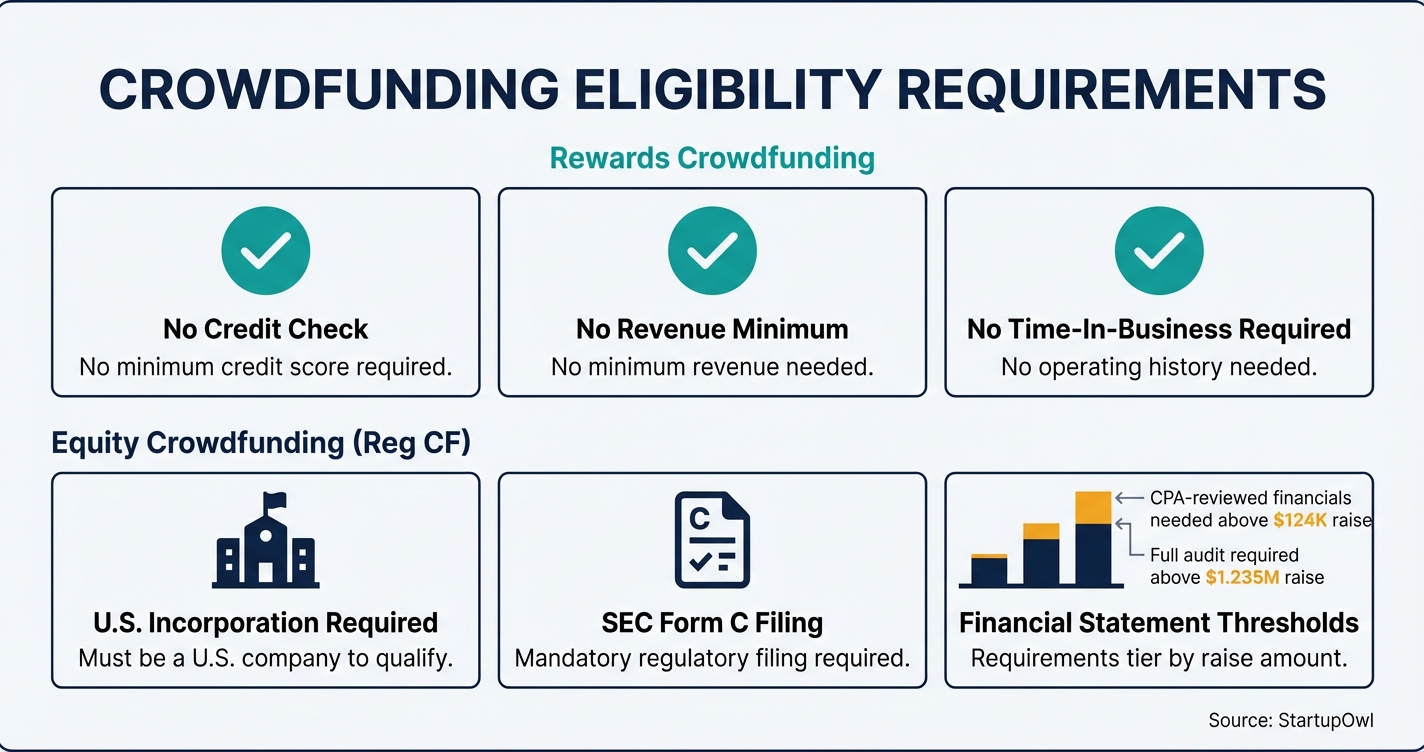
Rewards-based crowdfunding has no credit score requirement, no revenue minimum, and no time-in-business threshold. You need a product or project idea, a compelling story, and the ability to fulfill rewards if funded. Kickstarter requires you to be at least 18 years old and a legal resident of a country where the platform operates.
Equity crowdfunding under SEC Regulation CF has more requirements. Only U.S.-incorporated companies can raise funds. You must use an SEC-registered funding portal or broker-dealer. Companies with securities violations or those that have failed Reg CF reporting requirements in the prior two years are disqualified.
Your financial disclosure requirements under Reg CF scale with how much you raise. Raises up to $124,000 require financial statements certified by your principal executive officer. Raises between $124,001 and $618,000 require CPA-reviewed financials. Above $1,235,000, you need fully audited financial statements from an independent CPA.
If your credit score is too low for traditional lending, crowdfunding sidesteps that barrier entirely. Compare this to a traditional business loan, which typically requires a personal credit score of 620+. Crowdfunding does not check your business credit score at all.
How to Launch a Successful Crowdfunding Campaign
Running a crowdfunding campaign is part product launch, part marketing sprint, and part logistics operation. The steps below cover both rewards and equity campaigns. The entire process from planning to launch typically takes 3-4 months, with the live campaign running 30-40 days.
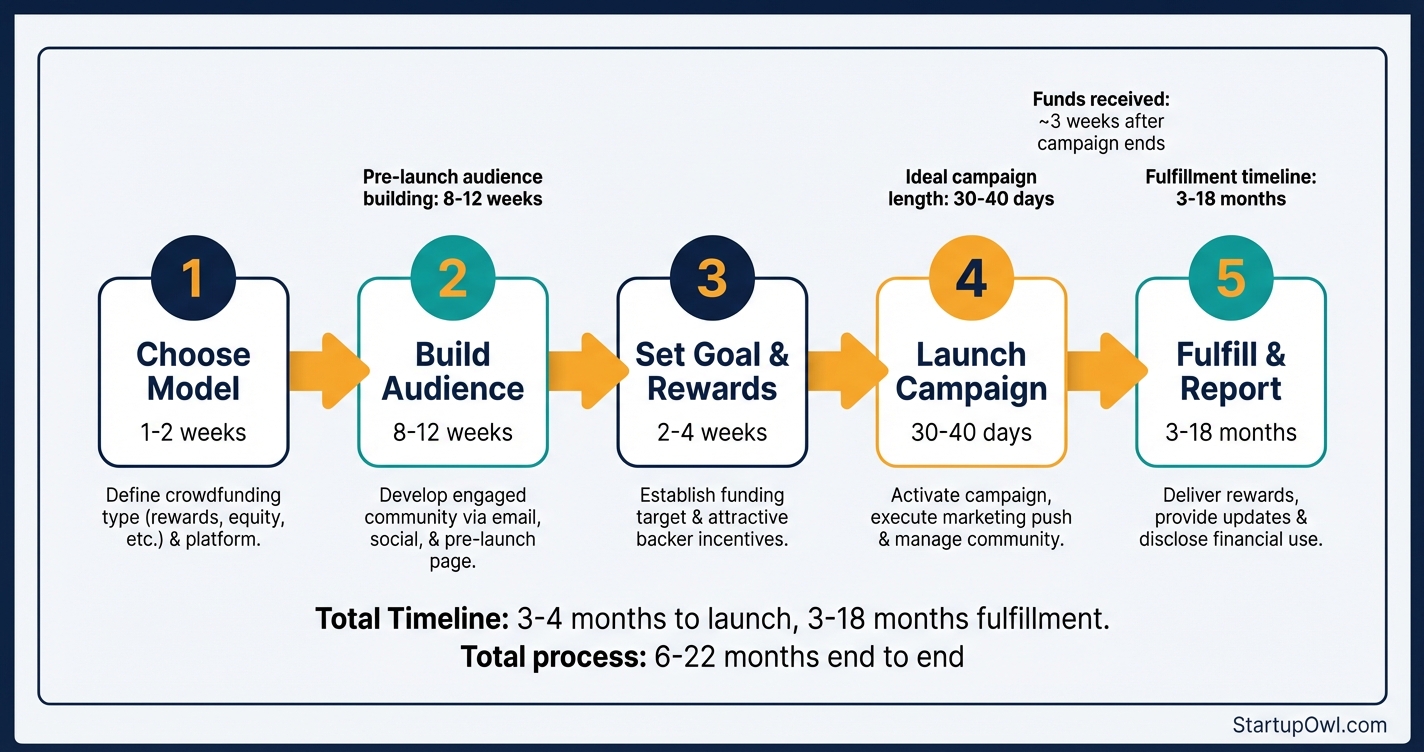
Start by choosing your platform and model (rewards vs. equity). Build a pre-launch email list for 8-12 weeks before going live. Data shows that 70-80% of successful campaigns bring their own traffic. Set your funding goal at the minimum viable amount and price your rewards so costs stay at 25-35% of the pledge price.
On launch day, mobilize your network immediately. Hitting 20-30% of your goal within 48 hours triggers platform algorithms that boost your visibility. About 42% of all funds come in during the first and last three days of a campaign. Post at least 4 updates during the campaign (campaigns with regular updates raise up to 126% more).
For equity campaigns, you will also need to file Form C with the SEC through your chosen funding portal, prepare financial statements appropriate to your raise tier, and comply with advertising restrictions. You can only advertise the terms of a Reg CF offering through a notice that directs investors to the funding portal platform.
The True Cost of Crowdfunding Your Business
Platform fees are just the beginning. On a $100,000 Kickstarter campaign, you will lose roughly $5,000 to the platform fee and another $3,200 in payment processing, leaving about $91,800 before taxes, shipping, or production costs. When you factor in dropped pledges, taxes, and shipping, expect to lose 15-20% of your gross raise to fees and expenses.
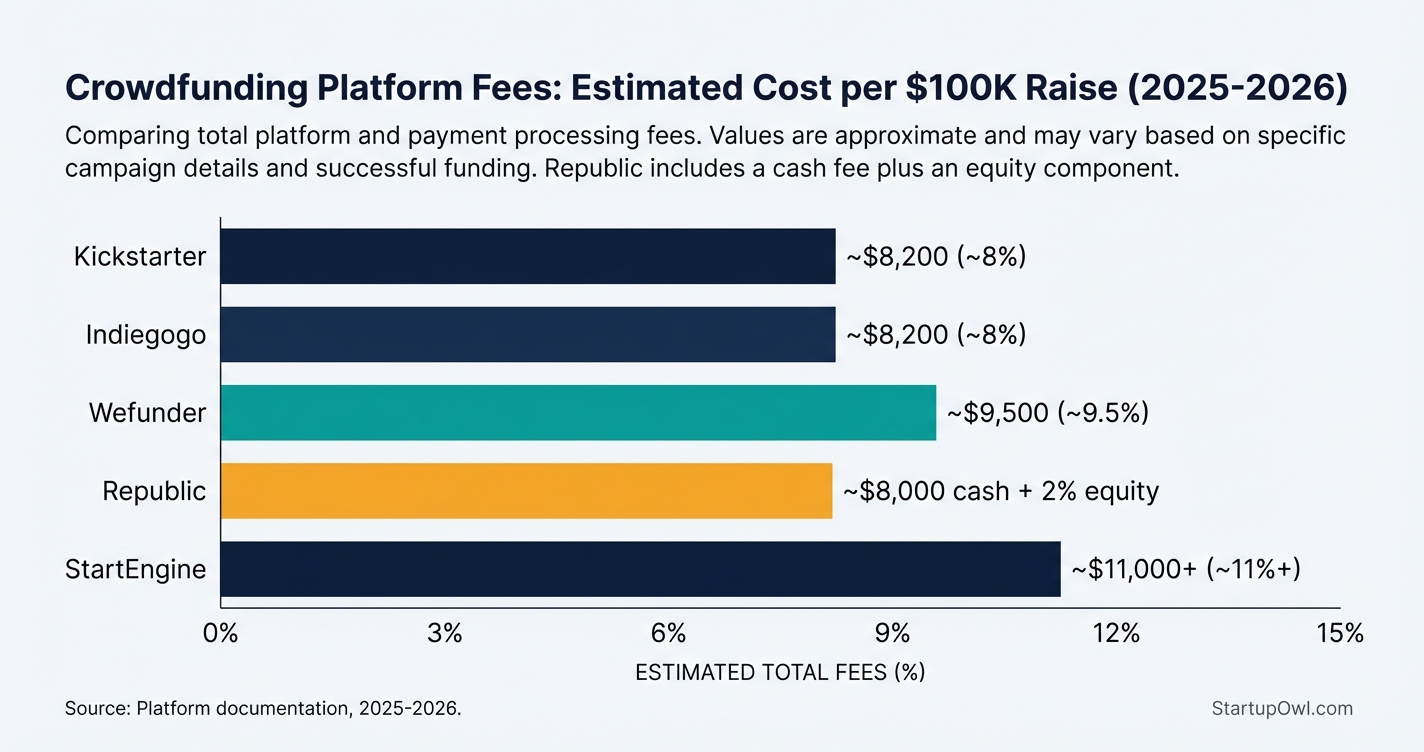
Equity platforms cost more. Wefunder charges 7.5% of funds raised as a success fee plus a 2% payment processing and escrow fee. Republic charges 6% in cash plus 2% in Crowd SAFE equity. StartEngine fees range from 7-12% of funds raised plus an additional 2% equity stake and $10,000 in deferred revenue.
On top of platform fees, equity campaigns require legal compliance spending. A securities attorney to prepare your Form C filing costs $3,000-$10,000. CPA-reviewed financial statements run $2,000-$5,000, and fully audited statements for raises over $1.235 million cost $5,000-$15,000. Budget these before committing to an equity raise.
Crowdfunding Platform Fee Comparison (as of 2026-2026)
| Type / Provider | Rate | Notes |
|---|---|---|
| Kickstarter (rewards) | ~8% total | 5% platform fee + 3% + $0.20 per pledge processing; all-or-nothing model |
| Indiegogo (rewards) | ~8% total | 5% platform fee + 3% + $0.20 per transaction; all-or-nothing as of Oct 2026 |
| Wefunder (equity, Reg CF) | 7.5% + 2% processing | No upfront cost; best price match guarantee; $50K-$5M raises |
| Republic (equity, Reg CF) | 6% cash + 2% Crowd SAFE | Fees only on successful raises; under 3% acceptance rate |
| StartEngine (equity, Reg CF) | 7-12% + 2% equity + $10K | Offers secondary market for investor liquidity; Reg A+ available up to $75M |
Top Crowdfunding Platforms for Business
Kickstarter is the largest rewards platform, with over $8.5 billion pledged across 650,000+ projects and more than 23 million backers. Its overall success rate is about 42%. Best for consumer products, games, design, and creative projects. Campaigns can run up to 60 days, though 30-40 days is the recommended sweet spot. Visit kickstarter.com.
Indiegogo was acquired by Gamefound in July 2026 and now focuses more on tech products and tabletop gaming. Fees are nearly identical to Kickstarter at about 8% total. As of October 2026, Indiegogo also uses all-or-nothing funding only. Its InDemand program lets you continue raising post-campaign at a 5-8% fee. Visit indiegogo.com.
Wefunder is one of the largest equity crowdfunding platforms, with over 900,000 investors and hundreds of millions raised. It charges 7.5% with no upfront costs and offers a price-match guarantee. Best for early-stage startups seeking Reg CF raises between $50,000 and $5 million. Visit wefunder.com.
Republic charges 6% cash + 2% equity and is known for its rigorous vetting process (fewer than 3% of applicants are accepted). Its investor base spans both accredited and non-accredited investors. Best for tech-focused startups and companies in biotech, AI, and blockchain. Visit republic.com.
StartEngine charges 7-12% plus equity but offers a secondary market where investors can trade shares post-campaign. Over $350 million has been raised by more than 500,000 investors. Best for companies planning larger raises or wanting to offer investors liquidity. Visit startengine.com.
Equity Crowdfunding Has Real Securities Obligations
When you raise money through equity crowdfunding, you are selling securities. That means you must file Form C with the SEC, provide financial disclosures appropriate to your raise amount, and file annual reports (Form C-AR) within 120 days of each fiscal year end. Securities purchased under Reg CF cannot be resold for one year. Failure to comply can result in SEC enforcement actions and disqualification from future offerings.
What to Do If Crowdfunding Is Not the Right Fit
If you do not have a consumer-facing product to pre-sell or a story that generates public excitement, crowdfunding may not work well for you. Service businesses and B2B companies typically struggle on rewards platforms. If you need capital faster than the 3-4 month crowdfunding timeline allows, consider these alternatives.
An SBA loan is cheaper. The rate is capped at 10.00% on amounts above $350,000, for businesses with 2+ years of operating history and a credit score of 680+. If you are brand new, an SBA microloan provides up to $50,000 with more flexible requirements. A business line of credit gives you revolving access to capital on demand.
For businesses with unpaid invoices, invoice factoring converts receivables into immediate cash. If you have strong daily credit card sales, a merchant cash advance provides fast funding (though effective rates can be 20-40% higher than traditional loans). And do not overlook small business grants, which provide free capital with no repayment or equity required.
For very early-stage businesses, pre-seed funding from angel investors may be a better path than equity crowdfunding if you want hands-on mentorship alongside capital.
5 Crowdfunding Mistakes That Cost You Real Money
1. Launching without a pre-built audience. About 70-80% of successful campaign traffic comes from the creator's own network. If you go live with zero email subscribers and no social following, you are betting on the 58% of Kickstarter campaigns that fail. Build your list first.
2. Underpricing your rewards. If your cost of goods exceeds 35% of the pledge price, you will lose money after platform fees (8%), taxes, and shipping. One creator raised $400,000 on Kickstarter and still lost money because shipping from China consumed every cent of margin.
3. Ignoring post-campaign compliance on equity raises. Under Reg CF, you must file Form C-AR annually. If you fail to comply for two consecutive years, the SEC bars you from conducting future Reg CF offerings. That is a permanent door closing, not a slap on the wrist.
4. Running a campaign that is too long. Campaigns between 20-40 days perform best. Longer campaigns lose urgency in the middle. The maximum allowed on both Kickstarter and Indiegogo is 60 days, but most crowdfunding professionals recommend 30 days as the sweet spot.
5. Choosing the wrong platform model for your business type. If you sell a B2B SaaS product, Kickstarter is the wrong platform (it is designed for creative and consumer products). An equity raise on Wefunder or Republic makes more sense for software businesses, while traditional small business loans may be even simpler.
This content is for informational purposes only and does not constitute financial, legal, or tax advice. Business financing terms, rates, and eligibility vary by platform, credit profile, and business characteristics. Crowdfunding fees and regulatory requirements may change without notice. Equity crowdfunding involves selling securities subject to SEC regulation. Consult a licensed financial advisor, CPA, or securities attorney before making fundraising decisions. Fee and rate data reflects publicly available platform information as of 2026-2026.
Step-by-Step Process
- 1
Choose between rewards and equity crowdfunding
Your first decision is whether to give backers a product (rewards-based) or a stake in your company (equity-based). Rewards crowdfunding on Kickstarter or Indiegogo works best if you have a physical product you can pre-sell. You keep 100% ownership and pay about 8% in fees.
Equity crowdfunding through platforms like Wefunder or Republic lets you raise up to $5 million under SEC Regulation CF, but investors receive ownership shares in your company. Platform fees run 6-12%, and you will need to file Form C with the SEC and provide annual reports.
Tips
- Pick rewards crowdfunding if you want to validate a physical product with zero equity dilution.
- Pick equity crowdfunding if you need larger capital (over $50,000) and are comfortable giving up ownership.
- Review SEC Reg CF rules before committing to an equity raise to confirm your business is eligible.
Common Mistakes
- Running an equity raise without understanding that investors become shareholders who require annual reporting.
- Choosing a platform before comparing fee structures (the difference between 7.5% and 12% on a $500K raise is $22,500).
- 2
Build your pre-launch audience and email list
Data shows that 70-80% of successful campaigns bring their own traffic. Do not rely on platform discovery alone. Start building an email list 2-3 months before launch through landing pages, social media, and early-bird signup forms.
Your goal is to have enough committed backers to hit 30% of your funding goal within the first week. Reaching that threshold raises your probability of full funding to about 75%. Campaigns with personal videos raise 105% more than those without, so invest in a strong campaign video before launch day.
$500-$5,000 for video production, landing pages, and advertising 8-12 weeks before campaign launch KickstarterTips
- Aim for an email list of at least 1,000 warm leads before going live.
- Run pre-launch Facebook or Instagram ads to a landing page to gauge interest.
- Post regular updates to build anticipation (campaigns with frequent updates raise 3x more).
Common Mistakes
- Launching without any pre-built audience and expecting platform traffic to carry you (only about 20-30% of funding comes organically from the platform).
- Skipping video production (campaigns without video raise roughly half as much as those with video).
- 3
Set your funding goal and reward tiers
For rewards campaigns, set your goal at the minimum viable amount you need to deliver. Remember, Kickstarter and Indiegogo both use all-or-nothing funding as of 2026, so if you miss your goal, you get nothing. Factor in 8% platform fees, a 3-5% dropped-pledge rate, and your actual production costs.
Build reward tiers where your cost of goods sits at 25-35% of the pledge price. Anything higher and you risk losing money after fees, taxes, and shipping. For equity campaigns, the median Reg CF valuation in 2024 was $15 million, with average raises around $368,000.
Tips
- Budget an extra 10-15% beyond visible fees to cover dropped pledges, taxes, and shipping surprises.
- Keep your minimum goal conservative (you can always add stretch goals).
- For equity raises, hire a securities attorney to review your Form C filing ($3,000-$10,000).
Common Mistakes
- Setting the goal so high that the all-or-nothing model kills the campaign when you fall short.
- Pricing rewards too low and losing money on every order once shipping and fees are subtracted.
- 4
Launch your campaign and drive early momentum
Launch day matters more than any other day. Your email list, social following, and personal network should all be notified the moment you go live. Aim to hit 20-30% of your funding goal within 48 hours to trigger platform algorithms that promote trending campaigns.
About 42% of total funds are raised in the first and last three days of a campaign. The ideal campaign length is 30-40 days (shorter campaigns create urgency). Post at least 4 updates throughout the campaign, because campaigns with regular updates raise up to 126% more.
$1,000-$10,000 for paid advertising and marketing during the campaign 30-40 days for the live campaign KickstarterTips
- Schedule your launch for a Tuesday or Wednesday morning when platform traffic is highest.
- Send 3-5 email blasts to your list in the first 48 hours (one before launch, one at launch, and follow-ups).
- Respond to every backer comment quickly to build momentum and trust.
Common Mistakes
- Going dark after launch day (skipping updates kills momentum and erodes backer confidence).
- Running a campaign longer than 40 days (longer campaigns tend to lose urgency and stall in the middle).
- 5
Fulfill rewards or manage your new investors
For rewards campaigns, plan for 12-18 months of fulfillment, not the optimistic 6-9 months most creators promise. Shipping and manufacturing costs in 2026-2026 remain volatile. Kickstarter funds arrive about 3 weeks after your campaign ends (14-day processing plus bank transfer time).
For equity campaigns, you now have shareholders. Under Reg CF, you must file annual reports using Form C-AR within 120 days of your fiscal year end. Securities purchased in a crowdfunding transaction cannot be resold for one year. Use your new investor community as brand ambassadors.
Tips
- Over-communicate on fulfillment timelines (backers tolerate delays but not silence).
- For equity raises, consider using a lead investor or SPV structure to keep your cap table clean.
- Set aside 10% of funds raised as a fulfillment buffer for unexpected cost increases.
Common Mistakes
- Underestimating shipping costs (international shipping can consume 20-30% of a backer's pledge).
- Failing to file annual reports after an equity raise (the SEC can bar you from future Reg CF offerings).
Cost Breakdown
| Item | Cost Range | Notes |
|---|---|---|
| Kickstarter platform fee | 5% of funds raised | Charged only if campaign reaches its goal (all-or-nothing model) |
| Kickstarter payment processing | 3% + $0.20 per pledge | Pledges under $10 incur 5% + $0.05 instead |
| Indiegogo platform fee | 5% of funds raised | All-or-nothing model as of October 2026; InDemand charges 5-8% additionally |
| Indiegogo payment processing | 3% + $0.20 per transaction | Total combined fees approximately 8% of funds raised |
| Wefunder success fee (equity) | 7.5% of funds raised | Includes processing; no upfront costs; price-match guarantee |
| Republic success fee (equity) | 6% cash + 2% Crowd SAFE | Fees charged only upon successful funding; stringent acceptance process |
| StartEngine fee (equity) | 7-12% of funds raised + 2% equity + $10K deferred | Fee varies by offering type; investors may also pay 3.5% |
| Legal and compliance (equity) | $3,000-$15,000 | Form C filing, securities attorney, CPA-reviewed financials |
| Campaign video production | $500-$10,000 | Videos increase funding by approximately 105% |
Frequently Asked Questions
Rewards platforms like Kickstarter and Indiegogo charge about 8% total (5% platform fee + 3% payment processing). Equity platforms charge 6-12% in success fees plus $3,000-$15,000 in legal and compliance costs. On a $50,000 rewards campaign, expect to net roughly $42,000-$44,000 after all fees and dropped pledges.
Rewards crowdfunding gives backers a product or perk in exchange for their pledge, and you keep 100% ownership. Equity crowdfunding gives investors actual ownership shares in your company. Rewards campaigns have no ongoing obligations after delivery, while equity campaigns require SEC annual reports and shareholder management.
No. Neither rewards nor equity crowdfunding platforms check your personal or business credit score. Rewards platforms like Kickstarter require only a valid ID and bank account. Equity platforms under Reg CF require that your company be incorporated in the U.S. and not disqualified under SEC rules, but there is no credit score threshold.
Under SEC Regulation CF, you can raise up to $5 million in any 12-month period. The average successful Reg CF campaign raised about $368,000 in 2024, with a median of $114,000. For larger raises, Regulation A+ allows up to $75 million annually.
Kickstarter's overall success rate is about 42% as of 2024-2026. Reward-based campaigns across all platforms succeed at roughly 39.6%. Equity crowdfunding campaigns have a lower success rate of about 20%, mainly because they require higher funding targets. Adding a video to your campaign raises your odds of success by about 105%.
Yes. Funds raised through crowdfunding are generally considered taxable income by the IRS. For rewards campaigns, you may also need to collect and remit sales tax depending on your state. Equity crowdfunding proceeds are treated as capital contributions (not income to the company), but consult a CPA for your specific situation.
This content is for informational purposes only and does not constitute financial, legal, or tax advice. Business financing terms, rates, and eligibility vary by lender, credit profile, and business characteristics. Consult a licensed financial advisor or CPA before making borrowing decisions. APR ranges reflect industry averages as of 2026 and may change without notice.
Sources & References
- SEC Regulation Crowdfunding: Guidance for Issuers
- SEC Regulation Crowdfunding Overview
- SEC Regulation CF Offering Statistics (2016-2024)
- Indiegogo Fees and Pricing for Campaigners
- KingsCrowd 2024 Investment Crowdfunding Trends and Platform Rankings
- SEC DERA Report on Regulation CF Offerings
- Crowdfunding Legal Requirements and SEC Regulations (JGCG)
- Kickstarter vs Indiegogo 2026 Fee Comparison (Fundpop)
- Indiegogo Platform Fees (Effective October 2026)
About the Author
Editor, StartupOwl
Eliot leads StartupOwl's state data research. He maintains the site's fifty state records of LLC filing fees, annual costs, processing times, and small business grant programs, checking each figure against the state office that publishes it and logging the date it was verified. Based in New Jersey, he has spent his working life in and around small businesses, and he writes for the founder who wants the real number rather than the advertised one. Every figure under his byline traces to a named source, and when a state proves a number wrong, the correction is published, not buried.
Was this article helpful?
Questions about Crowdfunding for Business
No comments yet. Ask the first question and a member of our team will answer.
Leave a comment