
How to Start a Consulting Business
You can start a solo consulting practice for about $2,000 and sign your first client in 30 to 60 days, if you already have a network to call. One choice moves the cost more than any other.

In This Article
- Overview
- Business Snapshot
- Introduction
- Sub-Niches
- Research the Market and Validate Your Consulting Niche
- Write a Lean Business Plan That Focuses on Revenue
- Cost Breakdown
- Choose Your Business Structure and Protect Your Assets
- Register Your Business and Get Your EIN
- Get Licensed and Establish Your Professional Credentials
- Licenses & Permits
- Set Up Your Workspace and Essential Tools
- Day-1 Equipment
- Set Your Pricing and Choose the Right Fee Structure
- Get Business Insurance Before You Take Your First Client
- Mistakes to Avoid
- Land Your First Clients From Your Existing Network
- Set Up Accounting and Understand Your Tax Obligations
- Marketing Channels
- Build Your Online Presence and Stay Compliant Year-Round
- Is This Right for You?
- Top Challenges
- Tools & Equipment
- How to Find Clients
- Marketing
- Copy-and-Use Templates
- Scaling Your Business
- Helpful Resources
- Taxes & Structure
- Insurance
- State Variations
- FAQ
- Next Steps
What This Guide Covers
This guide walks you through every step to start a consulting business, from validating your idea to choosing the right legal structure, getting licensed, and reaching your first customers. Updated for 2026.
Business Snapshot
- Startup Cost Range
- $4,900–$32,800
- Avg. Annual Revenue
- $75,000 - $200,000 (solo); $300,000+ (small firm)
- Profit Margin
- 14% - 40%
- Time to Launch
- 2-6 weeks
- Break-Even Timeline
- 3-7 months
- Avg. Owner Salary
- $75,000 - $150,000/year (solo); $150,000+ (firm owner)
- Avg. Insurance Cost
- $1,128/year (E&O $62 + general liability $32 a month)
- Monthly Operating Cost
- $2,000 - $7,000/month
- Pricing Model
- Project-based, Hourly, and Monthly retainer
- Avg. Hourly Rate
- $100 - $300/hour
- Avg. Per-Job Rate
- $5,000 - $50,000 per project
- Market Growth Rate
- 3.6% a year over the five years to 2024 (IBISWorld, NAICS 54161)
- Year-1 Failure Rate
- 25.5% close in year one (BLS, professional services)
- Marketing Budget
- $300 - $1,000/month first year
- Recommended Entity
- LLC
- Market Size
- $392.2 billion US market (IBISWorld, 2024)
- Last Updated
- September 12, 2026
Industry Trend
Health care and life sciences is the fastest growing client field, forecast at 6.21% a year to 2031. Small and mid sized firms are the fastest growing client size, at 5.96%. Digital work took 24.73% of 2025 US consulting revenue and is still growing faster than strategy work. Scope decides the market number you see. Those growth rates are Mordor Intelligence, which counts fee based consulting only and puts the 2026 US market at $132.3 billion. IBISWorld counts more widely and puts it at $392.2 billion.
Two lines in the table below create most of the spread. The cash reserve runs $2,000 to $15,000. Gear and office setup runs $1,000 to $5,000. Work from a laptop at home with a client already signed and you skip the larger part of that bill. Renting space and hiring staff is what puts you at the top of the range.
What It Actually Takes to Launch a Consulting Business in 2026
You can start a solo consulting practice for about $2,000 and sign your first client in 30 to 60 days, if you already have a network to call. One choice moves the cost more than any other. Work from home and you spend $2,000 to $10,000. Lease an office and hire help and you spend $25,000 to $50,000 or more. Your first three clients will come from people who have seen your work, not from ads.
About 80% of consulting revenue comes from repeat clients and referrals, so your first six months are about building ties that pay for years.
Two costs catch people out. Errors and omissions cover averages $62 a month for a consultant, and many larger clients will not sign until they see the certificate. Self employment tax then takes 15.3% of net profit before any income tax lands on top. Set aside 25% to 30% of every client payment from day one and neither one stings.
Consulting Business Sub-Niches to Explore
Research the Market and Validate Your Consulting Niche
IBISWorld put the US management consulting market at $392.2 billion in 2024. Over a million businesses share it. The market is huge, so the real work is picking one niche where you can show results.
The odds are worth knowing. Of the firms in this trade that opened in the year to March 2024, 25.5 percent had closed a year later, says the Bureau of Labor Statistics. That is one in four. So test demand before you register anything. Talk to 10 buyers in your niche and ask what they would pay to fix today.
Then use the startup cost calculator to model your first 12 months against real revenue. If the sums work on 2 or 3 clients, the niche holds up.
Pro Tip
Search LinkedIn for consultants in your niche. Find more than 50 in your metro area and you need a sharper focus, or a different city.
Write a Lean Business Plan That Focuses on Revenue
Your plan does not need 40 pages. It needs to answer three things. Who you serve. What problem you fix. How you get paid. A one page plan with 12 months of numbers is enough to start.
If you want a loan or a line of credit, lenders will ask for the revenue you expect, your costs, and the month you break even. Our guide on how to write a business plan sets out the format banks expect.
Pro Tip
Put three numbers in the plan. How you price, how many clients you want each quarter, and your average job size. Those three tell you what you must earn to cover costs.
Startup Cost Breakdown
Itemized estimate for launching a Consulting Business. Costs vary by location and whether you hire staff.
| Item | Low Est. | High Est. |
|---|---|---|
| Business Registration and Legal SetupLLC filing fees run from $35 in Montana to $500 in Massachusetts. Add a lawyer's read of your contract if you want one. | $100 | $1,500 |
| Equipment and Office SetupA good laptop, a second screen, a desk and chair, and a webcam for client calls. | $1,000 | $5,000 |
| Software and TechnologyCRM, project tracking, video calls and books software for the first year. | $300 | $1,500 |
| Professional Liability Insurance (E&O)Insureon puts the average consultant at $62 a month. Yearly policies run from about $400 to over $3,750. | $500 | $1,300 |
| General Liability InsurancePays when someone is hurt or something is damaged, such as a client tripping in your space. | $250 | $500 |
| Marketing and BrandingWebsite, cards, LinkedIn Premium, and the first run of writing you publish. | $500 | $5,000 |
| Professional Development and CertificationsMarks such as the CMC or PMP add weight. They help you hold a higher rate. | $250 | $3,000 |
| Working Capital ReserveNet 30 to net 60 terms are normal here. Hold cash for 2 or 3 months of costs. | $2,000 | $15,000 |
| Total Estimate | $4,900 | $32,800 |
Your rate turns on your field, your years in it, and whether you sell to small firms or large ones. Price by the project from day one. An hourly rate caps what you can earn.
Choose Your Business Structure and Protect Your Assets
Form an LLC on day one. Consulting carries real risk, because your advice moves a client's business. An LLC keeps your own savings out of a lawsuit, which matters the first time a client says your plan cost them money.
LLC filing fees run from $35 in Montana to $500 in Massachusetts. Check yours before you budget. Our state by state cost table carries the figure. Our guide on how to form an LLC walks the filing in under an hour.
Pro Tip
Pick an LLC on day one. You can switch to S-Corp tax treatment later, once yearly profit clears $50,000 and the saving beats the payroll admin.

Form Your Consulting Business LLC with Northwest
An LLC keeps your own savings out of a client lawsuit and lets you pick how you are taxed. That matters when you sell advice.
Register Your Business and Get Your EIN
Once the LLC is filed, get a free Employer Identification Number (EIN) at IRS.gov. It takes 10 minutes online and the number lands at once.
You need the EIN to open a bank account, file tax and sign with larger clients. Most big firms want it on a W-9 before they raise a purchase order.
If you would rather not use your home address on the public filing, our registered agent guide covers the options, from $50 to $150 a year.
Pro Tip
Open the business bank account the day your EIN lands. Mixing your own money with the firm's is the fastest way to lose the cover an LLC gives you.
Get Licensed and Establish Your Professional Credentials
Most states do not licence general consulting. You still need the basic permits. Here is what to file.
- A general business licence from your city or county, $50 to $500 a year, through the local clerk
- A state business registration with your Secretary of State, see SBA.gov
- A home occupation permit if you work from a house, which many towns require
- Optional, the Certified Management Consultant (CMC) mark from IMC USA, which shows clients you meet a standard
- Optional, PMP from PMI if you sell operations or project work
Pro Tip
If you advise in a regulated field such as finance, health care or law, check whether your state wants a separate licence to advise in that field.
Important
Some cities require a separate permit for home-based businesses. Operating without one can result in fines of $200 to $1,000 per violation.
Licenses & Permits for a Consulting Business
Requirements vary by state and city — confirm with your local government before opening.
General Business License
RequiredNeeded in most cities and counties. It costs $50 to $500 a year, depending on where you are.
Apply / Learn MoreState Business Registration
RequiredFile the LLC or corporation with your Secretary of State. Fees run from $35 in Montana to $500 in Massachusetts.
Apply / Learn MoreCertified Management Consultant (CMC)
Optional but well regarded. The mark from IMC USA shows clients you meet a standard of skill and ethics.
Apply / Learn MoreProject Management Professional (PMP)
Worth having if you sell operations or project work. The Project Management Institute mark is known worldwide.
Apply / Learn MoreNote
The Certified Management Consultant (CMC) mark from IMC USA is the best known credential in the trade. To earn it you need 3 years of consulting work. IMC USA also asks for client reviews and a written and oral exam.
Set Up Your Workspace and Essential Tools
A solo practice needs a good laptop ($800 to $2,000), a second screen ($200 to $500) and a decent webcam and mic ($80 to $250). Budget $1,500 to $4,000 for the whole home office.
For software, take a CRM such as HubSpot on its free tier, books software such as QuickBooks Online, and a booking tool such as Calendly. Those three cover most of what you need for under $100 a month.
Pro Tip
Buy a USB-C hub and a wireless clicker before your first meeting in person. Looking sharp while you present earns trust faster than the slides do.
Day-1 Equipment for a Consulting Business
These are the essentials you need before taking your first job. Prices are estimates — shop used gear to cut startup costs.
Business Laptop
$800 - $2,000Buy a machine with at least 16GB of RAM and a fast chip, so slides and video calls do not stutter.
External Monitor
$200 - $500A 27 inch screen saves your eyes and makes work across two documents much quicker.
Webcam and Microphone
$80 - $250The camera in your laptop is not good enough for client calls. Buy a 1080p webcam and a USB mic.
Ergonomic Desk and Chair
$300 - $1,000You will sit here 8 to 10 hours a day, so a good chair pays for itself in health and output.
Portable Presentation Kit
$100 - $300A small projector adapter, a wireless clicker and a USB-C hub for meetings in person.
Set Your Pricing and Choose the Right Fee Structure
Consultants in the US charge $100 to $300 an hour. Project fees run $5,000 to $50,000, depending on the scope and how rare your skill is. Consultants with high impact work charge a monthly retainer of $5,000 to $20,000+ for ongoing advice.
Price by the project and the client knows the bill up front. It also lifts the cap on what an hour of your time earns. Once you can scope work well, it beats the clock. Work out your floor first. Take the income you want, add your costs, then divide by the hours you can bill.
Pro Tip
Do not cut your rate to win early work. Offer a smaller job at the full rate instead. A discount on day one sets a price you will find hard to raise.
Get Business Insurance Before You Take Your First Client
Errors and omissions cover (E&O) is the one policy you cannot skip. It pays if a client says your advice cost them money. Insureon puts the average consultant at $62 a month for E&O and $32 a month for general liability, roughly $1,128 a year for both. Yearly E&O policies run from about $400 to over $3,750 once your field and limits are counted.
Carry these two at least.
- Errors and omissions (E&O) at $1 million per claim and $1 million in total, the pair 71 percent of consultants choose
- General liability at $1 million per event and $2 million in total, the pair 83 percent choose
Compare rates at our best business insurance guide. Many larger clients want proof of cover before they sign, so buy it before you pitch.
Pro Tip
A Business Owner's Policy bundles general liability with property cover, not E&O, so budget for E&O on its own whatever your broker quotes. Consultants average $61 a month for a BOP.
Important
Do not take your first client or job without insurance in place. One incident without coverage can end the business before it starts.
Mistakes to Avoid
Billing by the hour from day one instead of pricing the project. Hourly caps what you earn and casts you as a contractor, not an adviser.
Chasing every trade at once. Pick one niche where you have real skill and results you can show.
Skipping a written contract and a scope of work. The job then grows, and the unpaid hours pile up.
Spending $5,000 on a website before a single client. Your LinkedIn profile and your network come first.
Under rating the 3 to 6 month sales cycle. Cash runs out before the deals close.
Taking clients before you buy errors and omissions cover. That leaves you open to a claim over advice that did not land.
Failing to set aside 25% to 30% of revenue for tax. It bites when the quarterly payment falls due.
Letting a free first call run to 90 minutes. Cap it at 30, with an agenda and a next step.
Land Your First Clients From Your Existing Network
About 80% of consulting work comes from repeat clients and referrals. Your first three clients will almost certainly be people who have seen you work. Send a note to 20 or 30 old colleagues, bosses and contacts. Say what you now sell and who you sell it to.
Do not send one mass email. Write each note on its own and name a job you shared. Offer a free 30 minute call, no longer, to pin down one problem they have. Give them a win on that call and the paid work tends to follow.
Pro Tip
Ask every contact for one warm intro, even when they are not a buyer. Two intros from each of 20 chats gives you 40 warm leads in month one.
Set Up Accounting and Understand Your Tax Obligations
Open a business bank account at once. Mixing your own money with the firm's makes tax time a mess and weakens what the LLC protects. Compare options in our best business bank accounts guide.
As a self employed consultant you owe 15.3% self employment tax on net profit, which covers Social Security and Medicare, plus federal and state income tax on top. Quarterly payments fall due in January, April, June and September. Miss one and you pay a penalty.
Consultants can deduct a home office, software, training, travel and health cover. Use accounting software such as QuickBooks Online to log every cost from day one, so you claim all of it.
Pro Tip
Move 25% to 30% of every client payment into a separate savings account for tax. Automate it, so you never spend the tax money by mistake.
Top Marketing Channels for a Consulting Business
Primary
Secondary
Build Your Online Presence and Stay Compliant Year-Round
Your website and your filing dates keep the firm running long after launch. Set these up and keep them on a schedule.
- Claim your Google Business Profile, free, 15 minutes, and it matters for local search
- Build a simple site with a services page, an about page, case studies and a contact form, using a website builder such as Squarespace or WordPress
- Treat your LinkedIn profile as a landing page, with a clear headline, client results in the summary, and case studies in the featured slot
- Set a reminder for the annual report your state wants, since the date shifts by state
- Renew the business licence each year, and your cover before it lapses
- Read your consulting contract again every 6 months
Use our compliance calendar to track each date, so none of them slip.
Pro Tip
Publish one piece of writing a week on LinkedIn. Turning up beats any ad budget, and 35% of leads at consulting firms come from what the firm publishes.
Is Starting a Consulting Business Right for You?
Consulting suits people who set their own hours, live with doubt, and like solving other firms' hard problems. If you enjoy variety and can switch between trades without losing the thread, you will enjoy the work.
You need 5 to 10 years in one field to advise paying clients. With no record of results, you will struggle to charge above $75 an hour, which barely covers costs after tax.
The money comes, but not at once. Most solo consultants earn $50,000 to $80,000 in year one while they build a client base, then reach $100,000 to $200,000 in years two and three as repeat work and referrals stack up.
You will struggle if you need a steady pay cheque. A consulting deal takes 3 to 6 months to close, and net 30 to net 60 terms mean cash can lag the work by weeks. Keep at least 3 months of living costs in the bank before you go full time.
If you dislike selling, this is not your trade. Even old hands spend 20% to 30% of their time on pitching, proposals and keeping in touch. The consulting is only half the job.
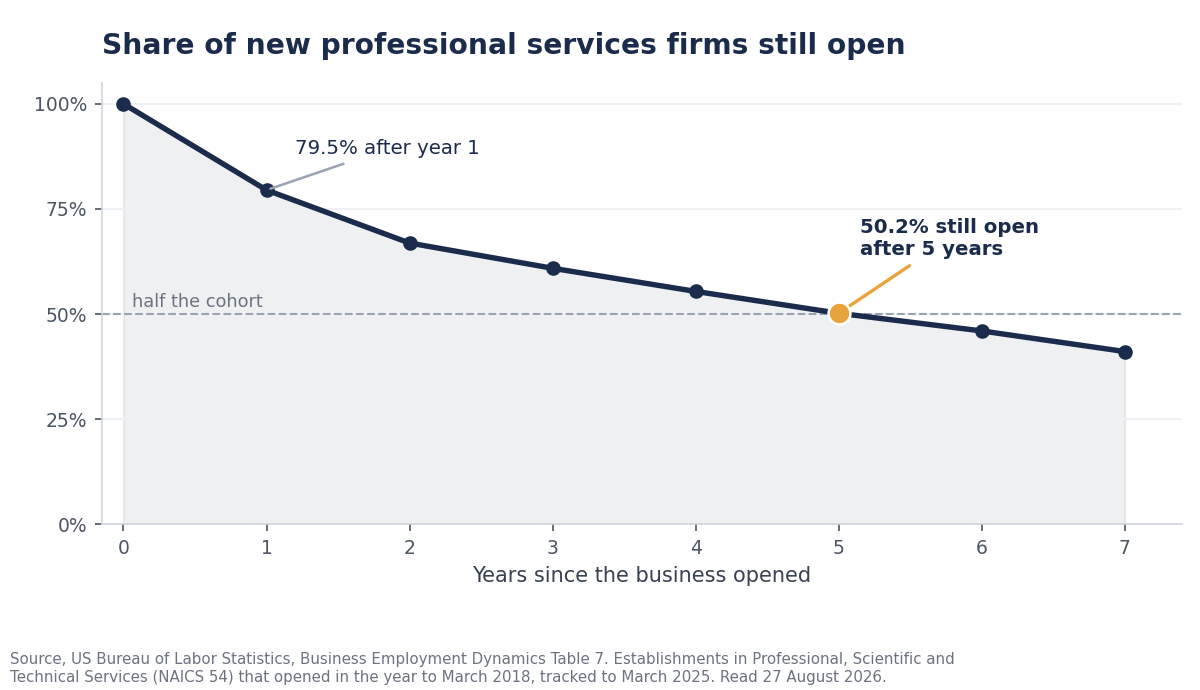
Most consulting firms live through year one. Staying open is the hard part. Of the firms in this trade that opened in the year to March 2018, 79.5% were still trading a year later, and 50.2% after five years. The newest group did worse at the one year mark, 74.5%. Size your cash reserve against the five year line, not the first birthday.
Top Challenges When Starting a Consulting Business
1
Most solo consultants swing between feast and famine until they hold 3 to 5 clients who come back. Budget for 2 or 3 months of no income while you ramp up.
2
A new consulting job takes 3 to 6 months to close. Keep the pipeline full at all times, not just when current work is winding down.
3
Clients will ask for more than you agreed. A clear scope of work, with terms for changes, stops unpaid hours eating your margin.
4
Your first five clients care about results, not your brand. Offer a tight job at a fair rate in exchange for a written case study and a quote.
5
Deliver hard and you stop selling. Then the job ends and the pipeline is empty. Block 20% of your week for selling, whatever the workload.
Tools & Equipment for a Consulting Business
Your one big buy is a laptop with 16GB of RAM and a fast SSD. Budget $800 to $2,000. A MacBook Air, ThinkPad or Dell XPS will run video calls, slides and data work at once.
Add a 27 inch monitor ($200 to $500). Add a real webcam too, such as the Logitech Brio or the Elgato Facecam. How you look on a client call says more than you think.
For software, start with HubSpot CRM on its free tier to track clients. Add QuickBooks Online at $30 a month for the books. Calendly runs $12 a month for booking and Google Workspace $7 a month for email and files. Compare CRM options at our best CRM software guide.
Toggl Track has a free tier and logs time against each job. Run it even when you bill by the project. Knowing your real hours tells you whether the price worked, or whether a premium job paid you $30 an hour.
Software Consulting Businesses Commonly Use
How to Find Your First Consulting Business Clients
Your first five clients will come from the people you know. That is not a guess. About 80% of consulting revenue comes from repeat clients and referrals. Before you build a website, list every person who has seen your work and would vouch for you.
Send 20 to 30 notes, written one at a time, to old colleagues, bosses and contacts in your trade. Say what you now sell and who you sell it to. Ask each one for a single warm intro, even if they are not a buyer.
Offer a free 30 minute call to prospects worth your time. Cap it at 30 minutes and keep an agenda. Name one problem, say what fixing it is worth to them, and offer paid work to fix it. That shape closes 30% to 50% of warm leads.
When a job ends, ask for a written quote and a short video case study. Proof sells better than anything else here, because clients are buying trust in your judgement. Three real case studies on your site beat any ad spend.
Join 2 or 3 trade bodies where your buyers are members. Turn up at local events each month and offer to speak or chair a panel. The IMC USA at imcusa.org is a good place to start for referral partners.
How to Market Your Consulting Business
LinkedIn is your main channel. Over 35% of leads at consulting firms come from what the firm publishes. Post 3 to 5 times a week. Use what you learn on real jobs, with names removed, plus your own take on where the trade is going and tools your readers can use today.
Referrals close best. When a job ends, ask for two named intros to people in your client's world who face the same problem. Draft the email for your client to forward, so the ask is easy.
Talks put you in front of buyers. Trade events, chapter meetings and online summits all need good speakers, and one 30 minute talk can bring 3 to 5 real leads. Start with local chapters before you aim at national events.
Claim your Google Business Profile now. It is free and it puts you in local results when buyers look for a consultant in your city.
Skip paid ads in year one. Your budget of $300 to $1,000 a month does more on a good website, LinkedIn Premium for outreach, and 2 or 3 trade events a quarter where your buyers gather.
Copy-and-Use Templates
Real templates to help you land your first clients. Click "Copy" and paste directly into your email or messaging app.
First Client Outreach Email
emailSubject: Quick question about [specific challenge] at [Company Name]
Hi [First Name],

I recently launched my consulting practice focused on helping [type of company] solve [specific problem]. Given our work together at [previous company or context], you were one of the first people I thought of.

I am offering a free 30-minute strategy session to a handful of people in my network this month. I would love to take a look at [specific area] for [Company Name] and share a few ideas.

Would you be open to a quick call next [Tuesday or Wednesday]? No pitch, just a focused conversation about what is working and what is not.

Best,
[Your Name]
[Your Phone Number]
[Your LinkedIn URL]
Discovery Call Opening Script
scriptThanks for taking the time, [First Name]. I want to make sure this call is valuable for you, so here is how I suggest we use our 30 minutes. First, I will ask a few questions to understand where [Company Name] is today with [specific area]. Then I will share 2 to 3 observations based on what I am seeing in the market. If it makes sense to work together, I will outline what an engagement could look like. If not, no hard feelings and I am happy to point you toward other resources. Does that structure work for you? Great. Let me start here: What is the single biggest challenge you are facing with [specific area] right now?
30-Day Consulting Business Launch Checklist
checklistWeek 1: - Choose your niche and write a one-sentence positioning statement - File your LLC with the Secretary of State - Apply for your EIN at IRS.gov - Open a dedicated business bank account Week 2: - Purchase professional liability (E&O) and general liability insurance - Set up QuickBooks Online and connect your bank account - Draft your consulting agreement and scope of work template - Set up HubSpot CRM (free tier) to track leads and contacts Week 3: - Update your LinkedIn profile with your new consulting focus - Build a simple website with services, about, and contact pages - Claim your Google Business Profile - Send personalized outreach messages to 20 to 30 contacts Week 4: - Schedule 5 to 10 discovery calls with warm leads - Create your first piece of thought leadership content for LinkedIn - Set up Calendly for scheduling and Zoom for calls - Review your first month financials and adjust your 12-month plan
Proposal Follow-Up Message
messageHi [First Name], I wanted to follow up on the proposal I sent over on [date]. I know these decisions take time, so I am not looking to rush you. If anything in the scope or pricing needs adjustment to fit your budget or timeline, I am happy to discuss. I can also share a relevant case study from a similar engagement if that would help your team evaluate the fit. What would be the best next step from your end? Best, [Your Name]
Post-Engagement Referral Request
emailSubject: A quick favor (and a thank you)
Hi [First Name],

It was a pleasure working with you and the team at [Company Name] on [project description]. I am glad we were able to [specific result achieved].

I have a quick favor to ask. If you know 1 or 2 people in your network who are dealing with similar challenges around [specific area], I would really appreciate a warm introduction. I have drafted a short blurb below that you can forward if it is helpful.

[Draft intro: "Hi [Name], I wanted to connect you with [Your Name], who recently helped us [result]. They specialize in [niche] consulting for [type of company]. I thought you two should connect."]

Also, if you have 2 minutes, a short testimonial or LinkedIn recommendation would mean a lot. Happy to write a draft for your review.

Thank you again for trusting me with this project.

Best,
[Your Name]
Scaling Your Consulting Business
Most consultants work alone for 12 to 18 months before the first hire. The trigger is steady monthly revenue of $15,000 or more with a queue of clients you cannot serve on your own.
Hire a part time assistant or job coordinator at $20 to $35 an hour first, not a second consultant. Handing over booking, invoices, proposal layout and email frees 10 to 15 billable hours a week.
When you are ready for a subcontractor, use a 1099 deal rather than a W-2 hire. Pay them 40% to 60% of the client rate and keep the rest. That lets you take bigger jobs without the fixed cost of payroll.
Build packaged offers too, fixed scope work at a set price, next to your custom advice. Packages are easier to sell, easier to hand off and steadier. The break even calculator models the revenue you need before each new hire.
Helpful Resources
Government & Licensing
SBA Business Licenses and Permits Guide
governmentOfficial SBA resource for finding the specific federal, state, and local licenses and permits your consulting business needs.
IRS EIN Online Application
governmentApply for your free Employer Identification Number directly from the IRS in about 10 minutes.
SBA Register Your Business Guide
governmentOfficial guide to registering your business entity with federal and state agencies, including links to each state's filing portal.
Industry Associations
Training & Certifications
IMC USA CMC Certification Process
trainingStep-by-step details on earning the Certified Management Consultant (CMC) designation, including requirements and exam process.
Consulting Success (Training and Resources)
trainingComprehensive training library and community for independent consultants covering pricing, proposals, marketing, and client acquisition.
Business Tools & Software
HubSpot CRM (Free Tier)
toolA free CRM with contact management, deal tracking, and email integration that handles client pipeline management for solo consultants.
QuickBooks Solopreneur
toolAccounting software that tracks income, expenses, mileage, and quarterly estimated taxes for independent consultants.
Insureon Consulting Business Insurance
toolCompare professional liability, general liability, and BOP quotes from multiple carriers in one application designed for consultants.
Taxes & Business Structure for a Consulting Business
Self employment tax hits hard in year one if you have not planned for it. The rate is 15.3%, made of 12.4% for Social Security and 2.9% for Medicare. The IRS charges it on 92.35% of your net profit, which is revenue minus costs, not on the whole figure. That puts the real bite nearer 14.1%. You start owing it once net earnings reach $400. The Social Security half stops at the first $184,500 you earn in 2026. The Medicare half never stops. Half of what you pay comes back as an income tax deduction. Your federal and state income tax sits on top. That is why most consultants end up between 25% and 35% of net profit once both layers are counted.
Quarterly tax payments fall due on April 15, June 15, September 15 and January 15. Use IRS Form 1040-ES to work out each one. Miss a quarter and you pay a penalty, even if you settle the full amount the following April.
Claim every deduction you can. Consultants commonly claim a home office (the simple method is $5 a square foot, up to 300 square feet), software, training, travel, the work share of internet and phone, and health cover. Log every receipt with accounting software from day one.
If net profit passes $50,000 a year, ask a CPA about S-Corp tax treatment for your LLC. You then pay yourself a fair salary, which carries payroll tax, and take the rest as a distribution, which does not carry self employment tax. That can save $3,000 to $10,000 a year.
Insurance for a Consulting Business
Errors and omissions cover (E&O) is your first policy. Buy it before you pitch. It pays your legal costs if a client says your advice cost them money. Insureon puts the average consultant at $62 a month, and 71 percent buy $1 million per claim limits. But an average is not a budget. Yearly premiums run from about $400 to more than $3,750. And 38 percent of Insureon's consulting clients pay under $50 a month. Your own quote is the only number that counts.
General liability averages $32 a month, about $384 a year. Most consultants carry both. It pays when someone is hurt or something is damaged, and for ad claims such as copied work. Shared offices and landlords often want proof of it before you can book a meeting room. 83 percent of consultants take $1 million per event with a $2 million cap.
Hire anyone and workers comp is next. Most states require it from the first employee, and Insureon puts consultants at $44 a month, or $250 to over $3,000 a year.
If you hold client data such as accounts, customer lists or health records, add cyber cover. The data is the risk. Consultants pay an average of $81 a month for it, and $350 to over $6,500 a year, depending on how much you hold. Compare your options at our best business insurance guide.
State-by-State Considerations
LLC filing fees run from $35 in Montana to $500 in Massachusetts, the two ends of our own 50 state fee table. Massachusetts charges $520 to file online, because it adds $20 to electronic filings. Where you file matters. A few states charge more each year on top. California takes an $800 franchise tax whatever you earn, which is real money for a solo consultant.
Cover costs shift by state too. E&O in New York runs $125 a month on average, while consultants in North Dakota pay closer to $91 a month for the same cover. Where you sit, what you do and your claims record all feed the price.
Some towns want a separate home permit for a business run from a house. Ask your city clerk before you start. Licence renewal and annual report dates also shift by state, so use our compliance calendar to keep track.
Frequently Asked Questions
What to Do Next
Ready to launch your consulting business? Take these next steps to go from plan to open.
Form Your Consulting LLC
Protect your personal assets with an LLC. Our guide walks you through formation in every state, from filing to EIN.
Get Business Insurance
Compare professional liability and general liability policies from top carriers. Most consultants pay under $100/month for full coverage.
Open a Business Bank Account
Separate your finances from day one. See which banks offer free business checking and the best perks for consultants.
Write Your Business Plan
A lean one-page plan with financial projections is enough to launch. Use our template to build yours in under an hour.
Explore Small Business Grants
Find grants that fund consulting startups, especially if you serve underrepresented communities or operate in a high-growth sector.
About the Author
Editor, StartupOwl
Eliot leads StartupOwl's state data research. He maintains the site's fifty state records of LLC filing fees, annual costs, processing times, and small business grant programs, checking each figure against the state office that publishes it and logging the date it was verified. Based in New Jersey, he has spent his working life in and around small businesses, and he writes for the founder who wants the real number rather than the advertised one. Every figure under his byline traces to a named source, and when a state proves a number wrong, the correction is published, not buried.
Was this article helpful?
Ready to Launch?
Form your consulting business LLC today with Northwest. $39 + state fee includes registered agent, business address, domain, and more.
Questions about starting a consulting business
No comments yet. Ask the first question and a member of our team will answer.
Leave a comment