
Small Business Tax Deductions That Save You Real Money in 2026
Every deduction you can claim, what it costs to track and file them, and how much you can realistically save in year one.

You can deduct rent, utilities, insurance, advertising, vehicle expenses, office supplies, contractor payments, health insurance premiums, retirement contributions, and up to 20% of qualified business income through the QBI deduction. Self-employment tax alone runs 15.3% on net earnings, so every legitimate deduction directly reduces what you owe. Tracking them costs $0 to $50/month with accounting software, or $500 to $2,500 if you hire a CPA.
The average small business owner overpays by $5,000 to $12,000 per year in federal taxes simply by missing deductions they already qualify for. Knowing which expenses are deductible is only half the battle. The other half is understanding what it costs to track, document, and file them properly (from $0 with free software to $2,500+ with a CPA).
This guide breaks down every deduction available to you in 2026, the real costs of claiming them, and the dollar-for-dollar consequences of skipping any. If you have not yet set up your small business accounting, start there first.
Cost Overview
Claiming your small business tax deductions costs between $0 and $3,500 per year depending on how you handle tracking and filing. A solo freelancer using Wave for bookkeeping and TurboTax Premium for filing spends about $200 per year. An S-Corp owner hiring a CPA and running QuickBooks Simple Start spends closer to $1,500 to $2,500.
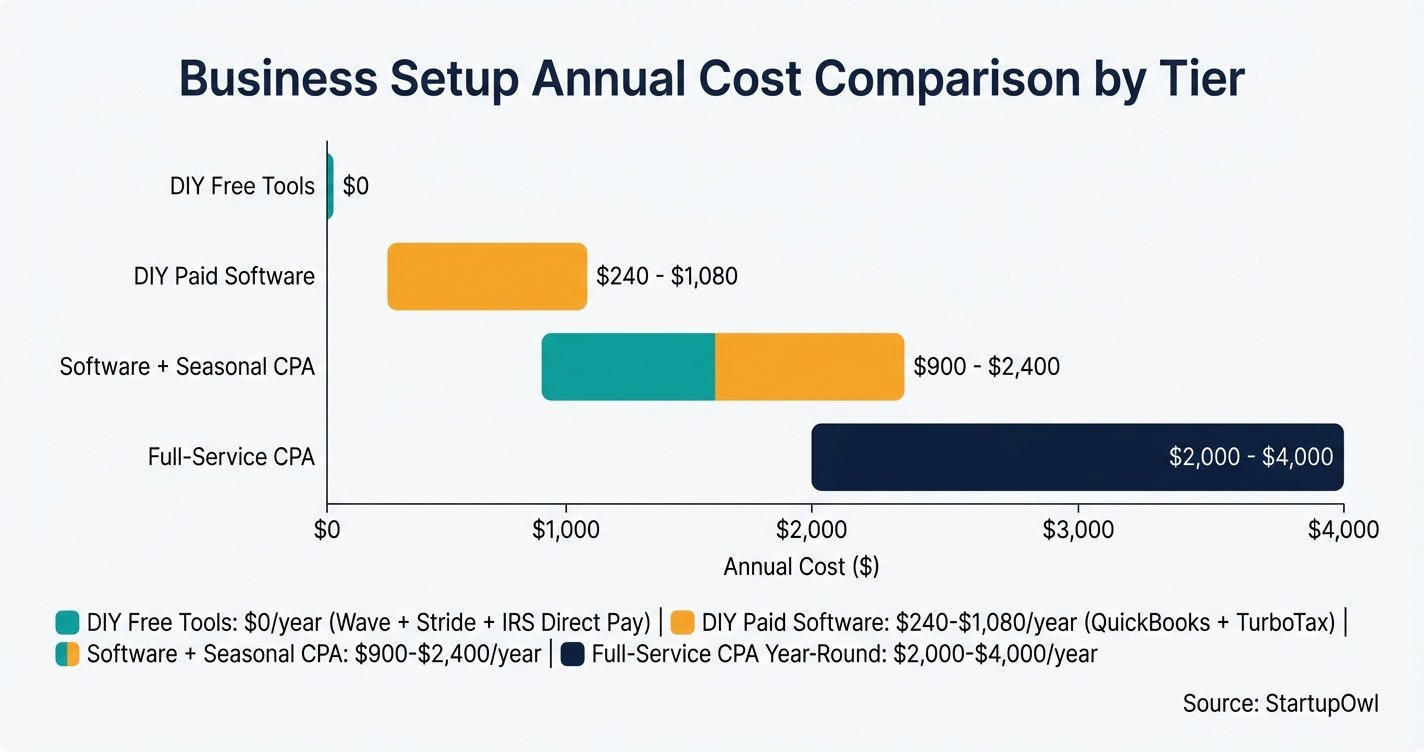
The real cost is not the software or the CPA fee. It is the deductions you miss. On $100,000 in net self-employment income, you owe approximately $14,130 in self-employment tax alone (that is 15.3% of 92.35% of your net earnings, as of 2026). Every dollar you deduct reduces that liability directly. Missing $10,000 in legitimate deductions means overpaying by roughly $1,500 to $3,700 in combined income and SE tax.
The cost drivers that determine your total spending are your business structure (sole prop vs. S-Corp vs. partnership), the number of deduction categories you claim, whether you need a CPA or can DIY, and how organized your records are before tax time. Messy books trigger a surcharge at 78% of firms, averaging $166.
Free Options
You can track and claim every deduction on this page for $0 if you are willing to put in the time. Here is exactly how.
- Bookkeeping with Wave (free accounting software with invoicing, expense tracking, and basic reporting).
- Mileage tracking with Stride (free GPS-based mileage log accepted by the IRS).
- Receipt storage with Google Drive or your phone's camera. The IRS accepts digital photos of receipts.
- Tax filing through IRS Free File if your AGI is below $84,000, or by manually completing Schedule C on paper.
- Quarterly payments through IRS Direct Pay (free, instant confirmation, no enrollment required).
The trade-off is time. DIY bookkeeping and filing takes 3 to 8 hours per month once you are up and running, plus 10 to 20 hours for the annual tax return. If your time is worth more than $50/hour, paid tools or a CPA may actually cost less.
Paid Tiers
Here is what you get at each price point for tracking and filing your deductions.
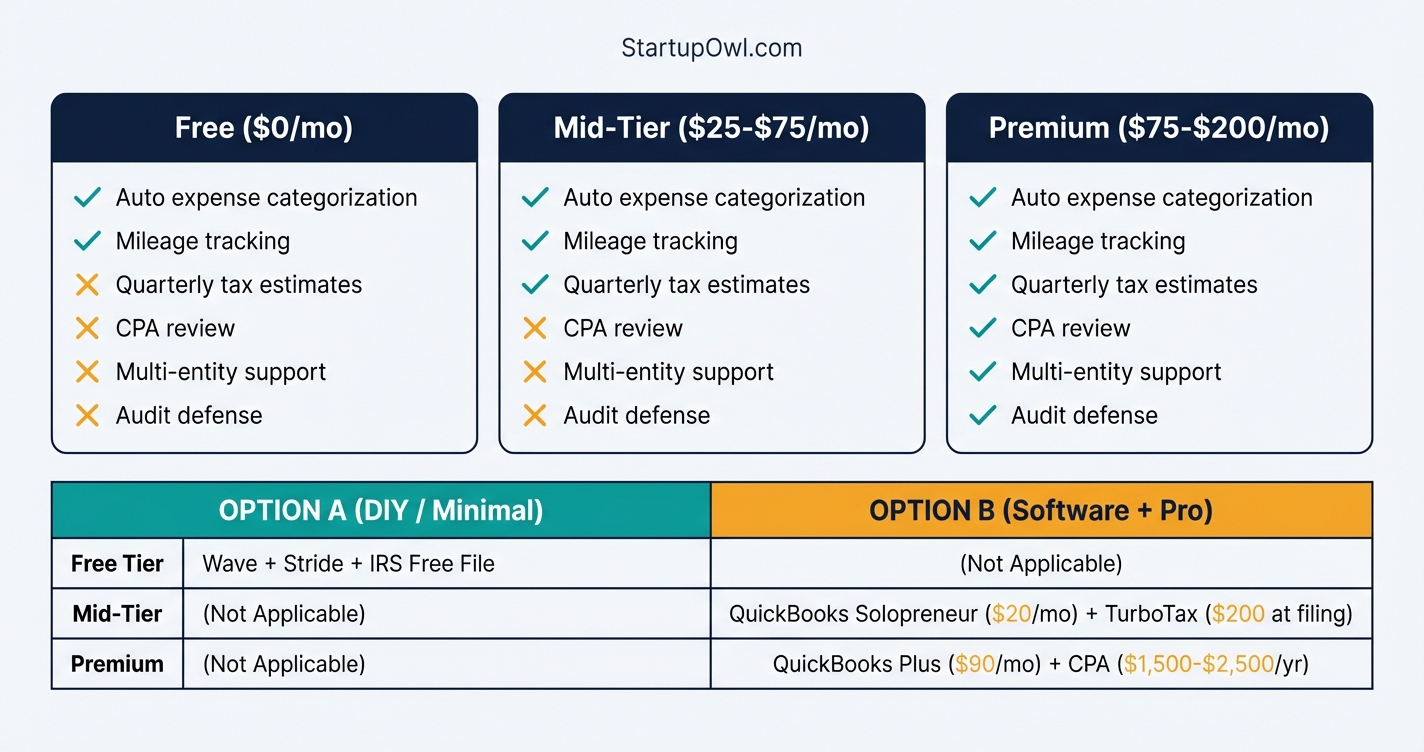
$0 to $25/month (DIY with basic software)
- Wave or QuickBooks Solopreneur handles expense categorization and basic tax estimates.
- You file your own return using TurboTax or TaxSlayer ($60 to $139 at filing time).
- Best for solo freelancers with fewer than 50 transactions per month and simple Schedule C filings.
$25 to $75/month (mid-tier software plus seasonal CPA)
- QuickBooks Simple Start or Essentials ($30 to $65/month) with automatic bank feeds and categorization.
- Hire a CPA only at tax time. That averaged $192 to add a Schedule C to your personal return.
- Best for sole proprietors or single-member LLCs earning $50,000 to $150,000 per year.
$75 to $200/month (full-service bookkeeping and CPA)
- QuickBooks Plus or Xero with a dedicated bookkeeper ($200 to $500/month).
- Year-round CPA relationship for tax planning and filing ($1,500 to $3,500/year).
- Best for S-Corps, partnerships, or businesses with employees, inventory, or multiple revenue streams.
How to Save
Here are 6 specific strategies to reduce what you spend on tracking and filing your tax deductions while maximizing what you save.
- Use QuickBooks Solopreneur at $20/month instead of hiring a year-round bookkeeper. It auto-categorizes transactions and estimates quarterly taxes. That replaces $200 to $500/month in bookkeeping fees for most solo businesses.
- Batch your CPA work. Hire a CPA only for annual filing and one mid-year tax planning session. Two to three hours of CPA time, which averaged $151 to $180 an hour, costs less than a year-round retainer.
- Maximize the QBI deduction. If you are a sole proprietor, partnership, or S-Corp, you may deduct 20% of qualified business income (up to $201,775 single / $403,550 MFJ before phase-out, as of 2026). This single deduction can save $2,000 to $15,000+ depending on income.
- Elect S-Corp status when your net income exceeds $60,000. An S-Corp lets you pay yourself a reasonable salary and take remaining profit as distributions, which are not subject to the 15.3% SE tax. On $120,000 net income with a $60,000 salary, you save roughly $7,775 in SE tax, the gap between $16,955 on the full profit and the $9,180 in payroll tax on the salary. Consult a CPA first. See our LLC vs S Corp tax comparison for details.
- Buy annual software plans instead of monthly. QuickBooks and most tools offer 10 to 20% discounts for annual billing. On a $30/month plan, that saves $36 to $72/year.
- Use Section 179 to front-load equipment deductions. Instead of depreciating a $10,000 laptop and equipment purchase over 5 years, expense it all in year one. The 2026 limit is $2,560,000. Even a $5,000 purchase in the 22% bracket saves $1,100 immediately.
When to Upgrade
Start with free tools. Upgrade when you hit any of these triggers.
- Your annual revenue crosses $50,000. At this point, the potential tax savings from better deduction tracking (and a CPA review) outweigh the cost of paid software and professional help.
- You have more than 100 transactions per month. Manual categorization in a spreadsheet or free tool starts eating 5+ hours per month. QuickBooks or Xero auto-categorization pays for itself in time saved.
- You hire your first employee or contractor. Payroll tax withholding, 1099 filing, and W-2 obligations add complexity that requires payroll software ($40 to $80/month) and possibly a CPA.
- Your net self-employment income exceeds $60,000. This is the threshold where an S-Corp election can save you $3,000 to $10,000+ per year in SE tax. A CPA consultation ($300 to $500) to model this is well worth it.
- You receive an IRS notice or get selected for audit. At this point, you need a CPA or Enrolled Agent for representation. Audit defense services run $1,500 to $5,000, but the cost of going it alone can be far higher.
Full Cost Breakdown
| Item | Cost Range | Notes |
|---|---|---|
| Accounting Software (deduction tracking) | QuickBooks Solopreneur auto-categorizes expenses and estimates quarterly taxes; Wave is free but lacks mileage tracking. | |
| Tax Filing Software (DIY) | Free File limited to simple returns. Self-employed filers typically need the Premium tier or higher. | |
| CPA Tax Preparation | National averages from the National Society of Accountants study of the 2020 and 2021 seasons, the most recent published. Expect more today. Hourly fees averaged $151 for a Schedule C and $180 for S corp work. 78 percent of firms surcharge disorganized records, averaging $166. | |
| Mileage Tracking App | IRS requires contemporaneous mileage logs. GPS-based apps satisfy this requirement automatically. | |
| Receipt Scanning and Storage | Digital receipts are IRS-accepted. Keep records for at least 3 years (7 years for property depreciation). | |
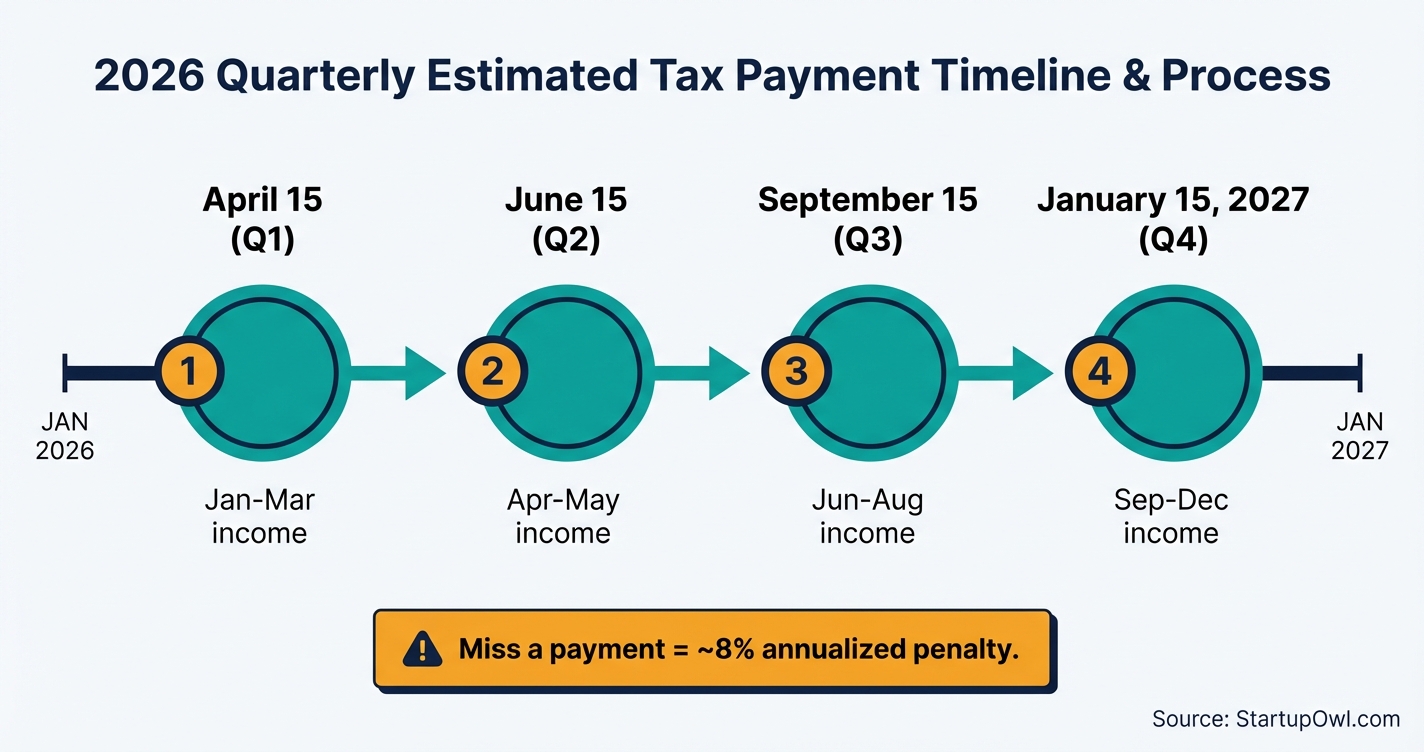
| Quarterly Estimated Tax Payments (processing) | Payments due April 15, June 15, Sept 15, and Jan 15. Missing a payment triggers roughly 8% annual penalty. |
By Business Type
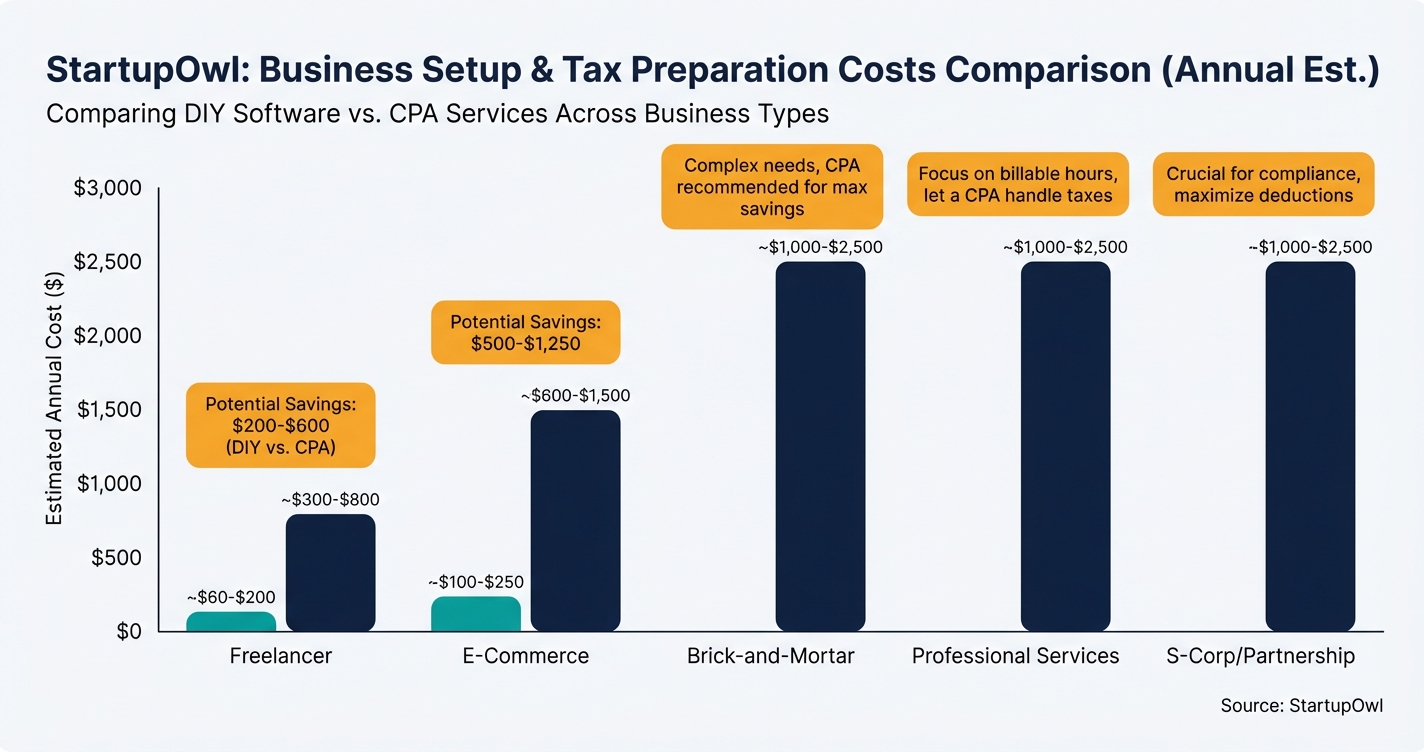
Your deduction profile and filing costs vary significantly by business type. Here is a realistic breakdown.
Freelancer or Consultant (Schedule C)
- Primary deductions include home office ($1,500 simplified), software subscriptions, internet, phone, and mileage.
- Typical deduction total for a freelancer earning $75,000 is $8,000 to $15,000.
- Filing cost with DIY software runs $60 to $200. With a CPA, expect $300 to $800.
E-commerce Seller
- Add cost of goods sold (COGS), shipping materials, platform fees (Amazon, Shopify), product photography, and warehouse/storage rent.
- Section 179 applies to equipment like label printers, cameras, and packaging machines.
- Inventory tracking pushes you toward accounting software with inventory features ($50 to $90/month).
Brick-and-Mortar Retail or Restaurant
- Rent, utilities, employee wages, POS systems, food costs (for restaurants), signage, and business insurance premiums are all deductible.
- Meals for employees working overtime are 50% deductible. Customer-facing entertainment is not deductible.
- CPA costs run higher here, above the $192 Schedule C average, because payroll, sales tax and inventory each add work.
Professional Services (Law Firm, Medical Practice, Accounting Firm)
- Professional licensing fees, continuing education, malpractice insurance, and professional association dues are all deductible.
- The QBI deduction has income-based limits for specified service trades. Phase-out begins at $201,775 (single) for 2026.
- Most practices benefit from S-Corp election once net income exceeds $60,000 to $80,000.
S-Corp or Partnership
- Requires separate business tax return (Form 1120-S or 1065) with K-1s for each owner.
- Filing cost with a CPA jumps to a national average of $733 for a partnership return and $903 for an S corporation.
- Owner health insurance and retirement contributions flow through differently and require correct setup. See how to set up payroll for S-Corp owner payroll specifics.
Frequently Asked Questions
The home office deduction. The simplified method gives you $5 per square foot up to 300 sq ft ($1,500 max). The regular method based on actual expenses (mortgage interest, utilities, insurance prorated by square footage) often yields $3,000 to $6,000. You qualify if you use a dedicated space regularly and exclusively for business.
The last survey of preparer fees is the National Society of Accountants Income and Fees Study of the 2020 and 2021 seasons. It averaged $192 for a Schedule C, the form a sole proprietor attaches to a personal return, $733 for a partnership return and $903 for an S corporation return. Expect to pay more today. The National Association of Tax Professionals reported in 2025 that 83% of preparers raise fees every year or two, by 6 to 10%. And 78% of firms surcharge messy records, averaging $166.
Yes, business meals are 50% deductible when directly related to active business conduct. You must document the date, amount, business purpose, and who attended. Entertainment expenses (concerts, sporting events, country club dues) are not deductible at all.
The Qualified Business Income (QBI) deduction lets pass-through business owners (sole proprietors, S-Corps, partnerships) deduct 20% of qualified business income. For 2026, the income threshold before phase-out is $201,775 (single) or $403,550 (married filing jointly). Above those amounts, limits based on W-2 wages and property apply.
The four due dates for 2026 estimated tax payments are April 15, June 15, September 15, and January 15, 2027. You must pay if you expect to owe $1,000 or more after withholding and credits. Use IRS Direct Pay (free) or EFTPS (free) to submit payments.
The 2026 Section 179 limit is $2,560,000, with a phase-out beginning at $4,090,000 in total qualifying purchases. This applies to equipment, vehicles over 6,000 lbs GVWR, and off-the-shelf software placed in service during the tax year. Items under $2,500 can be expensed outright without filing Form 4562.
Yes. The IRS requires contemporaneous mileage logs (meaning you record them as trips happen, not retroactively). Use a GPS-based app like Stride (free) or MileIQ ($5.99/month). Without a log, the IRS will deny your entire vehicle deduction in an audit. The standard mileage rate changes annually, so confirm the current rate at IRS.gov.
Sources & References
- IRS: Self-Employment Tax (Social Security and Medicare Taxes)
- IRS: Estimated Taxes
- IRS: Publication 509 (2026) Tax Calendars
- IRS: Publication 946 How To Depreciate Property
- Section179.org: 2026 Section 179 Deduction Limits
- SSA: 2026 Social Security Wage Base ($184,500)
- TurboTax Online 2026-2026 Pricing
- QuickBooks Solopreneur Pricing
- NerdWallet: Estimated Tax Payments 2026-2026 Rules and Deadlines
About the Author
Editor, StartupOwl
Eliot leads StartupOwl's state data research. He maintains the site's fifty state records of LLC filing fees, annual costs, processing times, and small business grant programs, checking each figure against the state office that publishes it and logging the date it was verified. Based in New Jersey, he has spent his working life in and around small businesses, and he writes for the founder who wants the real number rather than the advertised one. Every figure under his byline traces to a named source, and when a state proves a number wrong, the correction is published, not buried.
Was this article helpful?
Questions about Small Business Tax Deductions Checklist
No comments yet. Ask the first question and a member of our team will answer.
Leave a comment