
Value-Based Pricing: How to Charge What Your Product Is Actually Worth
Value-based pricing can boost revenue by 5-10% over cost-plus methods. Learn the 6-step process, best tools, and real examples to price by customer value.

In This Article
- Key Takeaways
- Step-by-Step
- Cost Breakdown
- What Value-Based Pricing Actually Means (and Why Cost-Plus Leaves Money on the Table)
- 6 Steps to Implement Value-Based Pricing in Your Business
- Best Tools for Value-Based Pricing (With Real Prices)
- 5 Value-Based Pricing Mistakes That Cost You Revenue
- What to Do Next
- FAQ
$0–$599
Est. Cost
336 hours
Timeline
6
Total Steps
Some links in this guide are affiliate links, meaning StartupOwl may earn a small commission if you sign up through them. This doesn't affect our recommendations or the price you pay. We only recommend tools we've independently evaluated. See our full disclosure policy for details.
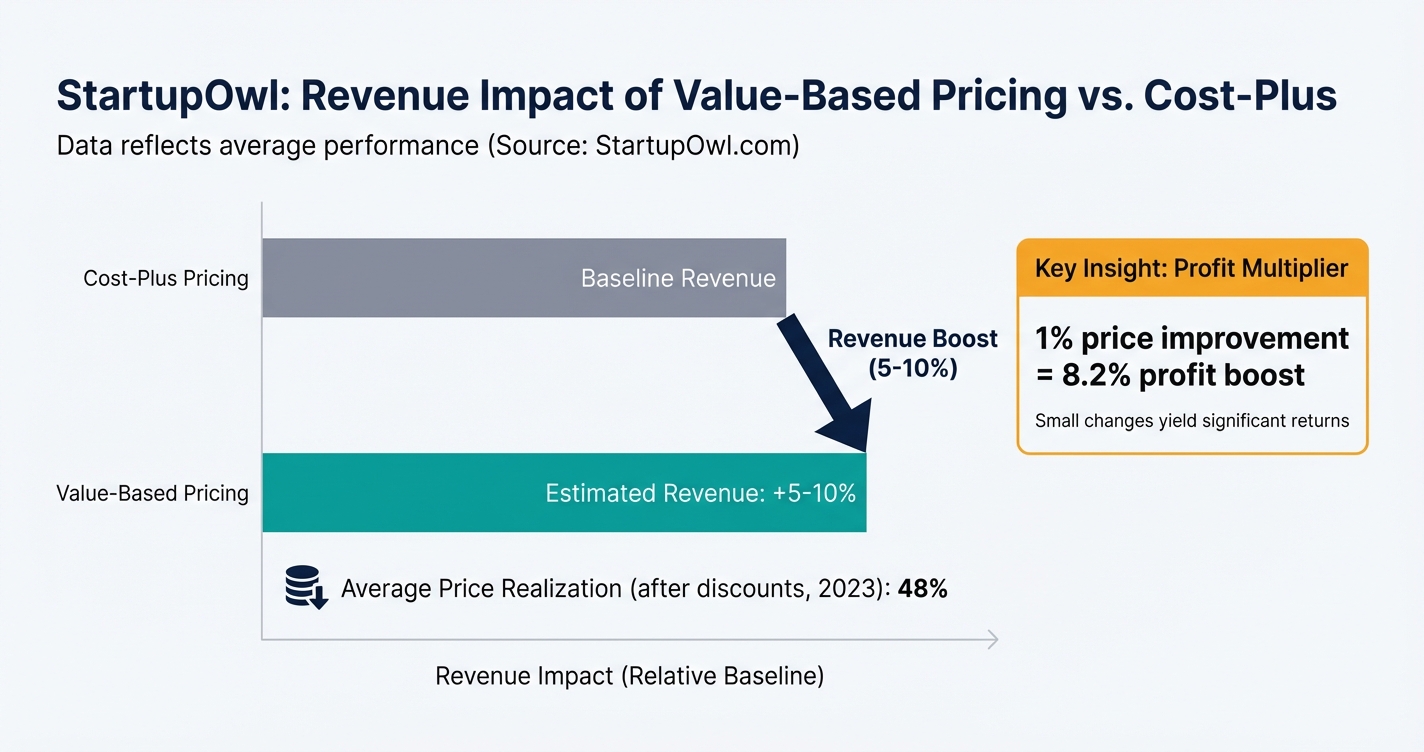
Yet most small businesses set prices once (usually with a cost-plus formula), rarely revisit them, and leave thousands in revenue on the table. Value-based pricing flips this by setting your price according to the outcomes and benefits your customers perceive, not your production costs. Companies that switch from cost-plus to value-based typically see 5-10% higher revenue (Phoenix Strategy Group).
This guide gives you a 6-step process to implement value-based pricing in your business, plus the specific tools and price points to make it work. If you're still using a simple markup model, check out our cost-plus pricing explainer to understand the trade-offs before you switch.
What Value-Based Pricing Actually Means (and Why Cost-Plus Leaves Money on the Table)
Value-based pricing sets your price based on the measurable benefits your customer receives, not on your internal costs. If your software saves a client $20,000/year in admin work, a cost-based model might charge $4,000 (development cost + 20% markup), but a value-based model could charge $8,000 and still leave the client with $12,000 in savings (Productive.io, 2026).
Cost-plus pricing has one advantage: simplicity. You add up costs, slap on a margin, and you're done. But it ignores what customers are actually willing to pay and assumes every customer values your product equally. That disconnect is why researchers and practitioners "largely agree that value-based pricing leads to higher profits" (IMD Business School).
The "value stick" framework (developed at Harvard Business School) maps four components: willingness to pay (WTP), price, cost, and willingness to sell (WTS). Your profit margin lives in the gap between price and cost. Value-based pricing works by pushing your price closer to the customer's WTP ceiling while keeping enough "customer delight" (the gap between WTP and price) to maintain loyalty (HBS Online).
6 Steps to Implement Value-Based Pricing in Your Business
The process below works for SaaS products, service businesses, e-commerce stores, and B2B companies. Each step builds on the previous one, so don't skip ahead. Budget 6-10 weeks for the full implementation if you're doing it for the first time.
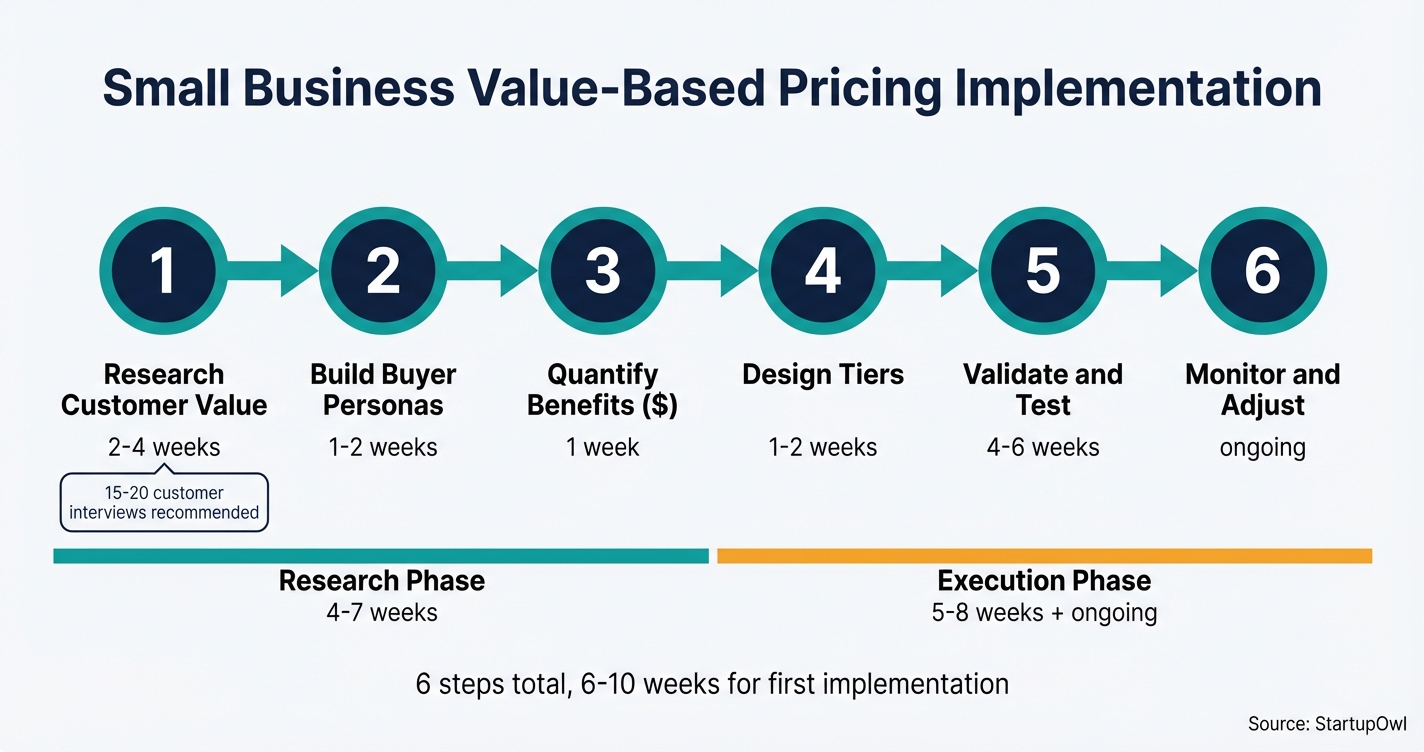
Step 1: Research what your customers actually value. Interview 15-20 customers using Van Westendorp price sensitivity surveys or conjoint analysis. Your goal is to find the 2-3 outcomes that drive their purchase decision and attach a dollar figure to each one. If your product saves 20 hours/month at $25/hour, that's a $500/month value anchor (Productive.io).
Step 2: Build buyer personas by value segment. Group customers by how they perceive value, not just demographics. Tag these segments in your CRM (our CRM for startups guide covers free options). Each persona should include their top pain point, expected outcome, price sensitivity, and alternatives they're considering.
Step 3: Quantify benefits in dollar terms. Every benefit needs a number. A consulting engagement that generates $50,000 in new revenue for your client sets the value ceiling. Your price sits between your cost floor and that ceiling. Model different price points with our pricing calculator.
Step 4: Design tiered pricing. Create 3-4 tiers where each adds measurable value. Place an anchor at the top tier so mid-tier options feel proportionate. Most customers (about 60-70%) should land in the middle. Use billing platforms like Chargebee (free up to $250K) or Stripe Billing (0.7% of volume) to manage tiers.
Step 5: Validate with real customers. Test new pricing with a small cohort or A/B test on your pricing page. If prospects say "sold" immediately, you're too cheap. Raise incrementally until you hear hesitation, then stop (Bessemer Venture Partners). Run each test for at least 30 days.
Step 6: Monitor and adjust quarterly. Track price realization (actual collected vs. list price), margins, churn, and satisfaction. In 2023, companies realized only 48% of price increases after discounts and rebates (Phoenix Strategy Group). If your realization rate drops below 70%, your team is discounting too aggressively. Re-evaluate every 6 months as your product evolves.
Best Tools for Value-Based Pricing (With Real Prices)
You don't need expensive enterprise software to start. Here are the tools that matter most at each stage, with current pricing as of 2026-2026.
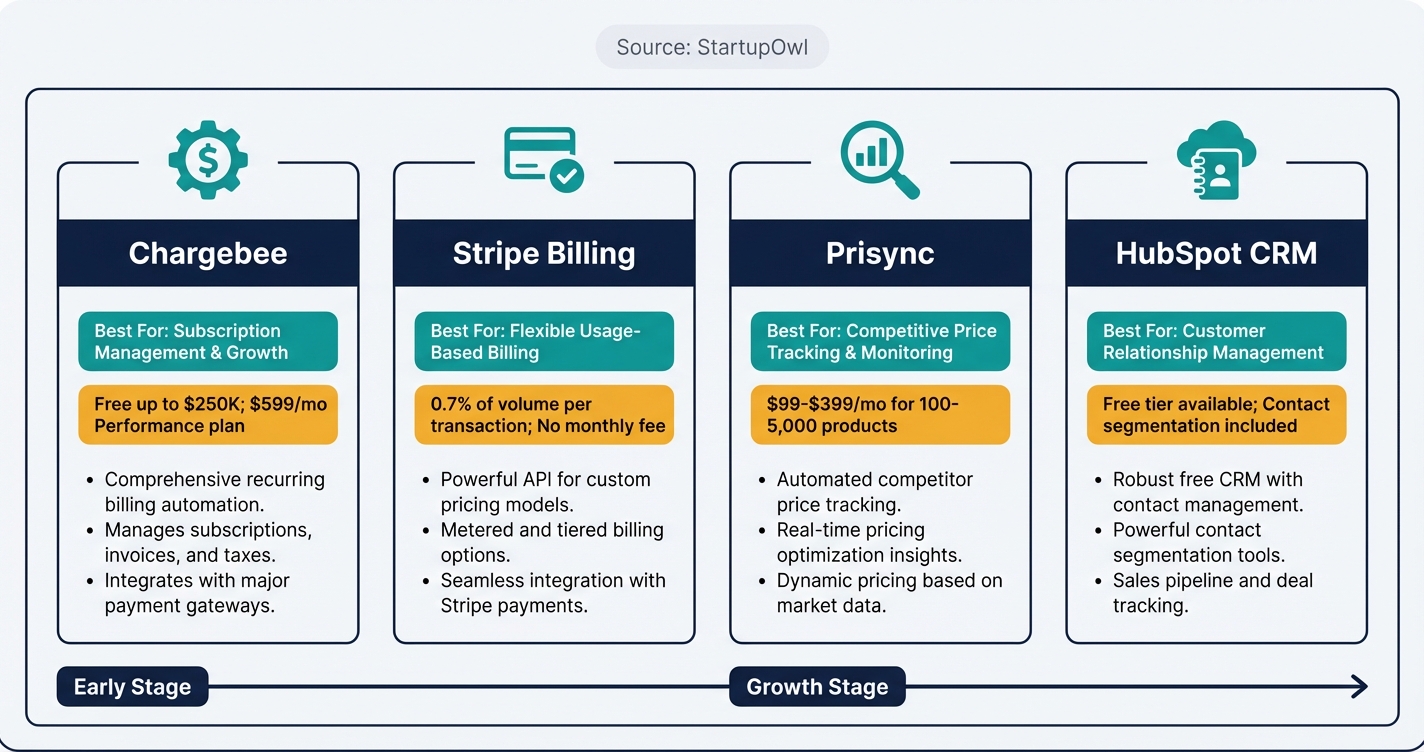
For subscription and tiered billing: Chargebee offers a free Starter plan for businesses processing up to $250,000 in lifetime billing, with a 0.75% overage fee after that threshold. The Performance plan costs $599/month (billed annually) for up to $100K in monthly billing. Chargebee was named a Leader in the 2026 Gartner Magic Quadrant for Recurring Billing Applications, making it a strong pick for SaaS pricing.
Stripe Billing takes a different approach with pay-as-you-go pricing at 0.7% of billing volume (no monthly minimum). It supports subscription, usage-based, and hybrid billing models. There are no setup fees or recurring platform fees, which makes it ideal for early-stage businesses with unpredictable volume. Keep in mind that payment processing fees (2.9% + $0.30 per card transaction) are charged separately.
For competitive price monitoring (e-commerce): Prisync has 3 pricing tiers ranging from $99 to $399/month as of 2026 (G2). The entry plan tracks up to 100 products with unlimited competitors. Capterra reviewers report "retailers catch a 20% increase in sales" on average. All plans include a 14-day free trial with no credit card required.
For customer research and segmentation: HubSpot CRM (free tier) lets you segment contacts by custom properties, which is exactly what you need for buyer personas in Step 2. For more on choosing the right platform, see our CRM for startups guide.
For enterprise price optimization: Pricefx delivers AI-powered pricing for manufacturing and distribution companies, with reported average margin improvements of 8.4% within 12 months. Pricing requires a sales conversation. Vendavo similarly targets complex B2B environments. Both are overkill for businesses under $10M in annual revenue.
Value-Based Pricing Tool Costs at a Glance
| Type / Provider | Rate | Notes |
|---|---|---|
| Chargebee Starter | $0/month | Free up to $250K lifetime billing. 0.75% overage after threshold. |
| Chargebee Performance | $599/month (annual) | Up to $100K monthly billing. Smart dunning, multi-currency support. |
| Stripe Billing (pay-as-you-go) | 0.7% of billing volume | No monthly fee. Card processing (2.9% + $0.30) charged separately. |
| Prisync (Professional) | $99 - $399/month | 100 to 5,000 products. 14-day free trial. Unlimited competitors. |
| HubSpot CRM (Free) | $0/month | Contact segmentation, custom properties, deal tracking. No time limit. |
| Pricefx (Enterprise) | Contact sales | AI-powered. Average 8.4% margin improvement in 12 months. Manufacturing/distribution focus. |
5 Value-Based Pricing Mistakes That Cost You Revenue
1. Guessing willingness to pay instead of measuring it. Most founders default to cost-plus because "asking for more feels awkward" (Bessemer Venture Partners). Without data from 15-20 customer interviews or a Van Westendorp survey, your prices are based on gut feeling, which almost always means undercharging.
2. Setting prices once and never revisiting them. Value perceptions shift with market conditions, new competitors, and product improvements. Re-evaluate your pricing every 6 months. Companies with a structured review cadence capture significantly more of their price increases.
3. Creating too many tiers or options. More than 4 pricing tiers causes decision paralysis. Stick to 3 tiers with a clear "recommended" option for most buyers. If you need flexible structures for your small business marketing plan, simplify on the pricing page and offer customization in sales conversations.
4. Failing to communicate value before showing the price. If the first thing a prospect sees is the dollar amount, you've lost the framing battle. Lead every sales conversation and landing page with measurable outcomes. Show the ROI calculation before the price tag. Build this into your brand-building strategy from day one.
5. Discounting too aggressively during sales. In 2023, companies realized only 48% of their price increases after factoring in discounts, rebates, and promotions. Every 10% discount you offer wipes out your value positioning. If you must offer incentives, use limited-time trials or bonus features instead of straight price cuts.
Quick-Start Pricing Test You Can Run This Week
Pick your top-selling product or service. Interview 5 current customers and ask: "If this product disappeared tomorrow, what would you do instead, and how much would that cost you?" The answer reveals your true value ceiling. If the average replacement cost is 3-5x your current price, you're significantly undercharging. Pair this insight with our pricing calculator to model a new price point before your next quarterly review.
What to Do Next
Start with Step 1: schedule 5 customer interviews this week using the replacement-cost question above. Then map your findings into buyer personas and draft a 3-tier pricing structure. Use Chargebee's free Starter plan or Stripe Billing to test new tiers with a small customer cohort before rolling out broadly.
For the bigger picture on how pricing fits into your growth strategy, read our small business marketing plan guide and explore guerrilla marketing ideas to drive demand without overspending on ads. If you sell online, our Shopify vs Squarespace comparison covers which platform gives you the most pricing flexibility.
Step-by-Step Process
- 1
Research what your customers actually value
Interview 15-20 customers across your key segments. Use Van Westendorp price sensitivity surveys or conjoint analysis to measure willingness to pay, not just satisfaction. Your goal is to identify the 2-3 specific outcomes (time saved, revenue gained, risk reduced) that drive their purchase decision.
Document the financial impact of each benefit. If your product saves a client 20 hours per month at $25/hour, that's $500/month in measurable value. That number becomes your pricing anchor.
Tips
- Ask 'What would happen if you couldn't use this product tomorrow?' to surface value drivers.
- Segment interview responses by company size, use case, and budget to spot patterns.
- Record exact dollar amounts customers mention when describing savings or gains.
Common Mistakes
- Asking 'How much would you pay?' directly, which almost always generates lowball answers.
- Interviewing only happy customers instead of including prospects who chose a competitor.
- 2
Build detailed buyer personas by value segment
Group your customers by how they perceive value, not just demographics. One SaaS segment might prioritize time savings while another cares most about data security. Use your CRM (see our CRM for startups guide) to tag and track these segments.
Each persona should include the customer's top pain point, the measurable outcome they expect, their price sensitivity level, and the alternatives they're considering. This data feeds directly into how you structure your tiers.
Tips
- Limit yourself to 3-4 personas to keep pricing manageable.
- Map each persona to a specific tier you'll create in Step 4.
Common Mistakes
- Creating personas based on assumptions instead of interview data from Step 1.
- 3
Quantify your product's benefits in dollar terms
Convert every key benefit into a specific dollar amount. If your consulting service helps a client close $50,000 in new revenue, that's your value ceiling. Your price should sit between your cost floor and that ceiling. Use our pricing calculator to model different price points against your costs.
In B2B, build a one-page "value calculator" you can share with prospects. Show them the ROI before they see the price. For example, a software feature that cuts annual admin costs by $20,000 could justify a $8,000 annual subscription, because the client still saves $12,000.
Tips
- Use before-and-after metrics from existing clients to build your value calculator.
- Include both hard ROI (dollars saved) and soft ROI (hours freed, risk reduced) in your pitch.
- Test your value calculator with 3-5 prospects before using it in sales conversations.
Common Mistakes
- Skipping the cost floor calculation, which means you might price below break-even for some customers.
- Overstating benefits without case study evidence to back them up.
- 4
Design tiered pricing that maps to customer value
Create 3-4 pricing tiers where each higher tier adds measurable, justified benefits. Place an anchor price at the top tier to make mid-tier options feel proportionate. Most of your customers (typically 60-70%) should land in the middle tier, which should be your most profitable.
Each tier should solve a different persona's top pain point. For a SaaS product, that might be feature access limits. For a service business, it could be turnaround time or number of deliverables. Make the upgrade path obvious by tying each tier to a specific business outcome.
Tips
- Name your tiers after outcomes (e.g., 'Starter,' 'Growth,' 'Scale') instead of features.
- Include a free or low-cost entry tier to reduce conversion friction.
Common Mistakes
- Creating too many tiers (5+), which causes decision paralysis and slows sales cycles.
- 5
Validate your pricing with real-world tests
Test your new prices with a small group before a full rollout. Run an A/B test on your pricing page, offer the new pricing to new customers only, or do live price negotiation with 10-15 prospects. If customers say "sold" immediately, you're priced too low. Raise incrementally until you hear "we have to think about that," then stop before it becomes a blocker.
Track conversion rate, average deal size, and churn rate at each price point. You need at least 30 days of data per test to draw meaningful conclusions. Revisit your pricing strategy every 6 months as your product and market evolve.
Tips
- Grandfather existing customers at their current price during testing to avoid churn spikes.
- Document every price test result for future reference, even the failed experiments.
Common Mistakes
- Making pricing decisions based on fewer than 20 data points or under 2 weeks of testing.
- 6
Monitor, adjust, and communicate price changes
Track price realization (what you actually collect after discounts vs. list price), profit margins, customer satisfaction, and churn. In 2023, companies realized only 48% of their price increases on average after factoring in discounts, rebates, and promotions. If your realization rate is below 70%, your sales team is discounting too aggressively.
Set up quarterly pricing reviews. Use your ChatGPT for small business toolkit to analyze customer feedback patterns and spot when perceived value shifts. When you raise prices, lead with the new value you've added, not the cost increase.
Tips
- Give existing customers 60-90 days notice before any price increase.
- Train your sales team to justify prices with value language, not cost language.
- Track competitor pricing shifts monthly to keep your positioning accurate.
Common Mistakes
- Setting prices once and never revisiting them, which leaves revenue on the table as your product improves.
Cost Breakdown
| Item | Cost Range | Notes |
|---|---|---|
| Customer research (DIY surveys) | $0 - $200 | Free tools like Google Forms or Typeform free tier. Budget for gift cards if incentivizing survey responses. |
| Professional conjoint analysis study | $3,000 - $15,000 | Only necessary for complex B2B products with multiple segments. Agencies like Simon-Kucher specialize in this. |
| CRM for segmentation | $0 - $99/month | HubSpot free CRM or Zoho CRM free tier work for basic segmentation. Paid tiers add automation. |
| Subscription billing platform | $0 - $599/month | Chargebee Starter is free up to $250K in billing. Stripe Billing charges 0.7% of billing volume on pay-as-you-go. |
| Competitive price monitoring (e-commerce) | $99 - $399/month | Prisync plans range from $99/mo (100 products) to $399/mo (5,000 products) as of 2026 per G2. |
Frequently Asked Questions
Value-based pricing means you set your price based on what your customer believes the product is worth, not what it costs you to make. If your software saves a client $20,000/year and costs you $2,000 to deliver, you price it at $8,000-$10,000 (capturing a share of the value created) rather than $2,400 (cost + 20% markup).
Cost-plus pricing starts with your expenses and adds a fixed margin. Value-based pricing starts with the customer's perceived benefit and works backward. The practical difference is revenue: value-based pricing typically generates 5-10% more revenue because it captures a share of the value you create instead of just covering costs. See our cost-plus pricing guide for a detailed comparison.
Yes, and it's often easier for small businesses because you can interview customers directly. You don't need expensive software to start. A free CRM (like HubSpot), 15-20 customer interviews, and a 3-tier pricing page are enough. The key requirement is that your product solves a specific, measurable problem. Commodity products with many identical competitors are harder to price this way.
Review pricing every 6 months and make adjustments at least once a year. Major triggers for an off-cycle review include launching significant new features, entering a new customer segment, or seeing conversion rates drop below your baseline. Give existing customers 60-90 days notice before any increase.
At minimum, you need a survey tool (Google Forms is free), a CRM for segmentation (HubSpot free tier), and a billing platform that supports tiers. Chargebee Starter is free up to $250K in billing, and Stripe Billing charges 0.7% of volume with no monthly fee. E-commerce sellers should add Prisync (from $99/month) for competitor price monitoring.
Value-based pricing is a poor fit for commodity products with many identical alternatives and minimal differentiation. If customers can easily switch to 10 other suppliers offering the exact same thing, perceived value gets compressed toward cost. It also requires ongoing customer research, so if you're pre-revenue with no customers to interview, start with cost-plus pricing and switch to value-based once you have data.
Some links on this page are affiliate links. If you sign up for a service through them, we may earn a commission at no extra cost to you. This does not influence our rankings.
Sources & References
- Revenue Management Labs: Value-Based Pricing and Profit Impact
- Phoenix Strategy Group: How Value-Based Pricing Boosts Revenue Growth
- Productive.io: What Is Value Based Pricing (2026 Guide)
- HBS Online: A Beginner's Guide to Value-Based Strategy
- IMD Business School: Obstacles to Implementing Value-Based Pricing
- Simon-Kucher: Value-Based Pricing Strategy
- Bessemer Venture Partners: The AI Pricing and Monetization Playbook
- Digital Applied: Pricing Strategy Optimization Revenue Guide 2026
- Chargebee Pricing Plans
- Stripe Billing Pricing
- Prisync Pricing (G2)
- Intuit: Value-Based vs Cost-Plus Pricing
- Capterra: Prisync Reviews and Pricing
About the Author
Editor, StartupOwl
Eliot leads StartupOwl's state data research. He maintains the site's fifty state records of LLC filing fees, annual costs, processing times, and small business grant programs, checking each figure against the state office that publishes it and logging the date it was verified. Based in New Jersey, he has spent his working life in and around small businesses, and he writes for the founder who wants the real number rather than the advertised one. Every figure under his byline traces to a named source, and when a state proves a number wrong, the correction is published, not buried.
Was this article helpful?
Questions about Value-Based Pricing
No comments yet. Ask the first question and a member of our team will answer.
Leave a comment