
How to Price a Service: A Practical Framework for Freelancers and Small Business Owners
Learn how to price a service using 4 proven models. The average U.S. freelancer charges $48/hour, but the right framework can double your effective rate.

$0–$50
Est. Cost
60 minutes
Timeline
5
Total Steps
Some links on this page are affiliate links, which means StartupOwl may earn a small commission if you sign up through them. This does not affect our recommendations or the price you pay. We only recommend tools we have researched and believe are genuinely useful for small businesses. Our editorial opinions are our own.
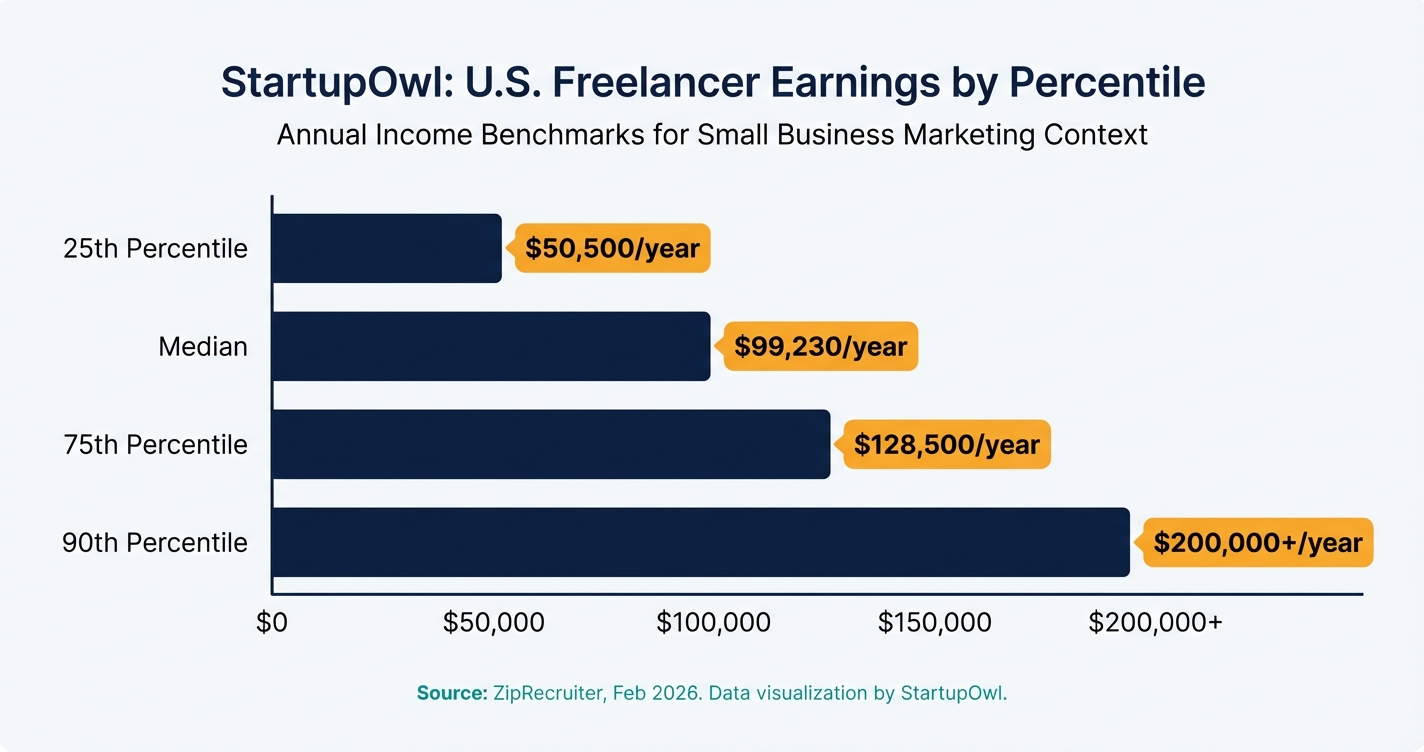
The average U.S. freelancer earns $47.71 per hour according to ZipRecruiter (as of February 2026), but that number hides a massive range. The 25th percentile earns around $50,500/year, while the 90th percentile pulls in $200,000+. The difference is not always skill; it is almost always pricing strategy.
Most freelancers set their rate once, based on a gut feeling or what a competitor charges on Upwork, and never revisit it. This guide gives you a repeatable framework you can use to set (and raise) your prices with confidence, whether you sell design, marketing, consulting, development, or any other service.
If you are still working on the broader business strategy behind your service, start with our small business marketing plan template to make sure your pricing fits your overall growth goals.
Why Your Pricing Model Matters More Than Your Hourly Rate
Cost-plus pricing (adding a markup to your costs) is the most common approach for new freelancers because it is simple. You calculate your costs, add a margin, and you have a price. But as Stripe's pricing guide explains, cost-plus pricing ignores what your customer is willing to pay and locks you into a markup rather than asking what the work is worth.
Value-based pricing flips that question. Instead of starting with your costs, you start with the outcome the client gets. A marketing consultant who generates $50,000 in new revenue for a client can justify a $5,000-$10,000 project fee, even if the work only took 20 hours. That is an effective rate of $250-$500/hour, which hourly billing would never capture. Companies that adopt value-based pricing consistently outperform on profitability because value varies more than cost.
The four models you will evaluate in this guide are hourly, project-based (flat fee), value-based, and productized packages (defined tiers with fixed pricing). Each has a place depending on your experience level, your niche, and how well you can demonstrate measurable results. Our cost-plus pricing explainer covers the markup method in detail if you want to compare.
How to Price Your Service in 5 Steps
Follow these steps in order. Each one builds on the previous, and skipping the first two is the most common reason freelancers underprice their work.
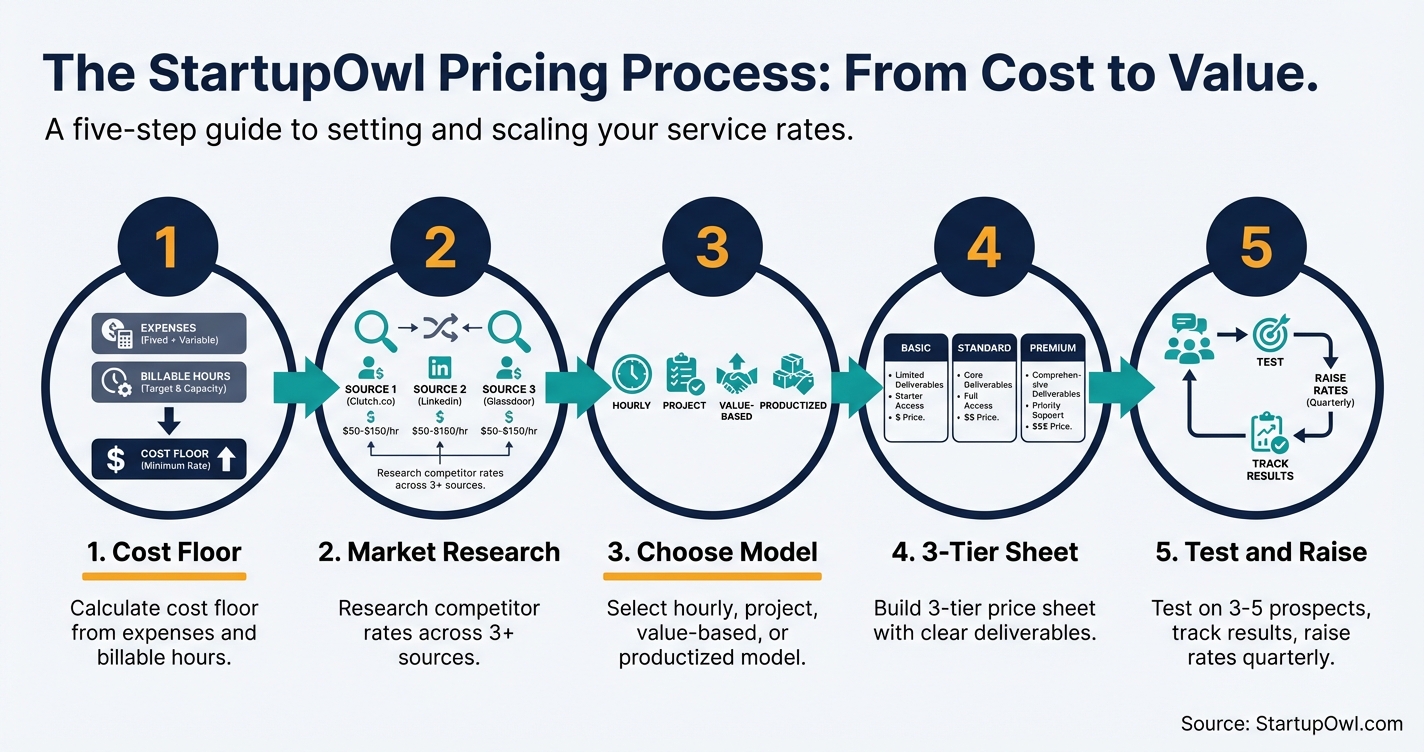
Step 1: Calculate your personal cost floor. Add your monthly business expenses, taxes (budget 25-30% of gross for self-employment tax in the U.S.), and living costs. Divide by your realistic billable hours per month. Most freelancers can bill 80-120 hours out of a 160-hour work month because admin, marketing, and invoicing eat the rest.
Step 2: Research what the market pays. Upwork's 2026 rate data shows writers at $15-$40/hr, web developers at $15-$50/hr, and digital marketers at $15-$45/hr. Enterprise clients pay 40-100% more than small businesses for the same service, so always segment your research by client type.
Step 3: Choose your pricing model. Hourly works when you are new and scope is unclear. Project-based rewards efficiency but needs tight scope agreements. Value-based delivers the highest margins if you can prove results. Productized packages (3-tier offers) simplify your sales process and help you scale. For more on how AI tools can help you draft proposals faster, see our ChatGPT for small business guide.
Step 4: Build a 3-tier price sheet. Anchor your middle tier at your ideal price. Set Tier 1 at 50-60% of that, and Tier 3 at 150-200%. Name each tier after outcomes ("Launch", "Growth", "Scale") rather than metals. List deliverables and exclusions clearly.
Step 5: Test, track, and raise. Quote your new pricing to 3-5 real prospects. Keep a log of what you quoted, whether they accepted, and your actual effective hourly rate after the project. If everyone says yes instantly, you are too cheap. Raise rates every 3-6 months as you collect results and testimonials.
Tools That Help You Price, Quote, and Invoice
You do not need expensive software to price your service correctly, but the right tools save hours on quoting and invoicing, and they help you track profitability over time.
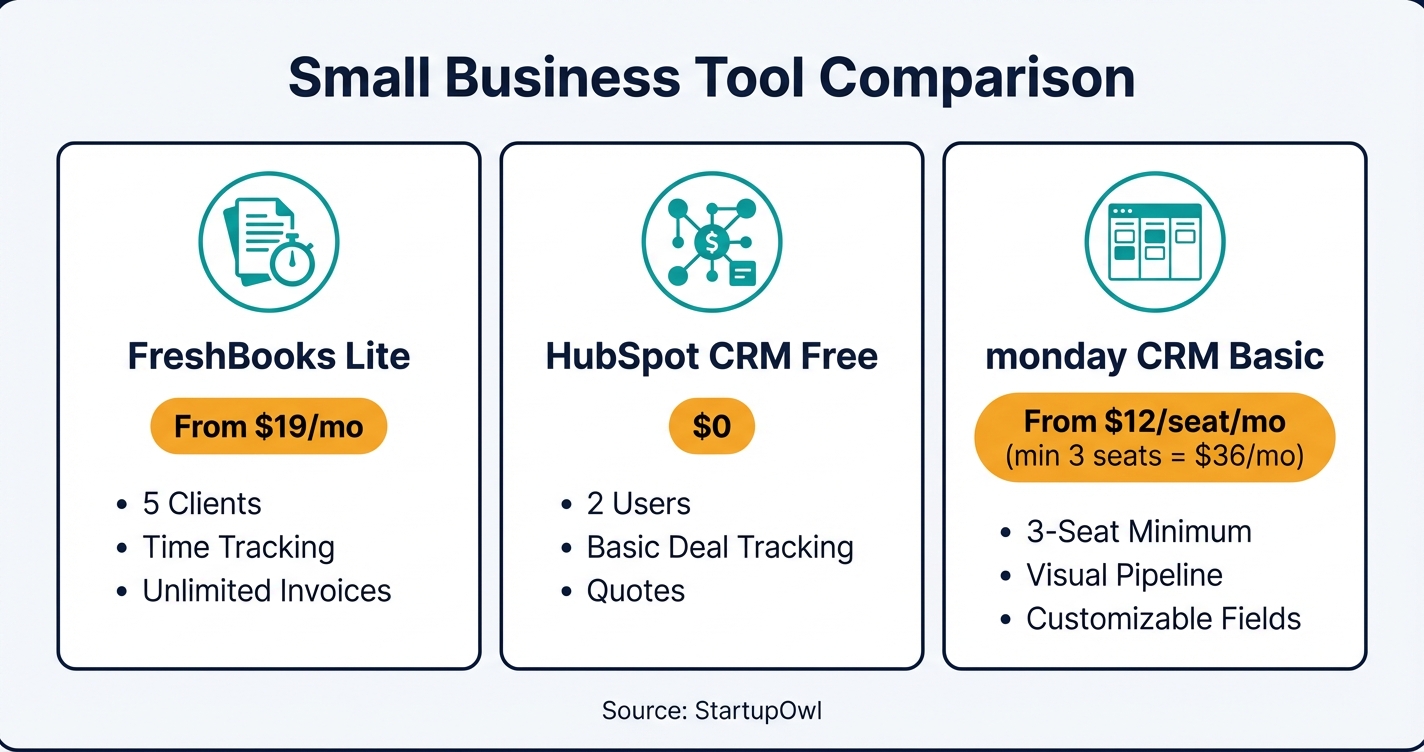
FreshBooks is the go-to invoicing tool for freelancers. The Lite plan starts at $19/month (as of 2026) and covers up to 5 billable clients with unlimited invoices, time tracking, and expense management. The Plus plan at $43/month raises the client cap to 50 and adds automated late-payment reminders, proposals, and retainer billing. If you are a solo freelancer just starting out, Lite is enough. Upgrade to Plus once you pass 5 active clients.
HubSpot's free CRM gives you deal tracking, a basic quote tool, and pipeline management for up to 2 users at no cost. The Sales Hub Starter plan starts at $20/seat/month and removes HubSpot branding from your quotes and emails. For a deeper look at CRM options for early-stage businesses, read our CRM for startups guide.
monday CRM is a strong pick if you have a small team. The Basic plan starts at $12/seat/month (billed annually, minimum 3 seats) and includes unlimited pipelines. The Pro plan at $28/seat/month adds quoting, invoicing, and sales forecasting. Keep in mind the 3-seat minimum means your actual starting cost is $36/month, not $12.
If you prefer to keep things free, a simple Google Sheet with columns for client, quoted price, deliverables, hours spent, and effective hourly rate does the job. Use our pricing calculator to model different rate scenarios before you quote.
Service Pricing Models at a Glance
| Type / Provider | Rate | Notes |
|---|---|---|
| Hourly | $25-$150+/hr typical | Simple to start. Caps income at available hours. Best for new freelancers or undefined scope. |
| Project-Based (Flat Fee) | $500-$25,000+ per project | Rewards efficiency. Requires tight scope control. Best for clearly defined deliverables. |
| Value-Based | 5-20% of client outcome value | Highest margin potential. Needs proof of results. Best for experienced consultants. |
| Productized Packages (3-Tier) | Varies by tier | Simplifies sales with defined deliverables. Best for scaling beyond hourly. Recommended long-term model. |
| Retainer | $1,000-$10,000+/month | Predictable recurring revenue. Requires clear monthly boundaries. Best for ongoing advisory or support. |
5 Pricing Mistakes That Cost You Thousands
1. Starting from scratch on every quote. Without a pricing framework, you second-guess every number, quote inconsistently, and spend hours per proposal. Build a template and adapt it, not reinvent it.
2. Racing to the bottom on platforms. On Upwork, the average effective fee rate for freelancers is 12-13% of earnings (based on 2026 user surveys from Upwork). If you also lower your rates to compete, you can lose $6,000-$10,000 annually on a $50,000 income between fees and underpricing.
3. Forgetting hidden costs of freelancing. Health insurance, self-employment tax (roughly 15.3% in the U.S.), software subscriptions, and unpaid vacation time can eat 30-40% of your gross revenue. If you do not factor these into your rate, you are subsidizing your clients.
4. Leading with price in the sales conversation. When you send your rate before understanding the client's problem, price becomes the primary decision factor. Scope the project, understand the desired outcome, and then present pricing tied to the value you deliver.
5. Never raising your rates. Your skills improve, your speed increases, and your portfolio grows, but your price stays the same as day one. Set a calendar reminder to review your rates every 90 days. Grandfathering existing clients at old rates for one project cycle is fine, but always move forward. If you need help building out the marketing side of your service business, check out our guerrilla marketing ideas for low-budget client acquisition.
Model Your Rates Before You Quote
Use the StartupOwl pricing calculator to test different hourly rates, project fees, and package structures. Input your costs, desired income, and billable hours to see exactly what you need to charge. It is free and takes about 5 minutes.
What to Do This Week
Open a spreadsheet and calculate your personal cost floor today. Then research 3 competitor rates in your niche using Upwork's rate guide and ZipRecruiter. Draft a 3-tier price sheet by Friday and test it on your next prospect. For the broader picture on how pricing fits into your growth plan, explore our building a brand guide and our free marketing plan template.
Pricing is not a one-time decision. It is a skill you sharpen with every project, every client conversation, and every data point you collect. Start now, track everything, and raise your rates when the evidence supports it.
Step-by-Step Process
- 1
Calculate your personal cost floor
Add up every monthly expense your business must cover: rent, software subscriptions, health insurance, taxes (set aside 25-30% of gross income for self-employment tax), and your personal living costs. Divide that total by the number of billable hours you can realistically work each month (most freelancers land between 80 and 120 billable hours out of a 160-hour month).
The result is your absolute minimum hourly rate. If you charge less than this, you lose money on every project. Write this number down and never go below it.
Tips
- Include software costs you forget about: domain renewal, email hosting, and accounting tools like FreshBooks (starting at $19/month).
- Add a 15-20% buffer for unexpected expenses like equipment repairs or slow-paying clients.
Common Mistakes
- Forgetting to include self-employment tax (roughly 15.3% in the U.S.) when calculating your floor rate.
- Counting every working hour as billable when admin, marketing, and invoicing typically consume 30-40% of your time.
- 2
Research what the market actually pays
Check at least three sources before setting your rate. Upwork's rate guide shows freelance writers earn $15-$40/hour, graphic designers $15-$35/hour, and digital marketers $15-$45/hour as of 2026. ZipRecruiter puts the overall U.S. freelance average at $47.71/hour.
Ask 2-3 peers in your niche what they charge. Most freelancers will share if you offer your own numbers first. Also check what lost prospects ended up paying elsewhere; that data tells you where the market ceiling sits for your service.
Tips
- Enterprise clients typically pay 40-100% more than small businesses for the same service, so segment your research by client type.
- Filter by your region: North American freelancers average $56/hour, while Central American freelancers average $18/hour according to Payoneer data.
Common Mistakes
- Using platform rates (like Upwork listings) as your only benchmark; those are often suppressed by global competition and platform fees of 0-15%.
- 3
Choose your pricing model
You have four primary models to pick from. Hourly pricing is the simplest starting point, but it caps your income at your available time and penalizes you for getting faster. Project-based (flat fee) rewards efficiency, but requires tight scope control or scope creep can erase your margin.
Value-based pricing ties your rate to the outcome you create for the client (revenue generated, costs saved), not the hours you spend. It consistently produces higher profit margins, but you need confidence and proof of results. Productized packages (also called offer-based pricing) bundle your work into defined tiers: an intro offer, a core package, and a premium option with additional support.
For most freelancers starting out, begin with hourly or project-based to build a track record, then shift to value-based or productized within 6-12 months. Read our cost-plus pricing guide for a deeper comparison of markup-based approaches.
Tips
- Include a scope creep clause in every contract, regardless of model. It protects you from unpaid tasks and keeps pricing transparent.
- Test your new model on one client before switching everything over. Track whether your effective hourly rate goes up or down.
Common Mistakes
- Sticking with hourly pricing permanently because it feels safe, even after you have a strong portfolio and repeat clients.
- Setting project fees by estimating hours and multiplying by your hourly rate instead of pricing based on client value.
- 4
Build a 3-tier price sheet
Create three packages with clear deliverables, fixed pricing, and specific outcomes. Your Tier 1 (Starter) should solve one specific problem at a price that feels low-risk for the client. Tier 2 (Core) delivers your flagship solution and is where most clients should land. Tier 3 (Premium) includes everything plus priority support, faster turnaround, or ongoing advisory.
Anchor your middle tier at the price you actually want to earn. Price Tier 1 at roughly 50-60% of Tier 2, and Tier 3 at 150-200% of Tier 2. This structure uses anchoring psychology to make Tier 2 look like the obvious choice. Write up each package with exactly what is included and what is not included, so there is no room for misinterpretation.
Tips
- Name your tiers after outcomes (like 'Launch', 'Growth', 'Scale') instead of generic labels (Bronze, Silver, Gold).
- Always list what is excluded from each tier to prevent scope creep and set clear expectations upfront.
- Revisit your tier pricing every 3-6 months as you collect testimonials and case studies that justify higher rates.
Common Mistakes
- Making all three tiers too similar in scope so the client always picks the cheapest option.
- 5
Test, track, and raise your rates
Quote your new pricing on your next 3-5 prospects and track the results. Record the price you quoted, whether they accepted, and any objections. If every prospect says yes immediately, your prices are too low. If nobody accepts, you have a positioning or communication problem (not necessarily a price problem).
Keep a simple pricing log: project name, quoted price, actual hours spent, and effective hourly rate after the work is done. This log becomes the data you need to raise rates confidently. Successful freelancers raise rates every 3-6 months as they build experience, improve efficiency, and collect proof of results.
Tips
- Ask prospects who did not buy why they passed. That feedback is the most valuable pricing data you will ever get.
- Grandfather existing clients at old rates for 1-2 projects, then move them to new pricing with 30 days notice.
Common Mistakes
- Never tracking actual hours on flat-fee projects so you have no idea if your pricing is profitable.
- Dropping your price at the first sign of hesitation instead of reframing the value you deliver.
Cost Breakdown
| Item | Cost Range | Notes |
|---|---|---|
| Service pricing strategy | $0 | Frameworks in this guide are free to implement. |
| FreshBooks (invoicing and time tracking) | $19-$70/month | Lite plan covers 5 clients; Plus plan covers 50 clients at $43/month. |
| Proposal and contract tool (e.g., HoneyBook, Dubsado) | $0-$40/month | Free options available via Google Docs templates. |
| CRM for tracking prospects | $0-$20/month | HubSpot free CRM works for up to 2 users. Starter is $20/seat/month. |
Frequently Asked Questions
Start with hourly if the project scope is unclear or you have fewer than 5 completed projects in your portfolio. Hourly billing protects you from scope creep because you get paid for every hour worked. Once you have enough data to estimate project timelines accurately (usually after 5-10 similar projects), switch to project-based or productized pricing to stop capping your income at your available hours.
If every prospect says yes without any pushback, you are almost certainly underpriced. A healthy close rate for service businesses is roughly 30-50%. If you are closing 80%+ of proposals, raise your rates by 15-25% on your next quote and track how the acceptance rate shifts. Also compare your effective hourly rate (total fee divided by actual hours worked) against the U.S. freelance average of $47.71/hour from ZipRecruiter.
Value-based pricing means you set your fee based on what the result is worth to the client, not how long the work takes you. If you redesign a website and it generates $100,000 in new revenue for the client over a year, charging $10,000 (10% of that value) is reasonable, even if the work only took you 30 hours. It requires you to understand the client's business goals and have proof (case studies, testimonials) that you can deliver.
Review your rates every 90 days and raise them when you have new evidence: completed projects, measurable client results, testimonials, or simply higher demand than you can handle. A good rule of thumb is to increase by 10-20% per adjustment. Give existing clients 30 days notice before applying new rates. Freelancers who raise rates every 3-6 months often earn 2-3x more within 2 years compared to those who never adjust.
You do not need software to set your prices, but invoicing tools like FreshBooks (starting at $19/month) help you track billable time, send professional quotes, and see which projects are actually profitable. The time-tracking data alone helps you calculate your true effective hourly rate on flat-fee projects. If you are billing fewer than 5 clients, a Google Sheets template works fine as a starting point.
Some links on this page are affiliate links. If you sign up for a service through them, we may earn a commission at no extra cost to you. This does not influence our rankings.
Sources & References
- ZipRecruiter Freelance Salary Data (February 2026)
- Upwork: How Much Do Freelancers Make in 2026
- Upwork: Freelancer Service Fee Documentation
- Stripe: Cost-Based and Value-Based Pricing
- FreshBooks Pricing Page
- HubSpot Sales Hub Pricing
- monday CRM Pricing
- Clockify: Average Hourly Rates for Freelancers and Consultants (2026)
- RecurPost: Freelance Marketing Rates Guide 2026
- Matt Olpinski: Pricing for First-Time Freelancers
- Ken Yarmosh: 10 Models to Price Your Freelance Services in 2026
About the Author
Editor, StartupOwl
Eliot leads StartupOwl's state data research. He maintains the site's fifty state records of LLC filing fees, annual costs, processing times, and small business grant programs, checking each figure against the state office that publishes it and logging the date it was verified. Based in New Jersey, he has spent his working life in and around small businesses, and he writes for the founder who wants the real number rather than the advertised one. Every figure under his byline traces to a named source, and when a state proves a number wrong, the correction is published, not buried.
Was this article helpful?
Questions about How to Price a Service
No comments yet. Ask the first question and a member of our team will answer.
Leave a comment