
Best Website Builder for Small Business in 2026. Squarespace vs Wix vs WordPress vs Shopify

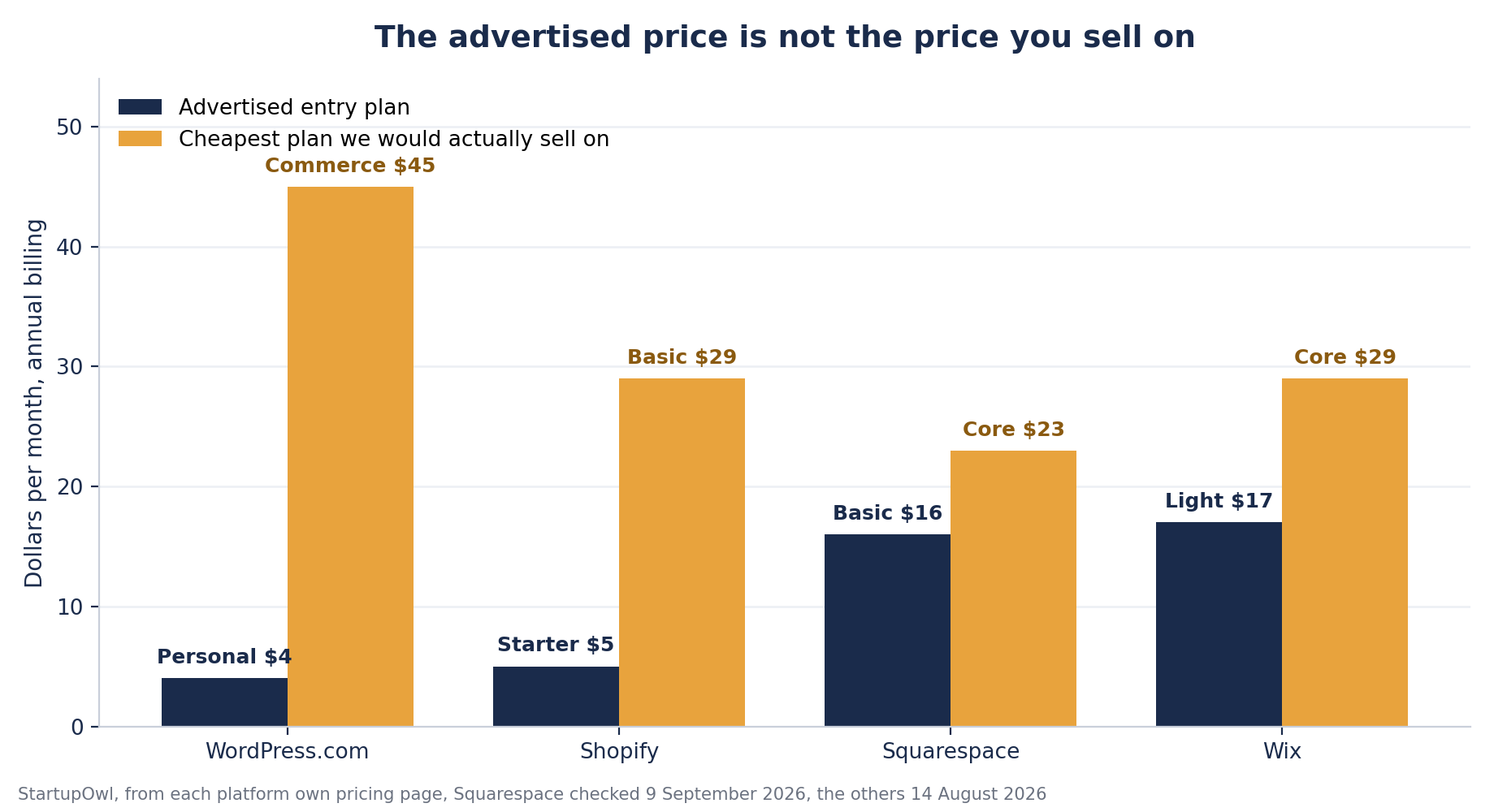
- Entry prices sit low. On annual billing you pay $4 a month for WordPress.com Personal, $16 for Squarespace Basic, $17 for Wix Light, and $29 for a Shopify store that can really sell. We checked Squarespace at the source on 9 September 2026 and the other three on 14 August 2026.
- Two of the four are free to start. Wix and WordPress.com both run real free plans. Squarespace gives you 14 days. Shopify gives 3 days, then $1 a month for 3 months.
- Watch the sales cut. Squarespace Basic keeps 2 percent of store sales and 7 percent of digital sales. WordPress.com Personal keeps 8 percent of payments. One tier up removes most of it.
- Shopify wins if you sell. Budget for apps though. Email, reviews and reporting are paid add ons, and they often run $50 to $150 a month on top of the plan.
- The cheap plan is rarely the plan you want. WordPress.com jumps from $4 to $45 for a store. Squarespace lands at $23, Wix and Shopify at $29.
Shopify is our top pick of these four. Most founders who land here end up selling something, and a platform that ships a working store on day one beats bolting commerce on later. Not selling products? Then the pick changes. Take Wix for a flexible business site with booking built in, WordPress.com for the lowest running cost, and Squarespace when looks decide it. We checked every price at the source, Squarespace on 9 September 2026 and the other three on 14 August 2026. On annual billing that is $4 a month for WordPress.com Personal, $16 for Squarespace Basic, $17 for Wix Light, and $29 for a Shopify store that can really sell.

Shopify
$29
Shopify is the only one of these four built to sell rather than to publish. A full store runs $29 a month on annual billing, with payments, shipping labels and 8,000+ apps included. It carries you from the first sale to a real brand, which is why it takes the top spot.
Get StartedSide-by-Side Comparison
| Feature | ||||
|---|---|---|---|---|
| Starting Price | $5/month (Starter) | $0/month (Free plan) | $17/month (Light) | $16/month (Basic) |
| Free Plan | No | Yes | Yes | No |
| Free Trial | 3 days + $1/mo for 3 months | N/A (free plan available) | 14-day money-back guarantee | 14 days |
| Store transaction fee, entry plan | None on Shopify Payments, 2% on other gateways | 8% on Personal | Not published | 2% store, 7% digital |
| Ease of Use Score | 4.5/5 | 3.2/5 | 4.5/5 | 4.2/5 |
| G2 Rating | 4.4/5 | 4.4/5 | 4.2/5 | 4.4/5 |
| Number of Integrations | 8,000+ apps | 59,000+ plugins (Business plan) | 300+ apps | Smallest library of the four |
| Customer Support | 24/7 chat and email | Email support on paid plans | 24/7 live chat and email | 24/7 email, weekday live chat |
| Best For | E-commerce and online stores | Bloggers and content-heavy sites | Small businesses and beginners | Creatives and portfolio sites |
| Annual Discount | 25% off annual plans | Monthly pricing shown is annual | Included (annual billing only) | Up to 36% off |
| Overall Rating | 3.8/5 | 3.7/5 | 3.6/5 | 3.5/5 |
Full Reviews
Fast to launch and loaded with features, but third-party app costs and payment gateway penalties quietly inflate what you actually pay.
Pros
- You can go from zero to a live, functioning store in under an hour with no developer and no server management.
- The app ecosystem is massive. If you need a feature, someone has probably built an app for it.
- Built-in POS syncs inventory across online and physical retail locations without third-party middleware.
- Platform stability is excellent. Shopify handles traffic spikes during flash sales without performance issues, backed by $11.6 billion in 2026 revenue and serious infrastructure investment.
Cons
- Essential features like email marketing, advanced reporting, and product reviews require paid third-party apps that add $50 to $150/mo to your real costs.
- Using any payment gateway other than Shopify Payments triggers a penalty fee of up to 2.0% per transaction on the Basic plan.
- Customer support quality drops sharply for anything beyond basic questions. Account holds and payment freezes get bot responses and slow escalation, backed by a 1.5 Trustpilot score from 4,325 reviews.
- No open-source access. You cannot modify backend code, host on your own server, or migrate easily if you outgrow the platform's constraints.
Free plan, or $4/mo billed yearly
A free plan and unmatched blogging tools. Plugins now open at $4 a month, not $25, though the block editor takes getting used to.
Pros
- A genuinely usable free plan that lets you publish a blog immediately with 1 GB of storage and SSL included.
- Paid plans start at $4 a month billed annually, and that entry tier now includes plugin installs, theme uploads and a free domain for the first year.
- No bandwidth or traffic caps on paid plans, so your site will not go down or charge overages during traffic spikes.
- Fully managed hosting means zero server maintenance, automatic security updates, and pre-installed SSL on every site.
Cons
- Server level access is the real Business plan wall. SFTP, WP-CLI and Git start at $25 a month, which is $300 a year.
- The block editor takes practice. Budget 30 minutes before you feel comfortable, longer if you have never used WordPress.
- The free domain lasts one year. A .com then renews at $13 a year, and checkout does not make that obvious.
Over 2,000 templates and a genuinely easy drag-and-drop editor, but slow page speeds and hidden costs add up fast.
Pros
- Easy drag-and-drop editor with pixel-level control and over 2,000 templates.
- AI site generator builds a full multi-page site in under 5 minutes.
- Hosting, SSL, backups, and 24/7 live chat come with every paid plan.
- Free plan available. Test the editor before you pay a cent.
Cons
- You cannot switch templates. A redesign means a full rebuild from scratch.
- Pages load slowly from heavy JavaScript. You get zero server-side control.
- No plan includes business email. Domain privacy costs an extra $9.90 a year.
- Trustpilot reviewers flag hard auto-renewal billing and refund trouble.
Polished templates and a fast setup from $16 a month billed yearly, but the Basic plan keeps 2% of store sales and 7% of digital sales, and there is no phone support.
Pros
- Templates are beautiful and mobile responsive out of the box, and they look professional without any design skills.
- All-in-one hosting, SSL, domain, and CDN means zero server management. You sign up and your site is live.
- Built-in analytics, SEO tools, and blogging features cover 90% of what a small business or portfolio site needs without third-party plugins.
- iOS app rated 4.6 and Android app rated 4.2 make on-the-go site management practical.
Cons
- Transaction fees on the Basic plan (2% on store sales, 7% on digital products and memberships) are a hidden cost. They can easily exceed the monthly subscription itself.
- No phone support at all. Live chat is weekdays only, 4am to 8pm ET.
- The extension marketplace is the smallest of the major builders by a wide margin. If Squarespace does not have a feature built in, you are mostly out of luck.
- The grid-based editor prevents freeform design. You cannot drag elements wherever you want.
- The free domain and the Google Workspace inbox are first-year promotions that become paid renewals. Campaigns is paid from day one.
How to Choose
You are an e-commerce founder selling physical products online.
Shopify is built for stores. You get POS, abandoned cart recovery and 8,000+ apps out of the box. Basic runs $29 a month on annual billing, with unlimited products and 24/7 support from day one.
You are a service business needing booking and lead generation.
Wix Core includes the Bookings platform outright. That is $29 a month, and it covers scheduling, staff calendars and paid appointments with no second subscription. Shopify's plans page lists no native booking at all, so a service business there buys an app to do its main job.

You are a content creator or blogger.
WordPress.com is built for publishing. The free plan gets you online with 1 GB of storage. Paid plans start at $4 a month on annual billing, and the blogging tools are the most mature of the four.

You are a solopreneur on a tight budget.
Shopify Starter costs $5 a month. You get checkout, payment processing and link in bio tools, with no website to build. The catch is the cut, Starter keeps 5 percent of each sale, so it suits testing demand rather than running real volume.
You are a local brick-and-mortar business wanting an online presence.
Squarespace makes local businesses look expensive. Basic runs $16 a month and includes SSL, hosting, a free first year domain and built in SEO tools. No design skill needed.

You need a website for a small team of 5 or more collaborators.
WordPress.com Business suits teams. It runs $25 a month and opens up 59,000+ plugins. User roles and granular permissions come built in, which is what a team of five or more actually needs.
You are migrating from another platform and need flexibility.
Migration is where WordPress.com earns its keep. Business at $25 a month unlocks 59,000+ plugins and custom themes. Outgrow the hosted version and you can move to self hosted WordPress.org with little friction.
You need a visual portfolio or photography website.
Squarespace owns visual work. Its designer grade templates are the best in class here. The Fluid Engine editor and built in galleries make it the pick for creatives and photographers.
How We Evaluated These Tools
We judged all four on six things. Entry price and total cost at each tier. Free plan quality. G2 and Capterra scores from verified users. Ease of setup for a founder with no tech background. App and integration count. Support that actually answers. Where we could, we built sample sites and contacted support ourselves.
We re-checked pricing at the source on 14 August 2026, and Squarespace again on 9 September 2026. The August figures for Squarespace were not US prices. This page quoted Basic, Core and Plus at $19, $29 and $49 when the US list prices are $16, $23 and $39, so we have put them back. Pricing pages serve different currencies by country, which is worth knowing before you trust any comparison. Treat one with no recent date on it with care. Every price here is the annual billing rate unless we say otherwise. We also counted the costs that sit outside the plan fee, sales fees, domain renewals after year one, and the apps you end up needing.
We cross-checked our own scores against G2, the official pricing pages, and outside reviewers like Website Builder Expert and Tooltester. The G2 scores were re-pulled at source on 4 September 2026. All four held. Squarespace 4.4/5 from 1,137 reviews, Wix 4.2/5 from 1,889, WordPress.com 4.4/5 from 2,717, and Shopify 4.4/5 from 5,142. Those cover each full user base, not just small firms. Shopify's review count has passed 5,000 since our last reading and its score has not moved.
Who Should Be Reading This Comparison
This guide is for owners who need a website and do not want to hire a developer. That covers a lot of people. Sellers weighing Shopify against a Wix store. Service providers who need booking and contact forms. Bloggers hunting the lowest cost. Local firms that want to look polished. If you are picking your first business site, or moving off the one you have, you are in the right place.
None of the four suits every job. Skip them if you need a complex web app, a forum heavy membership site, or heavy custom backend logic. Self hosted WordPress.org with a developer fits better, or a niche tool like Kajabi for courses or Circle for communities. Past $1M a year in revenue, look at Shopify Plus or a headless setup. Below that, one of these four will do the job well.
The Top Three, and Where the Fourth Fits
Want three names rather than four? By our scores it is Shopify at 3.8 out of 5, WordPress.com at 3.7, and Wix at 3.6. Squarespace sits fourth at 3.5. Those scores come from the six criteria above and were last reviewed on 14 August 2026. The gap matters more than the order. Three tenths of a point covers all four. So the ranking is not the decision, what you are building is. Pick Shopify to sell physical products. Pick WordPress.com to publish cheaply. Pick Wix for a general business site that also takes bookings. Pick Squarespace when design decides it.
A Closer Look at Each Platform
Wix is the most flexible builder here. Its drag and drop editor gives you control down to the pixel, and the AI generator can build a full multi page site in five minutes. The free plan is good enough to test with. It does show Wix branding and a Wix subdomain. Paid plans open at $17 a month for Light on annual billing, which drops the branding and adds a custom domain. Core at $29 a month adds e-commerce, the Bookings platform and 50 GB of storage. That is the sweet spot for most growing firms. Wix advertises 2,000+ templates and puts 24/7 live chat on every paid plan.
Squarespace wins on looks. Its templates are the most refined of the four, and they hold up on mobile with no extra work. Basic opens at $16 a month on annual billing, with a free domain for year one, SSL and unlimited bandwidth. Basic caps you at 2 contributors. It also keeps 2 percent of store sales and 7 percent of digital and membership sales. Core at $23 a month drops the store fee to zero, and that is the upgrade most sellers actually need. Plus at $39 a month only earns its keep on digital goods, where it cuts Core's 5 percent digital fee to 1 percent. The extension library is the smallest of the four by a wide margin.
WordPress.com is the budget pick. Its free plan gives you 1 GB of storage and SSL, and you can publish a blog today at no cost. Personal at $4 a month adds a custom domain and kills the ads. That is a fraction of what Wix or Squarespace ask. The catch sits higher up. Third party plugins and custom themes need Business at $25 a month, and a real store needs Commerce at $45. The block editor also asks more of you than the visual builders do.
Shopify is the only one built to sell. Starter at $5 a month lets you sell through social and messaging apps with shareable product links. It is not a website, and it keeps 5 percent of each sale. A full store means Basic at $29 a month on annual billing, or $39 billed monthly. That buys unlimited products, 24/7 chat and Shopify's built in POS for in person sales. The catch is cost creep. Email, reporting and product reviews are paid apps, and they commonly add $50 to $150 a month. Use a gateway other than Shopify Payments and you pay another 2 percent per sale.
Still working out the strategy? Our guide to building a small business marketing plan can help you name the features you need before you pay for any of them.
The Key Differences That Actually Matter
Transaction fees never make the headline price. On a small store they can beat the subscription. Squarespace Basic at $16 keeps 2 percent of store sales and 7 percent of digital and membership sales. WordPress.com Personal at $4 keeps 8 percent of payments, falling to 2 percent on Business and zero on Commerce. Shopify takes no cut through Shopify Payments, adds 2 percent on other gateways, and keeps 5 percent on its $5 Starter plan. Wix publishes no platform sales fee at all. Put a number on it. A store doing $2,000 a month on Squarespace Basic hands over $40, more than twice what the plan costs.
Ease of setup is the biggest day one difference. Wix and Squarespace both use drag and drop, but Wix lets you place things freely while Squarespace holds you to a grid. Wix's AI builder can produce a working site in minutes. Squarespace's Blueprint AI does much the same, with a slightly steeper editor. WordPress.com asks for the most patience. Give the block editor half an hour. Shopify's admin is clean for managing products, and it was never built for content heavy pages.
Support quality varies a lot. Wix puts 24/7 live chat on every paid plan, which matters when something breaks at midnight. Squarespace answers email around the clock but limits chat to weekdays, 4am to 8pm ET. There is no phone line. WordPress.com includes email on paid plans and no live chat lower down. Shopify offers 24/7 chat and email, though Trustpilot reviewers say quality drops once a problem stops being simple.
Pricing clarity is where they split hardest. Squarespace and Wix look simple, then charge for domain renewals after year one and lift first year promo pricing at renewal. Shopify looks simplest of all and then doubles once apps and processing land. WordPress.com is the most honest at the bottom and the most confusing at $25, where features arrive that could sit lower down. Read the renewal line first. For more once your site is live, see our local SEO guide and our Google Ads for small business primer.
Templates deserve their own line. Squarespace's look the best, full stop. If presentation is your top priority, for a portfolio, a restaurant or a creative agency, it is hard to beat. Wix wins on volume with over 2,000 templates, though average design quality sits a step below. WordPress.com's free themes are plain and the good ones need a paid plan. Shopify's are tuned for product pages and win no design awards. For help making any template work harder, read our guide to building a brand.
When to Choose Each Platform
Choose Wix if you want range. It handles service firms, small stores, portfolios and content sites equally well. The free plan lets you test everything before paying, the AI builder gets you live fastest, and Bookings is included from Core rather than sold on the side.
Choose Squarespace if design is your first priority, for a portfolio, a creative agency or a brand led business. It also suits simple sites with light commerce. Sell anything and the Basic fees bite. Choose WordPress.com if you write for a living or want the lowest entry price. Its free plan and $4 Personal plan are unmatched for publishing. Choose Shopify if selling physical products is the business. Nothing here matches its depth on commerce, POS and multichannel selling.
So who wins overall. Shopify. The common version of this decision is a founder who will sell something, and Shopify is the only one of the four where selling is the product rather than a module bolted onto a site builder. If you are certain you will never take a payment, take Wix instead. Its free plan lets you try the whole editor for nothing. Either way, tools like ChatGPT for small business can write your copy once the builder is picked.
One more note for Shopify sellers. Sales can outrun your stock budget faster than you expect. Our Shopify Capital review and alternatives covers the funding routes built for that moment.
Frequently Asked Questions
Yes, for most beginners. Wix scores 4.5/5 for ease of use in our testing. Squarespace scores 4.2/5. Wix's freeform editor and AI builder get a site live faster with no technical skill at all. Squarespace's grid editor produces better looking results by default, but the curve is a little steeper.
WordPress.com is cheapest by a distance. It has a free plan, and paid plans open at $4 a month. Squarespace starts at $16 and Wix at $17, both billed annually. The catch on WordPress.com sits higher up. Plugins and custom themes need the $25 Business plan, which costs more than the Squarespace or Wix entry tiers. Squarespace was checked at the source on 9 September 2026, the other three on 14 August 2026.
Three of the four do. Squarespace Basic at $16 keeps 2 percent of store sales and 7 percent of digital and membership sales. WordPress.com Personal at $4 keeps 8 percent of payments, falling to 2 percent on Business and zero on Commerce. Shopify takes nothing through Shopify Payments, adds 2 percent on other gateways, and keeps 5 percent on its $5 Starter plan. Wix publishes no platform sales fee. Card processing sits on top of all of these.
Yes, and there is no time limit. Wix runs a free plan and asks for no credit card. It shows Wix branding, puts you on a wixsite.com subdomain, and limits your storage. You cannot connect a custom domain or take payments on it. To drop the branding and add your own domain you need Light at $17 a month on annual billing.
It depends on volume. Basic costs $29 a month on annual billing, and apps usually add another $30 to $50. If you sell fewer than 50 products and do not need deep inventory tools, Wix Core at $29 includes e-commerce with no extra app cost for the basics. Shopify earns its price when you need multichannel selling, POS or serious shipping tools.
Wix is the easiest. Its AI generator builds a full multi page site from a few questions in under five minutes, and you can then edit it by dragging. Squarespace and Shopify are beginner friendly too. WordPress.com's block editor takes the longest to learn. Shopify is simple for a product store and less intuitive for a general business site.
About the Author
Editor, StartupOwl
Eliot leads StartupOwl's state data research. He maintains the site's fifty state records of LLC filing fees, annual costs, processing times, and small business grant programs, checking each figure against the state office that publishes it and logging the date it was verified. Based in New Jersey, he has spent his working life in and around small businesses, and he writes for the founder who wants the real number rather than the advertised one. Every figure under his byline traces to a named source, and when a state proves a number wrong, the correction is published, not buried.
Was this article helpful?
The information on this page is for educational and informational purposes only and should not be considered professional advice. Product features, pricing, and availability may vary. Always compare multiple options and verify details directly with the provider before making a decision.
Questions about Best Website Builder for Small Business in 2026. Squarespace vs Wix vs WordPress vs Shopify
No comments yet. Ask the first question and a member of our team will answer.
Leave a comment