
LLC First-Year Costs Explained (The Real Total)
Your LLC filing fee is just the start. Here's every first-year cost you'll actually pay, from state fees to registered agents to franchise taxes.

Most LLCs cost $50 to $1,900 in their first year. The state filing fee averages $132, registered agent services run $0 to $300/year, and annual reports add $0 to $500. California adds an $800 franchise tax, and New York tacks on $200 to $2,000+ in mandatory newspaper publication costs.
Your total first-year LLC cost ranges from $50 to $1,900 depending on your state, with most founders spending between $500 and $1,000 when you add up every required and commonly used service. The state filing fee alone averages $132 nationwide, but that number hides the registered agent fees, annual reports, franchise taxes, and (in some states) mandatory publication requirements that inflate your real total. This guide breaks down every line item so you can build an accurate first-year budget.
Cost Overview
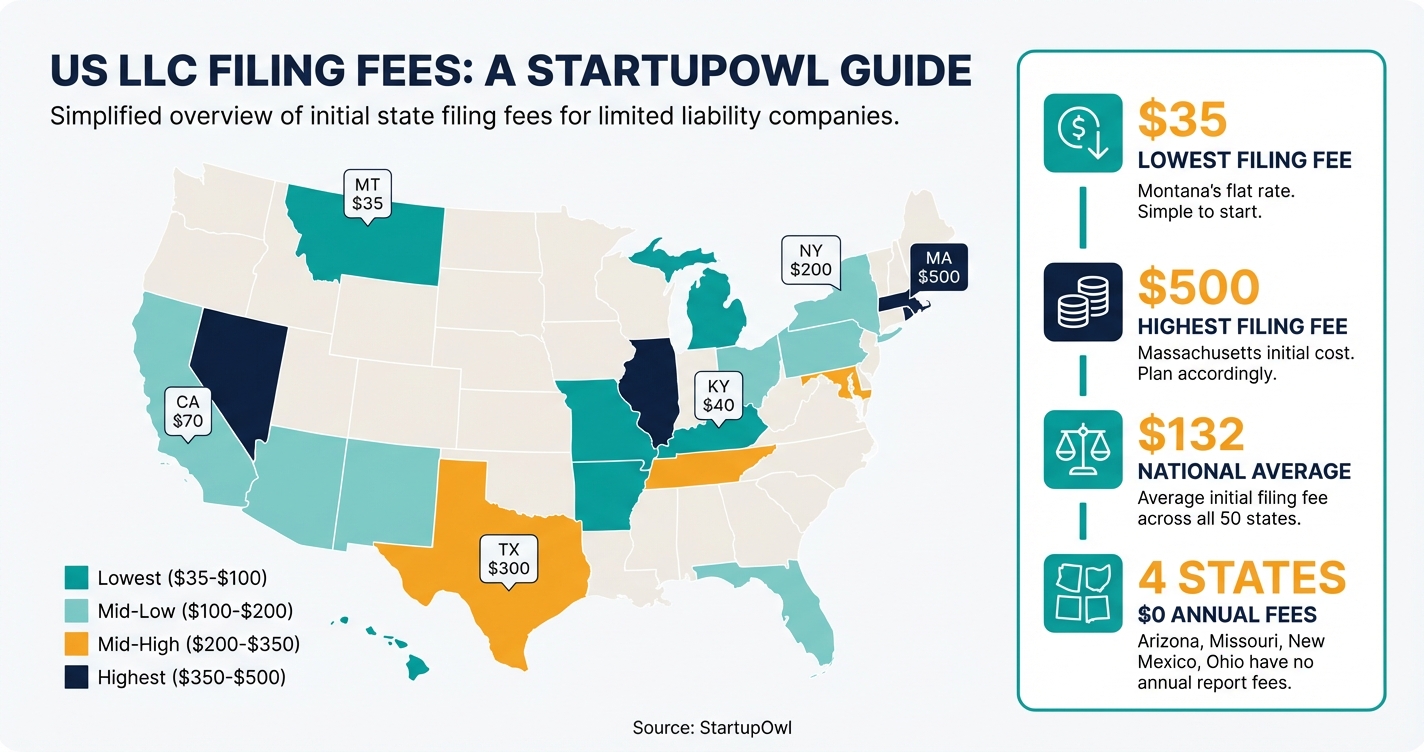
Your total first-year LLC cost depends on three variables: your state of formation, whether you hire professional services, and whether your state imposes franchise taxes or publication requirements. The filing fee alone ranges from $35 to $500, but the real total stretches to $50 to $1,900+ once you account for every required expense.
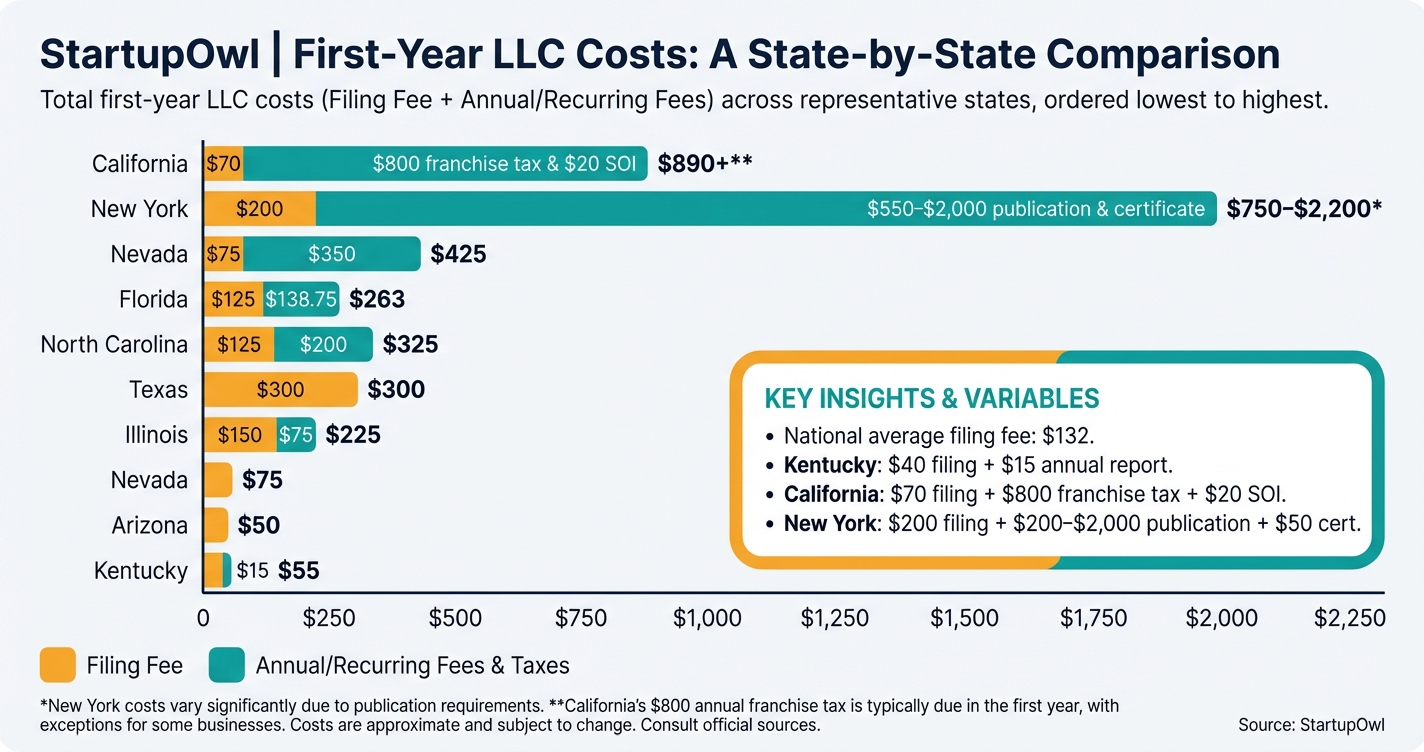
In the cheapest states (Kentucky, Montana, Arizona, Missouri, New Mexico), you can form and maintain an LLC for under $100 in year one if you serve as your own registered agent. At the other end, a New York City LLC with a professional registered agent, attorney-drafted operating agreement, and mandatory publication can cost $1,500 to $2,000+ before you open your doors.
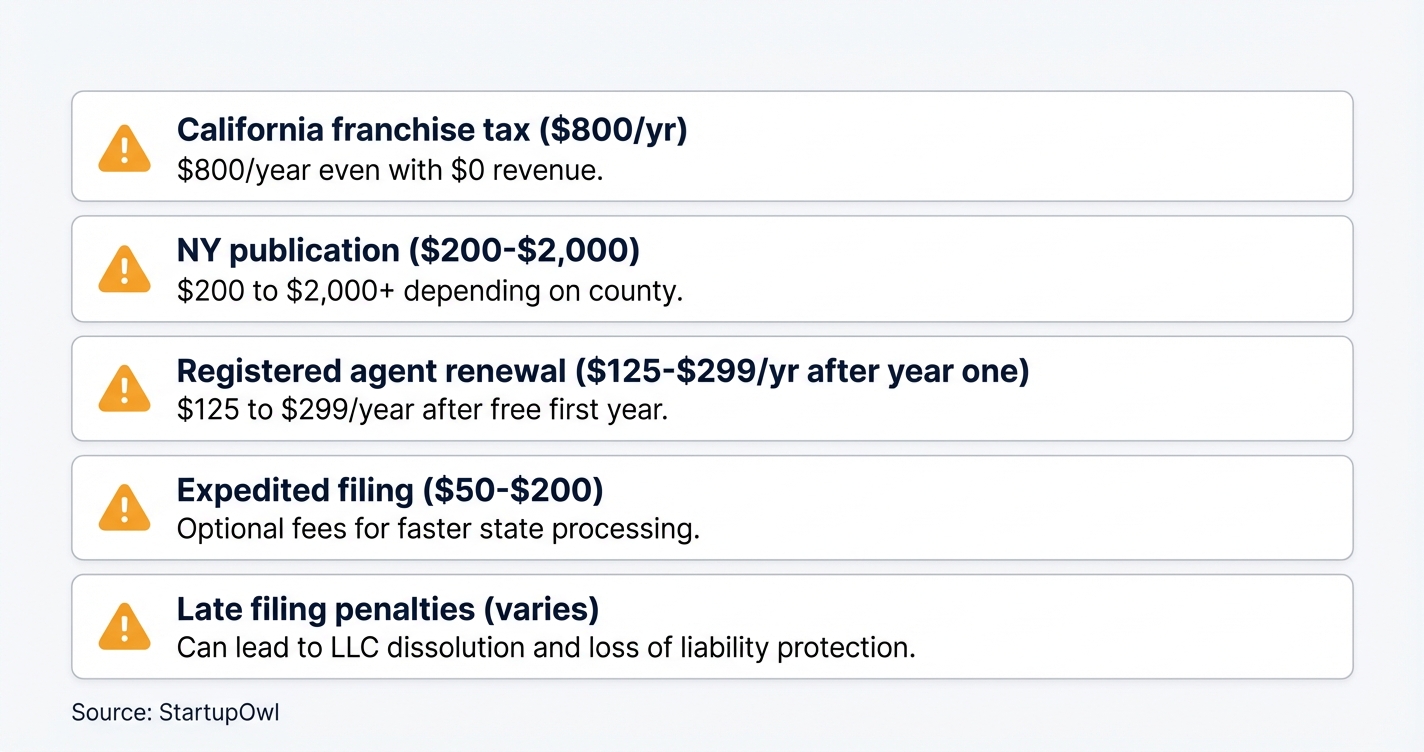
The average cost to form an LLC in the US is $132 in state filing fees, plus $91 in average annual fees, according to data compiled by LLC University (as of 2026). But these averages mask dramatic state-to-state differences. A Texas LLC costs $300 to file but has no annual report fee for most small businesses. A California LLC costs $70 to file but carries an $800 annual franchise tax every single year.
Here is what drives your cost up or down:
- State of formation determines your base filing fee and recurring obligations.
- Registered agent choice adds $0 (DIY) to $300/year (professional service).
- Professional help (formation services or attorneys) ranges from $39 to $2,500.
- Publication requirements in New York, Arizona, and Nebraska can add $200 to $2,000.
- Franchise taxes in California ($800), Delaware ($300), and others inflate your ongoing costs.
Free Options
You can form an LLC for nothing more than the mandatory state filing fee if you handle everything yourself. Here is what you can get at $0:
- EIN application. Always free at IRS.gov. Takes about 5 minutes online. Never pay a service to do this unless you are a non-US resident without an SSN.
- Registered agent (yourself). You can list yourself as registered agent in most states if you have a physical street address in the state. This saves $50 to $300/year, but your home address becomes public record.
- Operating agreement. Free templates are available from LLC University and Northwest Registered Agent. Adequate for single-member LLCs with straightforward structures.
- Annual report filing. You file this yourself through your state's Secretary of State website. The form itself costs nothing beyond the state fee.
A bare-bones DIY LLC in a low-cost state like Missouri or New Mexico costs $50 total in year one (filing fee only, no annual report fee, you are your own registered agent). That is the floor. In four states (Arizona, Missouri, New Mexico, and Ohio), there are no ongoing annual fees to keep your LLC active, as noted by MyLLC.
The trade-off with free options is privacy and risk. Serving as your own registered agent puts your home address on public filings. Using a free operating agreement template may not cover complex scenarios like multi-member profit splits. If your LLC has partners or investors, paying for professional help is usually worth it.
Paid Tiers
Here is what you get at each price point, from budget to premium.
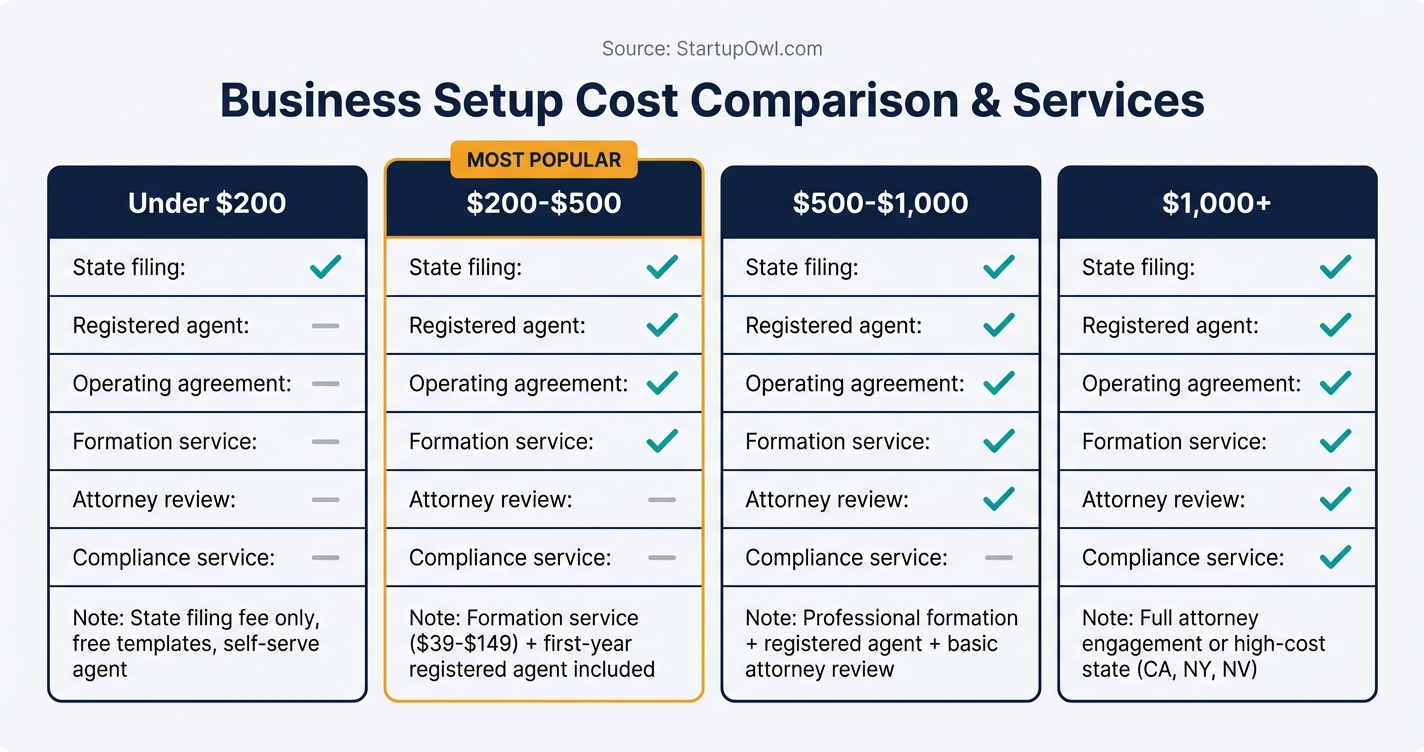
Under $200 (DIY in a low-cost state)
- State filing fee in a state like Kentucky ($40), Arizona ($50), or Colorado ($50).
- You act as your own registered agent and use a free operating agreement template.
- You file your own annual report (Kentucky charges just $15).
- Total first-year cost in Kentucky: roughly $55. In Colorado: about $75.
$200 to $500 (DIY or basic formation service in a mid-cost state)
- State filing fee in a state like Florida ($125), North Carolina ($125), or Texas ($300).
- Optional: formation service like Northwest Registered Agent at $39 + state fee, with registered agent service billed separately at $125 a year.
- North Carolina's first-year total (filing + annual report): about $325.
- Texas first-year total (filing only, most small LLCs owe $0 in franchise tax): about $300.
$500 to $1,000 (professional formation service plus compliance)
- Formation service like LegalZoom ($149 + state fee) or an attorney for basic setup ($500 to $1,000).
- Professional registered agent service ($125/year from Northwest).
- This range is typical for states with moderate fees plus one or two professional services.
- Good fit for single-member LLCs that want professional compliance support.
$1,000+ (high-cost states or attorney involvement)
- California: $70 filing + $800 franchise tax + $20 Statement of Information = $890 minimum. Add a registered agent and you're past $1,000.
- New York: $200 filing + $200 to $2,000 publication + $50 Certificate of Publication fee. NYC-based LLCs routinely spend $750 to $2,000+.
- Nevada: $75 filing + $150 initial list + $200 business license = $425 minimum.
- Attorney-drafted formation packages in any state: $500 to $2,500, which typically include a custom operating agreement and full filing support.
How to Save
You can cut your first-year LLC costs significantly with a few smart moves. Here are six specific strategies.
1. Form in your home state. Filing in Wyoming or Delaware to "save money" usually backfires. If you live and work in another state, you will need a foreign LLC registration there, plus registered agent fees and annual filings in both states. For most small businesses, your home state is the cheapest option.
2. Be your own registered agent. This saves $50 to $300/year. The trade-off: your home address goes on public record, and you must be available at that address during business hours to accept legal documents. If privacy is not a concern, this is the easiest way to save.
3. Use Northwest's $39 formation package. Northwest Registered Agent files your LLC for $39 + state fee, which is the cheapest filing on our list, but its registered agent service is a separate $125 a year from year one. ZenBusiness discounts the agent to $99 for the first year when you form with it, then renews at $199/year, so Northwest costs more up front and less every year after.
4. Get your EIN for free. Apply directly at IRS.gov. It takes 5 minutes. Never pay a formation service $50 to $200 for something you can do yourself instantly at no cost.
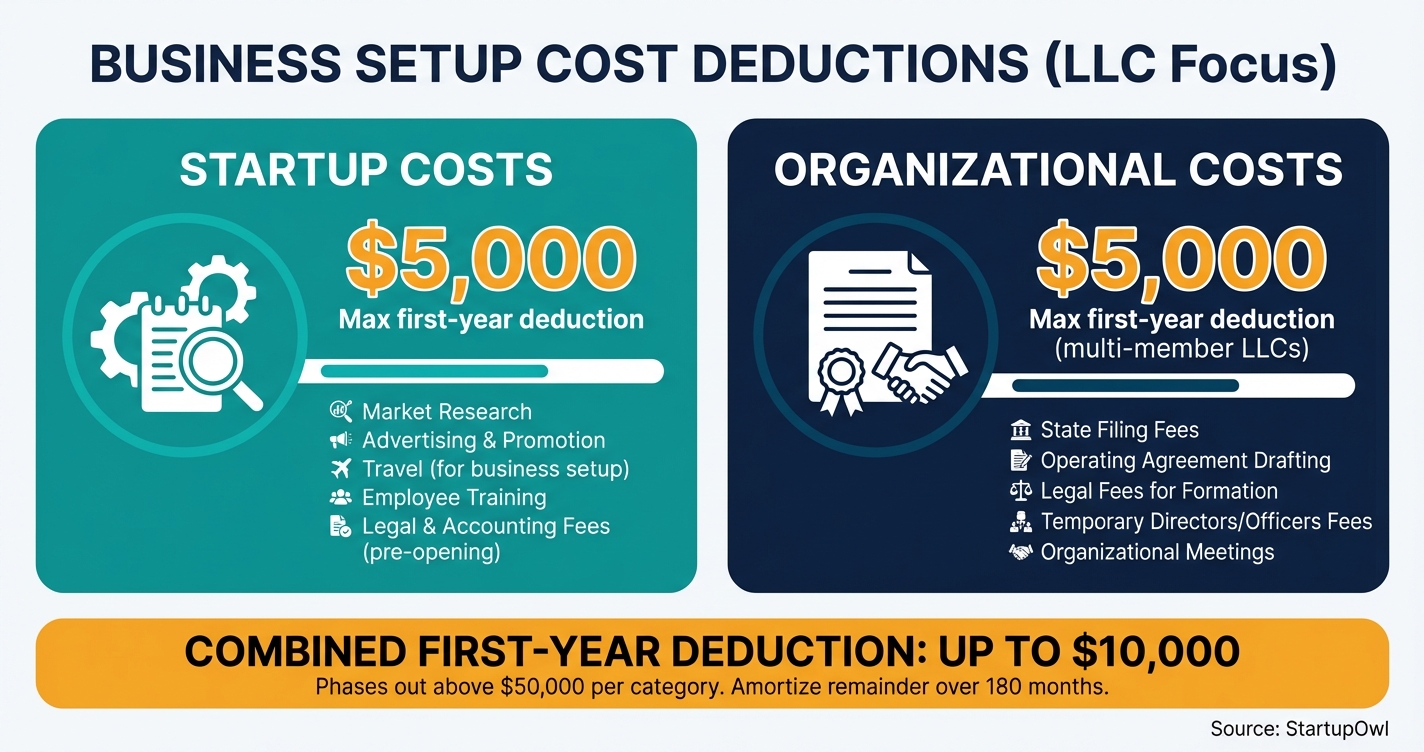
5. Deduct your LLC formation costs. Under IRC Section 195, you can deduct up to $5,000 in startup costs in your first year, with a separate $5,000 deduction for organizational costs (for multi-member LLCs). That is potentially $10,000 in combined first-year deductions if both categories apply, per IRS Publication 583. The deduction phases out if total costs exceed $50,000. You must elect this deduction on your first-year tax return.
6. In New York, use a registered agent in a low-cost county. Publication costs in Albany are under $400, compared to $1,000+ in Manhattan. List your registered agent's Albany address as your LLC's office to publish in the cheaper county. This single move can save you $500 to $1,000.
When to Upgrade
Start with the cheapest setup that meets your legal requirements, then upgrade when specific triggers signal you need more.
Upgrade to a professional registered agent when you are tired of listing your home address on public filings, you have received legal mail at home, or you are expanding into additional states. The $125/year cost from a service like Northwest is worth the privacy and compliance support.
Invest in an attorney-drafted operating agreement when you bring on a second member, accept outside investment, or your LLC's revenue exceeds $100,000/year. Free templates work fine for straightforward single-member LLCs, but multi-member agreements need custom profit allocation, buyout, and dispute resolution clauses. Expect to pay $500 to $2,500 for this.
Consider an S Corp election when your net self-employment income consistently exceeds $40,000 to $50,000/year. An S Corp election can save you 15.3% in self-employment taxes on distributions above a reasonable salary. You will need payroll (roughly $50 to $200/month), so review our guide on how to set up payroll and the LLC vs S Corp comparison before making this switch.
Switch from DIY to a formation/compliance service when you start missing annual report deadlines, need to file in multiple states, or simply cannot keep up with state-specific requirements. A compliance service runs $100 to $200/year and handles annual report filing, deadline reminders, and good-standing maintenance.
Full Cost Breakdown
| Item | Cost Range | Notes |
|---|---|---|
| State Filing Fee (Articles of Organization) | One-time fee paid to your Secretary of State. Montana is cheapest ($35), Massachusetts is highest ($500). National average is $132 as of 2026. | |
| Registered Agent Service | Required in all states. You can serve as your own agent for free if you have a physical address in the state. Northwest charges $125/year. | |
| Annual Report / Statement of Information | Required annually or biennially in most states. Four states (Arizona, Missouri, New Mexico, Ohio) charge $0. Massachusetts charges $500. | |
| Franchise Tax / Privilege Tax | Not all states charge this. California's $800 annual franchise tax is the highest. Delaware charges $300/year. Texas requires a report but most small LLCs owe $0. | |
| LLC Name Reservation (optional) | Optional. Holds your chosen name for 30 to 120 days depending on state. | |
| DBA / Fictitious Business Name (if needed) | Only needed if you operate under a name different from your registered LLC name. | |
| EIN (Employer Identification Number) | Always free directly from the IRS. Formation services charge $50 to $200 to file on your behalf. | |
| Operating Agreement (drafting) | Free templates available online. Attorney drafting is recommended for multi-member LLCs. | |
| LLC Formation Service (optional) | Northwest charges $39 + state fee to file, and its registered agent service is $125 a year. LegalZoom charges $149 + state fee. | |
| Publication Requirement (NY, AZ, NE only) | New York, Arizona, and Nebraska require newspaper publication. NY costs vary by county. Albany is cheapest; Manhattan is most expensive. | |
| Expedited Filing (optional) | Available in most states for faster processing. Standard filing takes 2 to 14 business days. | |
| Business License (varies by locality) | Required in some cities and counties. Costs vary widely by location and business type. |
By Business Type
Your LLC's first-year costs look different depending on what type of business you run. Here is what to expect.
Freelancers and Solo Consultants
You are likely forming a single-member LLC in your home state. Budget $100 to $400 in most states (filing fee + optional registered agent). Skip the attorney-drafted operating agreement and use a free template. You probably do not need a DBA if you operate under your LLC's legal name. Focus your budget on setting up accounting software and opening a business bank account instead.
E-commerce Sellers
You may need to register in multiple states depending on where your customers are (nexus rules). Each foreign LLC registration adds $100 to $300 in filing fees per state, plus a registered agent in each state. Budget $200 to $800 for a single-state LLC, more if you have multi-state obligations. You will also need a sales tax permit in most states, which is usually free to $50.
Brick-and-Mortar Retail
Local business licenses add $50 to $200+ on top of your state LLC costs. You may also need industry-specific permits (health department, signage, zoning). Budget $300 to $1,000+ for LLC formation plus local licensing. Consider a professional registered agent if you do not want legal documents delivered to your storefront.
Professional Services (Lawyers, Accountants, Doctors)
Some states require a Professional LLC (PLLC), which may have different filing fees and requirements. New York PLLCs face the same publication requirement as regular LLCs. Many states also require proof of professional licensing. Budget $500 to $1,500 and strongly consider an attorney for your operating agreement, especially in partnership structures. Review the LLC vs S Corp tax comparison to see if an S Corp election makes sense.
Restaurants and Food Service
Your LLC formation cost is just the beginning. Health department permits, food handler certifications, liquor licenses, and local business licenses can add $500 to $5,000+ to your first-year regulatory costs. The LLC itself typically runs $200 to $600 depending on state. Your bigger concern is ensuring your business insurance covers food service liability.
Frequently Asked Questions
The state filing fee ranges from $35 (Montana) to $500 (Massachusetts), with a national average of $132. Your actual first-year total will be higher once you add a registered agent, annual report, and any state-specific requirements. Most founders spend $500 to $1,000 all-in.
Kentucky ($40 filing + $15 annual report = $55 first year) and Montana ($35 filing + $20 annual report = $55) are the cheapest. Arizona, Missouri, and New Mexico charge $50 to file with $0 in annual fees. However, you should almost always form in the state where you live and work to avoid foreign LLC costs.
California is the most expensive for ongoing costs due to its $800 annual franchise tax. New York's $200 filing fee plus $200 to $2,000+ publication requirement makes it the most expensive for formation. Massachusetts charges the highest filing fee at $500 plus a $500 annual report.
Yes. Under IRS Section 195, you can deduct up to $5,000 in startup costs in your first year of business, plus a separate $5,000 in organizational costs for multi-member LLCs. The deduction phases out when total costs exceed $50,000. Remaining costs are amortized over 15 years (180 months). You must elect this deduction on your first-year tax return.
Yes, every state requires your LLC to have a registered agent with a physical address in the state. You can serve as your own agent for $0, or hire a professional service for $50 to $300/year. Read more about registered agent requirements and our picks for best registered agent services.
Your LLC will lose its good standing and could be administratively dissolved by the state. This means you lose your legal right to do business, your ability to open bank accounts, and your personal liability protection. In California, failure to pay the $800 franchise tax leads to suspension, penalties, and interest. Reinstating a dissolved LLC costs more than just paying on time.
Filing yourself is cheapest: you pay only the state fee. A formation service like Northwest adds $39 to file, and its registered agent service is a separate $125 a year, so compare the combined total rather than the headline filing price. Attorneys cost $500 to $2,500 but are worthwhile for multi-member LLCs or complex structures.
In many cities and counties, yes. A local business license typically costs $50 to $200, though fees vary widely. Some states (like California) do not require a statewide license but local jurisdictions often do. Check your city and county government websites for requirements specific to your location.
Sources & References
- LLC Filing Fees by State (2026) - LLC University
- LLC Annual Fees by State (2026) - LLC University
- LLC Costs by State: Filing Fees Comparison (2026) - Chamber of Commerce
- California Franchise Tax Board - LLC Filing Information
- NY Department of State - Certificate of Publication for Domestic LLC
- IRS Publication 583 - Starting a Business and Keeping Records
- IRC Section 195 - Startup Expenditures (via Congress.gov)
- Northwest Registered Agent - Registered Agent Pricing
- Cost of an LLC (2026) - MyLLC
- ZenBusiness - State Filing Fees (2026)
About the Author
Editor, StartupOwl
Eliot leads StartupOwl's state data research. He maintains the site's fifty state records of LLC filing fees, annual costs, processing times, and small business grant programs, checking each figure against the state office that publishes it and logging the date it was verified. Based in New Jersey, he has spent his working life in and around small businesses, and he writes for the founder who wants the real number rather than the advertised one. Every figure under his byline traces to a named source, and when a state proves a number wrong, the correction is published, not buried.
Was this article helpful?
Questions about LLC First-Year Costs
No comments yet. Ask the first question and a member of our team will answer.
Leave a comment