
I spent my first three months as a founder building outbound sequences before I realized I was sending emails to people who would never buy. Not because the product was wrong, but because I had no clue who I was actually selling to.
Sales·B2B·Growth·CRM
How to Build a Startup Sales Strategy That Actually Closes Deals
You don't need a sales team. You need a system. This guide gives you one, from your first cold email to your first SDR hire.

Written byEliot Reynolds
Editor, StartupOwl·Updated March 30, 2026·16 min read
Share:
In This Article
That experience taught me something that no sales blog ever mentioned: the hardest part of startup sales isn't closing. It's figuring out who to talk to, what to say, and when to shut up and listen.
This guide is the playbook I wish I'd had. It covers everything from defining your ICP to building a 15-touch outreach sequence, choosing the right CRM, structuring your first sales hire, and avoiding the mistakes that quietly kill pipelines. Every recommendation comes from real benchmarks and real founder experience, not theory.
Your Startup Sales Checklist Before You Start Selling
Before you write a single cold email or hop on a discovery call, you need six things locked in. Skip any of them and you'll burn time reaching the wrong people with the wrong message.
01
Define your Ideal Customer Profile (ICP)
Get specific. List the industry, company size range, revenue range, tech stack, and trigger events (recently raised funding, new leadership, product launch) that signal someone is ready to buy. If you can swap any company into your ICP description and it still fits, you're not specific enough.
02
Map your buyer journey
Figure out who actually signs the check, who influences the decision, and what each person worries about. In B2B, you're usually dealing with 3 to 7 people per deal. The person you email first is almost never the person who approves the budget.
03
Set a pricing hypothesis
Your average deal size determines your entire sales model. A $500/year product probably needs a self-serve funnel. A $50,000/year contract justifies a dedicated AE and a multi-week sales cycle. Know this number before you choose anything else.
04
Pick ONE starting channel
Inbound (content + SEO), outbound (cold email + LinkedIn + phone), or product-led (freemium with upgrade path). You'll layer more channels later. Right now, pick the one that matches your budget and your audience's behavior.
05
Set up tracking from day one
Even as a solo founder, you need a system of record. HubSpot's free tier or a well-structured spreadsheet. Log every conversation, every objection, every "not now." This data compounds. Six months from now, you'll be glad you have it.
06
Build a feedback loop between sales and product
Every call is product research. Every "we almost bought but..." is a roadmap signal. Log objections, feature requests, and competitor mentions somewhere your product team can see them. The founders who treat sales calls as research interviews learn faster than everyone else.
Pro Tip
Quick ICP test. For your next 5 target accounts, try filling in these fields: industry, employee count, annual revenue, tech stack, recent trigger event, ideal buyer's job title. If you can't fill at least 4 of 6, your ICP needs more research. Don't start outreach until you can.
Inbound vs. Outbound Sales for Startups
Here's the debate that wastes the most founder energy: should you do inbound or outbound?
The answer, increasingly, is both. About 43% of sales teams now blend the two into a single motion. But "both" doesn't mean "split your time 50/50 from day one." It means understanding which one to lead with and why.
Inbound means prospects come to you. They find your blog, sign up for a trial, respond to a LinkedIn post. These leads convert better and cost less because the buyer already has intent. The catch: inbound takes months to build and requires content that actually ranks.
Outbound means you go find prospects. You build a list of accounts matching your ICP, find decision-makers, and reach out via email, phone, or LinkedIn. The catch: it's a grind, the reply rates are low (around 5% for cold email), and you need solid messaging to cut through noise.
If you're bootstrapped and still figuring out product-market fit, lean into inbound. Build content, offer a trial, let early adopters find you. You'll learn what language resonates from the people who self-select in.
If you've raised money and your ICP is narrow (say, fintech companies with 50-200 employees), outbound makes more sense. You can name 200 target accounts and reach every one of them in a month, rather than hoping they stumble across your blog.
Note
The real power move. Use inbound to generate messaging data, then weaponize it for outbound. When 15 inbound leads ask the same question about a specific pain point, that question becomes the opening line of your next cold email sequence. The two channels feed each other.
The Multichannel Outreach Playbook
Single-channel outreach is how most founders start, and it's why most founders get terrible reply rates. If you're only sending cold emails, you're competing against every other founder who's also only sending cold emails. Your prospect's inbox looks like a warzone.
The data backs this up. SDRs who combine email, LinkedIn, and phone see roughly 287% more replies compared to email-only sequences. That's not a marginal improvement. That's the difference between getting ignored and getting meetings.
The average cold email reply rate is 5.1%. Cold calling converts at about 2.3% (dial-to-meeting). Both numbers feel discouraging until you realize they compound when you coordinate them. A prospect who sees your LinkedIn connection request on Monday, gets your email on Wednesday, and hears your voicemail on Friday doesn't think "this person is annoying." They think "this person is everywhere, they must be legit."
A 15-Touch Sequence Over 3 to 4 Weeks
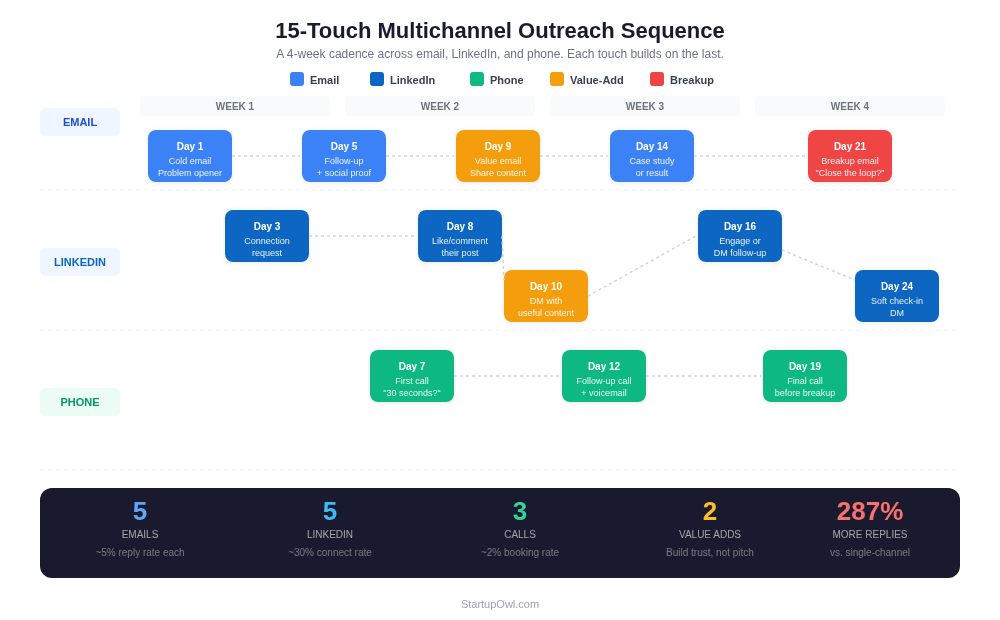
The framework below alternates between email, LinkedIn, and phone across four weeks. The key principle: every touch adds something new. A new proof point, a new question, a new piece of content. "Just checking in" messages are dead weight. Cut them.
01
Day 1 - LinkedIn connection with a personalized note
Reference something specific: a post they wrote, a job they listed, a product launch. Don't pitch. Just establish that you exist and you did your homework.
02
Day 3 - First cold email (problem opener)
Under 125 words. Open with the specific problem your ICP faces. One sentence about what you do. Ask if 15 minutes makes sense. That's it.
03
Day 5 - Follow-up email with social proof
Same thread. Acknowledge they're busy. Add one specific result from a customer. "We helped [Company X] cut their [metric] by [percentage] in [timeframe]." Ask again.
04
Day 7 - Phone call
"Hi [Name], I sent you an email about [problem]. Do you have 30 seconds?" If voicemail, leave a specific question that invites a callback. Reference the email so they know it's connected.
05
Day 8-10 - LinkedIn engagement + DM
Like or comment on their recent post (genuinely, not performatively). Follow up with a DM sharing something useful: a piece of content, a data point, an observation about their industry.
06
Day 12 - Second phone attempt + voicemail
Different angle. Ask about a challenge you know their segment faces. Leave a voicemail that feels like a conversation, not a pitch.
07
Day 14 - Value email (not a pitch)
Share a case study, a relevant benchmark, or a piece of content you've created. This email isn't asking for anything. It's proving you're worth listening to.
08
Day 16-19 - LinkedIn follow-up + third phone attempt
If connected, send a brief DM. If not, engage with their content again. Make the third call. At this point, they've seen your name across three channels.
09
Day 21 - Breakup email
"I've reached out a few times and haven't heard back, which usually means one of three things: (1) you're buried and this slipped, (2) you're not the right person, (3) this isn't relevant. Which one?" This email consistently gets the highest reply rate in any sequence, around 15-20%.
Watch Out
Before you send anything. Audit your email domain reputation, verify your DKIM/SPF/DMARC setup, and clean your contact list. One batch of emails bouncing off bad addresses can torpedo your sender reputation for months. Deliverability isn't an afterthought. It's infrastructure.
Building Your SDR and AE Structure on a Startup Budget
The SDR/AE split is the standard B2B playbook. SDRs handle prospecting and meeting-booking. AEs run discovery, demos, and closing. It works because prospecting and closing are fundamentally different skills.
But you can't afford it on day one. And you shouldn't try. Here's how to scale into it without blowing your runway.
The Founder-Led Sales Phase (Under $1M ARR)
If you're pre-revenue or under $1M ARR, you are the sales team. Every discovery call, every demo, every objection, you need to hear it yourself. No hire can shortcut this phase. The founder who's done 100 sales calls understands their market in a way that no amount of research can replicate.
Use Apollo.io's free tier for prospecting and personalization. Use your calendar link for booking. Track deals in HubSpot free or a spreadsheet. Resist the urge to hire a salesperson. You're not ready until you can hand them a script that you've personally tested and that you know converts.
Adding Your First SDR ($1M to $3M ARR)
Your first sales hire should not be a closer. It should be someone who books meetings for you. An SDR (or outsourced SDR pod) focused on one persona in one segment will produce sharper messaging and faster feedback than a generalist working a broad list.
A good outsourced SDR pod runs $4K-8K/month and delivers 12-20 qualified meetings. In-house, expect to pay $50K-70K base plus commission. Either way, measure reply rate, meeting rate, and deal size from week one. If meetings aren't converting to pipeline within 30 days, the problem is usually targeting, not the SDR.
The Full SDR/AE Model ($3M+ ARR)
Now you can specialize. Dedicated SDRs with clear quotas (meetings booked, pipeline generated). Dedicated AEs with clear quotas (revenue closed, deal velocity). The trend in 2025-2026 is AI-augmented SDRs: AI handles prospecting lists, email personalization, and CRM data entry while humans own qualification and conversation. The teams winning right now aren't replacing reps with AI. They're making each rep twice as productive.
Setting Up Your CRM Without Drowning in Tools
Here's a stat that should scare you: the average seller uses 8 different tools to close deals, and 42% of them feel overwhelmed by their own tech stack (Salesforce State of Sales). For a 3-person startup, that level of tool sprawl is a budget killer and a productivity trap.
Your first CRM needs to do four things: manage contacts, visualize your pipeline, integrate with your email, and report on conversion rates. That's it. Everything else is a distraction until you have a repeatable process.
HubSpot CRM (Free) is the default for most startups. Contact management, deal pipeline with Kanban view, email tracking via Gmail/Outlook, and basic reporting. Free for 2 users and 1,000 contacts with no expiration. You'll outgrow it eventually, but not soon. Starter plan is $15/month when you do.
Pipedrive ($14/user/month) is the alternative if you want something simpler and more sales-focused. Best visual pipeline in the category. Clean drag-and-drop interface. No free plan, but the 14-day trial is generous enough to know if it fits.
Apollo.io (Free tier + $49/month paid) isn't a CRM, but it combines prospecting, email sequences, and a contact database in one platform. The free tier gives you enough credits to validate your ICP. When you need more, the paid tier replaces what would otherwise be 2-3 separate tools.
| Tool | Free Plan | Paid Price | Best For |
|---|---|---|---|
| HubSpot CRM | Yes (2 users, 1K contacts) | $15/mo Starter | All-in-one CRM for most startups |
| Pipedrive | 14-day trial | $14/user/mo | Clean pipeline view for sales-focused teams |
| Apollo.io | Yes (60 credits/mo) | $49/user/mo | Prospecting + sequences in one platform |
| Salesforce | No free plan | $25/user/mo | Enterprise-grade. Wait until $5M+ ARR. |
One more thing: your first CRM project should be data quality, not automation. Clean bounced contacts immediately. Standardize your fields (company size, industry, decision-maker title). A CRM full of garbage data will produce worse results than a well-maintained Google Sheet.
Pricing When You Have No Data
Most sales guides skip pricing entirely, which is weird because it's the question every founder agonizes over. Your price determines your entire sales model. Get it wrong and everything downstream breaks.
If your annual deal value is under $1,000, you probably need a self-serve funnel. At that price point, you can't afford the time cost of manual sales calls. Build a trial or freemium tier, invest in product-led growth, and let marketing do the heavy lifting.
Between $1,000 and $10,000/year, a lightweight sales process works. Founder-led demos, short sales cycles, one or two calls to close. This is the sweet spot for most early-stage B2B startups.
Above $10,000/year, you're in enterprise territory. Expect longer sales cycles (weeks to months), multiple stakeholders, procurement processes, and security reviews. This model needs dedicated AEs and patience.
When you're desperate for revenue, it's tempting to drop your price to close deals. Resist this. A customer who pays $200/month values your product differently than one who pays $2,000/month. The cheap customer complains more, churns faster, and teaches you less about your real market. Price based on the value you deliver, not the revenue you need this month.
Pro Tip
A practical pricing test. If your first 5 prospects all say yes without negotiating, your price is too low. If all 5 say no, it's too high (or your ICP is off). You want some pushback. The right price makes roughly 40-60% of qualified prospects say yes after a real conversation.
Five Sales Mistakes That Kill Startups
I've watched dozens of founders make the same mistakes with their sales process. These five are the most common, and every one of them has a straightforward fix.
Blasting 10,000 Cold Emails and Calling It a Strategy
Volume feels productive. You sent 10,000 emails this month. But at a 5.1% reply rate, that's 510 replies, and most of those are "not interested" or "unsubscribe." The founders building real pipeline in 2026 are sending 500 emails to carefully selected prospects and getting better results than the founders spraying 5,000. Relevance beats volume every single time.
Email Only, All Day, Every Day
If you're only doing cold email, you're in a knife fight with everyone else who's also only doing cold email. Your prospect gets 50 cold pitches a week. Yours is one of them. The 287% multichannel uplift isn't a nice-to-have. It's the difference between getting meetings and getting ignored. Add phone and LinkedIn. It takes more effort, but the math is overwhelmingly in your favor.
Ignoring Deliverability Until It's Too Late
Bounced contacts and a damaged sender reputation will kill your cold email ROI before your messaging even gets a chance. Verify every contact before adding them to a sequence. Warm up new sending domains for 2-3 weeks before going full throttle. Monitor bounce rates weekly. If you're above 3% bounce rate, stop and clean your list. This isn't glamorous work, but it's the foundation everything else sits on.
Keeping Inbound and Outbound in Separate Worlds
Your inbound leads are telling you what language resonates. Your outbound data is telling you which segments respond. If these two teams (or these two spreadsheets, if you're a solo founder) never talk to each other, you're throwing away half your intelligence. Feed both data streams into the same CRM, the same weekly review, and the same messaging doc.
Buying Tools You Don't Need Yet
You don't need Outreach.io, Gong, ZoomInfo, SalesNav, and Clari on day one. You need a CRM, an email sequencing tool (or Apollo, which bundles both), and LinkedIn. That's your stack until you have a repeatable process that's hitting its ceiling because of tooling limitations, not because of strategy problems. The average seller uses 8 tools. You are not the average seller. Stay lean.
Which Sales Model Fits Your Startup Stage
Your sales model should change as your company grows. The approach that works at $200K ARR will actively hurt you at $3M ARR. Here's a decision framework based on where you are today.
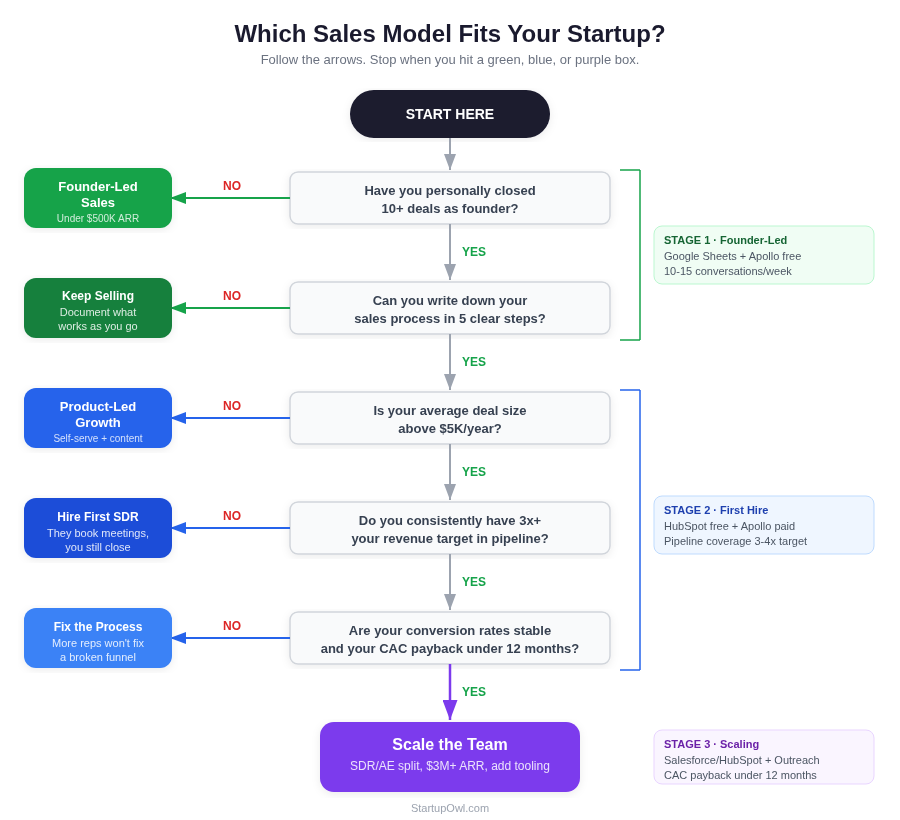
Pre-Product-Market Fit (Under $500K ARR)
You are the sales team. Your goal right now is learning, not scaling. Run small outbound experiments: 50-100 targeted emails per week, take every inbound call personally, track what objections come up again and again. Use HubSpot free or a spreadsheet. Do not hire a salesperson. Only 2 in 5 startups are profitable, and adding headcount before you have a process that works just burns cash faster.
Post-Product-Market Fit ($500K to $3M ARR)
You have paying customers and a message that gets traction with a defined segment. Now hire your first SDR (or outsource to a pod) and move yourself into the AE seat full-time. Build a multichannel sequence using the 15-touch framework above. Give 20-30% of SDR time to inbound follow-up and 70-80% to structured outbound. If your CRM's free tier is cramping you, upgrade.
Scaling Phase ($3M+ ARR)
Now you invest in specialization. Dedicated SDRs, dedicated AEs, maybe a product-led growth layer feeding your pipeline. Implement account-based marketing for your top 50-100 targets. Upgrade your tooling. This is when platforms like Outreach.io or Gong start justifying their cost, because you have enough reps and enough data for the analytics to matter.
Note
Don't forget referrals. Word-of-mouth is one of the most powerful channels at every stage. After a successful onboarding, ask your new customer to introduce you to two peers who face the same problem. It costs nothing, the trust is already there, and these deals close faster than anything from cold outreach.
Turning Customers Into Your Sales Team
Most startup sales content stops at "close the deal." That's a mistake, because what happens after the close determines whether your sales engine compounds or stalls.
Your first 10 customers are the most valuable people in your company. Not just because of their revenue, but because they're your only source of case studies, testimonials, referrals, and real usage data. Every satisfied customer is a potential introduction to 2-3 more prospects. Every churned customer is a signal that something in your sales or product process broke.
First, schedule a check-in call at 30, 60, and 90 days. Not to upsell. To learn. Are they actually using the product? What's working? What's friction? These calls produce more useful product feedback than any survey.
Second, ask for a case study after 90 days. Even a 3-paragraph written quote helps. "We were doing X, we switched to [your product], and now we do Y" is the most powerful sales asset you can create.
Third, build a referral ask into your workflow. After a positive check-in, ask: "Who else in your network deals with [the problem you solve]? I'd love an introduction." Most people will say yes if they're actually happy with your product.
Frequently Asked Questions
What is a startup sales strategy?
A startup sales strategy is a systematic plan for how an early-stage company will find, approach, and convert potential customers into paying users. It covers target customer identification (ICP), outreach channels (email, phone, LinkedIn), team structure, tooling, and pricing. Unlike enterprise sales strategies, startup sales strategies need to work with minimal budget and headcount, and they evolve quickly as the company finds product-market fit.
How do you do sales as a startup with no experience?
Start by selling yourself. The founder should handle all sales until they've personally closed at least 10 deals. Focus on conversations, not pitches. Ask prospects what their biggest challenge is, listen to the answer, and show how your product addresses it. Track everything in a CRM or spreadsheet. The learning from those first conversations is more valuable than any sales training.
What are the main types of sales strategies for startups?
The three most common are outbound (cold email, phone, LinkedIn outreach to targeted prospects), inbound (content marketing, SEO, and product trials that attract prospects to you), and product-led growth (a freemium tier that lets users experience value before a sales conversation). Most successful startups eventually blend two or three of these into a hybrid approach.
What's the first step to being strategic about sales?
Define your Ideal Customer Profile (ICP). Before you write an email, pick up the phone, or build a sequence, you need to know exactly who you're selling to. That means specific industries, company sizes, job titles, budget ranges, and trigger events. Everything else (messaging, channel selection, pricing, hiring) depends on getting this right first.
Every sales strategy eventually comes down to one question: can you build a repeatable process for turning strangers into customers? The frameworks in this guide give you the structure. The 15-touch sequence gives you the day-by-day playbook. And the free tools available right now mean there's no budget excuse for not starting.
Pick one section. Implement it this week. Measure what happens. Adjust. That's how startup sales actually work: not as a grand strategy, but as a series of small experiments that compound.
Up Next
How to Build a Sales Pipeline From Scratch
Share:
Was this article helpful?
Editorial Standards
This article is independently researched and written by the StartupOwl editorial team. Affiliate links may earn us a commission, this never affects our content or rankings. Read our policy →
About the Author
Editor, StartupOwl
Eliot leads StartupOwl's state data research. He maintains the site's fifty state records of LLC filing fees, annual costs, processing times, and small business grant programs, checking each figure against the state office that publishes it and logging the date it was verified. Based in New Jersey, he has spent his working life in and around small businesses, and he writes for the founder who wants the real number rather than the advertised one. Every figure under his byline traces to a named source, and when a state proves a number wrong, the correction is published, not buried.
Related Articles
📈
Growth
How to Build a Sales Pipeline From Scratch
Learn how to create, manage, and optimize a deal pipeline that gives you visibility into revenue before it arrives.
10 min read🤝
Founders
Founder-Led Sales and When to Hire Your First Rep
A practical guide to running sales yourself and recognizing the signals that it is time to hand off the phones.
8 min read📧
Growth
Cold Email for Startups That Gets Replies
Proven cold email frameworks, deliverability setup, and subject line strategies for B2B startup outreach.
11 min read🚀
Start
Product-Led Growth for Early-Stage Startups
How to build a freemium funnel that drives adoption and complements your sales motion.
9 min read
Questions about How to Build a Startup Sales Strategy That Actually Closes Deals
No comments yet. Ask the first question and a member of our team will answer.
Leave a comment