
Starting a Business on H-1B
Learn how the 2026 H-1B modernization rule lets you self-sponsor through your own startup. Covers the 35% lottery selection rate, 18-month validity, and entity setup.

StartupOwl may earn a commission when you use links on this page to sign up for business formation or banking services. This does not affect our editorial recommendations. See our full disclosure policy for details.
The H-1B modernization rule, effective January 17, 2026, fundamentally changed the equation for founders. You can now self-petition for H-1B status through your own startup (even with 100% ownership) if you meet specific USCIS requirements around specialty occupation duties and corporate governance.
This guide covers entity formation, the lottery process, petition costs, and the compliance rules that determine whether your self-sponsored petition gets approved or denied. If you are exploring other founder paths, check our immigrant entrepreneur guide for a broader overview of visa options and resources.
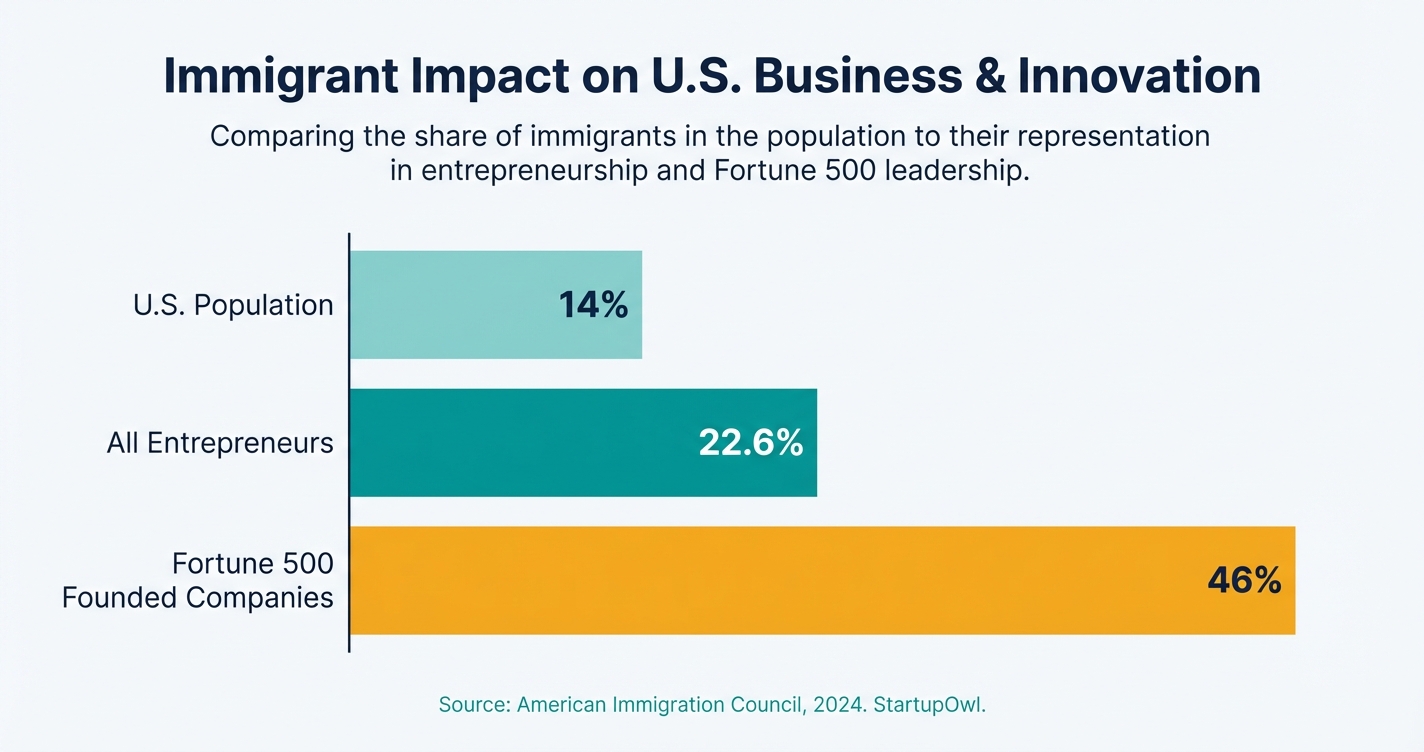
What the 2026 H-1B Self-Sponsorship Rule Changed
Before January 2026, USCIS required a traditional employer-employee relationship that forced startup founders into a structural contradiction. You owned the company but needed the company to control your employment. Many founders had to set up independent boards with hire-and-fire authority just to satisfy the old framework.
The final rule published December 18, 2024 codifies that beneficiary-owners (those with more than 50% ownership or majority voting rights) can petition for H-1B status through their own companies. USCIS now explicitly recognizes the dual role of entrepreneur-beneficiaries as both business owners and specialty occupation workers.
There are important guardrails. Your initial petition and first extension are each limited to 18 months of validity (compared to the standard 3 years), according to USCIS. Subsequent extensions may be approved for up to three years if you satisfy all requirements. USCIS also conducts unannounced site visits to verify that your business is real and operational.
You must still spend the majority of your working time performing specialty occupation duties. Administrative tasks related to running the business (signing leases, negotiating contracts, finding investors) are permitted as long as they remain the minority of your duties. Understanding the difference between a sole proprietorship and an LLC is critical, because sole proprietorships are explicitly disqualified.
How to Set Up Your Business and File the Self-Sponsored H-1B Petition
The process has five major stages, from entity formation through petition filing. Each step has specific documentation requirements that USCIS will scrutinize. Mistakes in any stage can trigger a Request for Evidence (RFE) or outright denial.
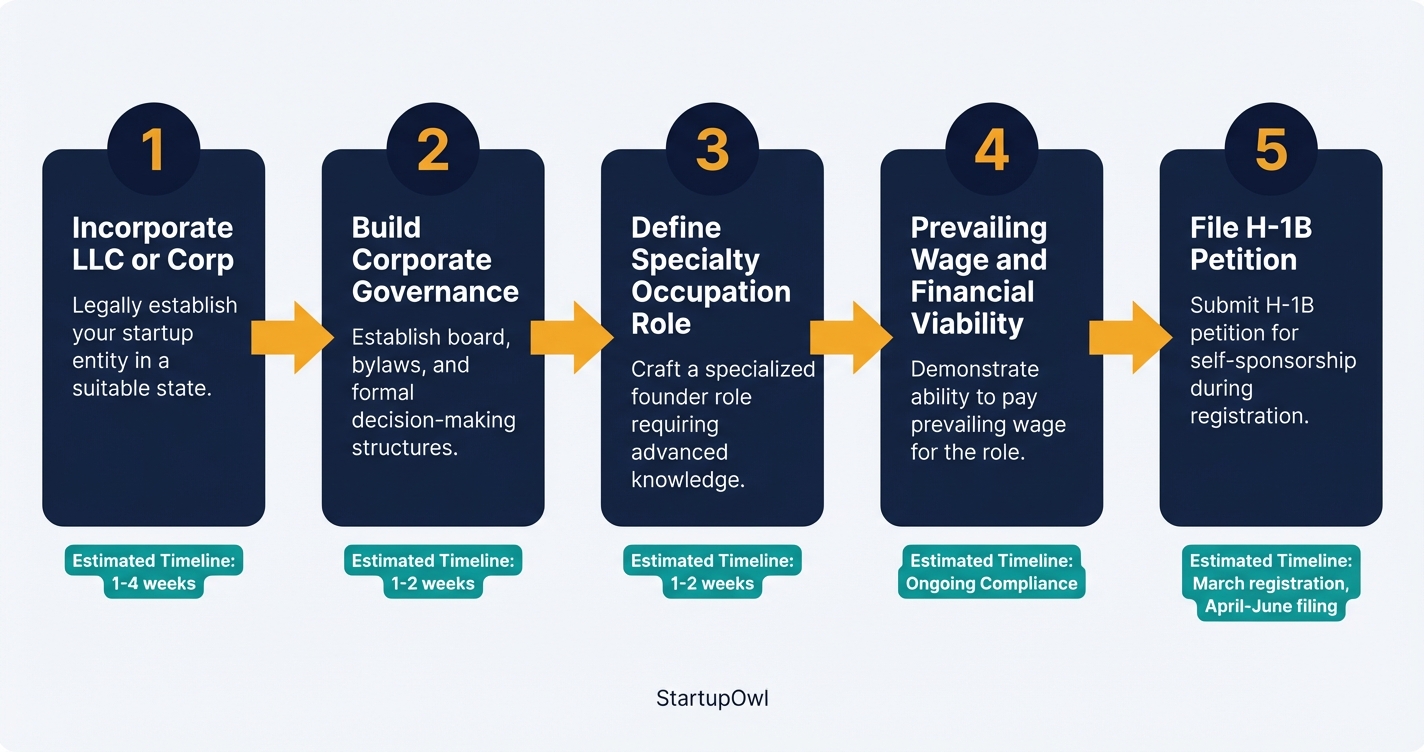
Start by forming an LLC or corporation in your state. USCIS accepts LLCs, C Corporations, and S Corporations as qualifying legal entities. Your company must have a U.S. legal presence, an IRS tax ID (EIN), and be amenable to service of process.
Next, build out your corporate infrastructure. Create a formal employment agreement that specifies your job title, duties (with time percentages), salary, and reporting structure. Open a business bank account to separate business and personal finances. Set up a physical or coworking office address (a home office may not suffice unless local zoning allows commercial activity).
Write a detailed business plan covering your product or service, market opportunity, revenue projections, and how your specialty occupation skills drive the company's core work. USCIS will use this to evaluate whether your company can pay the prevailing wage and whether your role is genuinely a specialty occupation.
File a Labor Condition Application (LCA) with the Department of Labor to establish the prevailing wage for your role and location. Then register for the H-1B cap lottery in March if your company is cap-subject. For FY 2026, 343,981 eligible registrations were filed and 118,660 unique beneficiaries were selected (a 35.3% selection rate), per USCIS data.
If selected, file Form I-129 with complete supporting evidence between April and June. Government fees for small employers (fewer than 25 employees) include the $460 base filing fee, $750 ACWIA training fee, $500 fraud prevention fee, $300 asylum program fee, and the $215 registration fee, totaling roughly $2,225 before attorney costs. Premium processing adds $2,805 for a 15-business-day decision.
Important notice (September 2026): A Presidential Proclamation introduced a $100,000 one-time fee for certain new H-1B petitions filed on or after September 21, 2026. USCIS has clarified this fee applies primarily to beneficiaries outside the U.S. who do not already hold valid H-1B status. Change-of-status and extension petitions for individuals already in the U.S. are exempt. Multiple lawsuits challenging this fee are pending. Consult an immigration attorney for the latest guidance on how this affects your specific situation.
H-1B Government Filing Fees for Small Employers (Under 25 Employees)
| Type / Provider | Rate | Notes |
|---|---|---|
| Electronic Registration Fee | $215 | Paid at lottery registration in March |
| Form I-129 Base Filing Fee | $460 | For employers with fewer than 25 employees |
| ACWIA Training Fee | $750 | Required for companies with fewer than 25 employees ($1,500 for 25+) |
| Fraud Prevention and Detection Fee | $500 | Required for initial petitions and change of employer |
| Asylum Program Fee | $300 | For employers with fewer than 25 employees ($600 for 25+) |
| Premium Processing (Optional) | $2,805 | Guarantees a decision within 15 business days |
| Immigration Attorney Fees | $3,000 to $10,000+ | Varies by complexity; self-sponsored petitions are on the higher end |
Recommended Tools for H-1B Founders
Getting your entity structure and compliance right from the start reduces the risk of USCIS scrutiny later. These tools handle the most common formation and operational tasks.
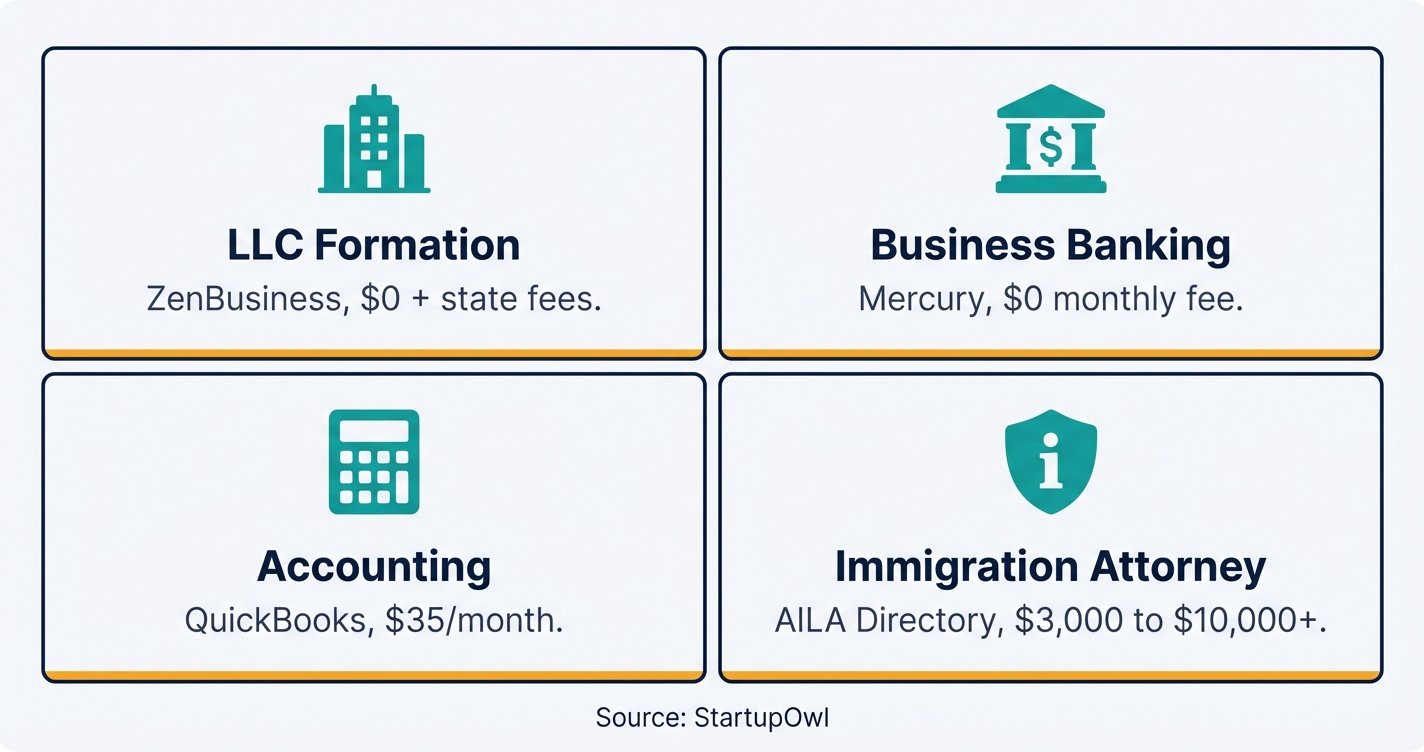
- The ZenBusiness Starter plan forms your LLC or C Corp for $0 + state fees, with 7 to 10 day processing. The Pro plan at $199/year adds 1-day processing, an operating agreement template, and EIN filing. Visit ZenBusiness to compare plans, or see our LLC formation services comparison.
- The Mercury business banking account is popular with startups because it offers FDIC-insured accounts with no monthly fees and integrates with common accounting tools. This matters because USCIS wants to see a clearly separated business bank account. Compare options on our business bank account page.
- The QuickBooks Online Simple Start plan (starting at $35/month) tracks income, expenses, and payroll records you will need to demonstrate prevailing wage compliance during H-1B extension filings. See our accounting software guide.
- An experienced immigration attorney is not optional for self-sponsored petitions. Find AILA-certified attorneys through the AILA Lawyer Directory. Budget $3,000 to $10,000+ for beneficiary-owner H-1B petition preparation. For general startup legal needs, see our legal services comparison.
5 Mistakes That Get Self-Sponsored H-1B Petitions Denied
Self-sponsored petitions face heightened scrutiny from USCIS. These are the most common errors that lead to Requests for Evidence (RFEs) or denials.
- Filing as a sole proprietorship. USCIS explicitly does not recognize sole proprietorships as separate legal entities for H-1B purposes. You need an LLC, C Corp, or S Corp. Read our guide on the sole proprietorship vs LLC decision to understand why.
- Spending most of your time on non-specialty duties. If your day is filled with sales calls, hiring, and lease negotiations instead of the technical work your degree qualifies you for, USCIS will deny your petition. Document that over 50% of your time goes to specialty occupation work.
- Setting salary below the prevailing wage. The Department of Labor sets prevailing wages by occupation and metro area. If your startup cannot demonstrate the ability to pay the prevailing wage (through revenue, funding, or capitalization), the petition will fail.
- Skipping corporate governance documentation. USCIS may conduct unannounced site visits and will request evidence of a real employer-employee relationship. Board meeting minutes, employment contracts, and documented performance reviews show your company operates independently from you as an individual.
- Filing without an immigration attorney. Self-sponsored petitions are significantly more complex than standard employer-filed H-1Bs. Errors in the Labor Condition Application, job description, or corporate structure evidence can result in denial. An attorney experienced with beneficiary-owner cases knows exactly what USCIS adjudicators look for.
Avoiding these mistakes starts with understanding common first-time founder mistakes and building proper compliance habits from day one.
This Is Not Legal or Immigration Advice
Immigration law is complex and changes frequently. The information on this page is for educational purposes only and should not be treated as legal advice for your specific situation. Always consult a qualified immigration attorney before making any visa or business formation decisions. Visit USCIS.gov for official H-1B requirements and the latest rule updates. For tax implications of self-employment as a beneficiary-owner, consult a CPA experienced with nonresident and dual-status tax filings.
What to Do This Week
If you are serious about starting a business on an H-1B, the single most important step is scheduling a consultation with an immigration attorney who has handled beneficiary-owner petitions under the 2026 modernization rule. Before that meeting, register your business as an LLC or corporation so you have a legal entity in place.
Open a dedicated business bank account, draft your specialty occupation job description with time-allocation percentages, and begin assembling your business plan with financial projections. Review startup funding options to figure out how you will demonstrate prevailing wage ability. Explore small business grants that may be available to immigrant-owned businesses.
The H-1B lottery registration window opens every March. If you plan to self-sponsor for the next fiscal year, start your entity setup and attorney engagement at least 6 months before registration opens. That timeline gives you enough runway to incorporate, build governance documents, write the business plan, and prepare a petition that stands up to USCIS scrutiny.
Mercury disclosure
Step-by-Step Process
- 1
Incorporate Your Business as a Separate Legal Entity
You need to form an LLC, C Corporation, or S Corporation in your chosen state. USCIS requires a distinct legal entity that separates the owner from the employee, so sole proprietorships do not qualify.
File your articles of organization or incorporation with the Secretary of State, then obtain a Federal Employer Identification Number (EIN) from the IRS. An LLC formation service can handle the filing for as little as $0 + state fees.
Tips
- Delaware and Wyoming are popular incorporation states, but choose the state where you will actually do business.
- Get your EIN immediately after formation so you can open a business bank account.
Common Mistakes
- Filing as a sole proprietorship, which USCIS will not accept as a separate legal entity.
- Skipping the operating agreement, which USCIS may request during adjudication.
- 2
Establish a Real Corporate Structure and Governance
USCIS needs proof that your company exercises genuine employer control over your position. Set up a board of directors or advisory board, create a formal employment contract between you and your company, and document a reporting structure.
Open a separate business bank account, get a dedicated business address (a coworking space counts), and keep all corporate decisions documented in written minutes.
Tips
- An outside investor or co-founder on the board strengthens your employer-employee relationship argument.
- Keep a paper trail of board resolutions and employment actions from day one.
Common Mistakes
- Working from a bedroom with no business address, which USCIS may flag during a site visit.
- Having no corporate governance documents to prove the entity makes independent decisions.
- 3
Define Your Specialty Occupation Role
Your role must qualify as a specialty occupation, meaning it requires at least a bachelor's degree in a directly related specific specialty. USCIS will scrutinize whether the majority (over 50%) of your time is spent performing specialty occupation duties like software development, data analysis, or engineering.
Document every duty you will perform and assign a percentage of time to each. Administrative tasks like signing leases and managing payroll are allowed but must remain the minority of your duties.
Tips
- Use the DOL's O*NET database to align your job title with recognized specialty occupation codes.
- If you hold a CTO role, detail the technical work (coding, architecture) separately from the managerial work.
Common Mistakes
- Choosing a vague title like CEO without documenting the technical duties that make it a specialty occupation.
- Failing to show that your degree is directly related to the core job duties.
- 4
Demonstrate Financial Viability and Prevailing Wage Compliance
You must pay yourself the prevailing wage for your specialty occupation and geographic area, as determined by the Department of Labor. For executive and technical roles in major metro areas, this can be $80,000 to $150,000+ per year.
If your startup has little or no revenue yet, USCIS will accept evidence of VC funding, signed client contracts, statements of work, bank statements showing capitalization, or credible financial projections in a formal business plan.
Tips
- File a prevailing wage request with DOL before building your business plan's salary projections.
- Show at least 12 months of financial runway to pay yourself the required wage.
Common Mistakes
- Setting your salary below the prevailing wage, which will result in an automatic denial.
- Relying solely on projected revenue with no supporting contracts or funding documentation.
- 5
File the H-1B Petition (or Enter the Cap Lottery)
If your company is cap-subject, you must register during the H-1B electronic registration period (typically March) and hope to be selected in the lottery. In FY 2026, USCIS selected approximately 35.3% of the 336,153 unique beneficiaries who registered, according to USCIS data.
If selected, your company files Form I-129 along with all supporting documentation. Government filing fees for small employers total roughly $2,000 to $3,500, plus optional premium processing at $2,805. An experienced immigration attorney is essential for self-sponsored petitions.
$2,000 to $8,000+ including attorney fees Registration in March; filing April through June; start date October 1 uscis.govTips
- Maintain concurrent H-1B employment at your current job while building your startup.
- Consider cap-exempt strategies through nonprofit research organizations if you cannot afford to wait for the lottery.
Common Mistakes
- Missing the March registration window, which locks you out for the entire fiscal year.
- Filing without an immigration attorney, which dramatically increases Request for Evidence (RFE) risk.
Frequently Asked Questions
Yes. You can incorporate a company, invest in a business, and serve as a director or shareholder on H-1B status. However, you cannot actively work for your own company (perform services in exchange for compensation) unless your company has filed and received approval for a self-sponsored H-1B petition naming you as the beneficiary-owner. Passive ownership alone does not require a separate H-1B petition.
Under the 2026 modernization rule, you no longer need an independent board with hire-and-fire authority over you to establish an employer-employee relationship. Beneficiary-owners with over 50% ownership or majority voting rights can qualify. However, having documented corporate governance (a board, meeting minutes, employment contracts) still strengthens your petition and reduces the risk of a Request for Evidence.
The initial petition and first extension for beneficiary-owners are each limited to 18 months, per USCIS regulations. Subsequent extensions may be granted for up to 3 years, assuming you satisfy all H-1B requirements. The overall 6-year H-1B limit still applies unless you qualify for an extension under AC21 provisions.
Yes. The 2026 rule explicitly allows concurrent H-1B employment. You can maintain your full-time H-1B job with your current employer and have your startup file a separate part-time or full-time H-1B petition. This is often the safest approach because it preserves your existing status while you build the new business.
If you filed a concurrent petition while maintaining your existing H-1B job, you retain your current status and employment. If you had already changed status, you may have up to 60 days to find a new employer to sponsor you, change to another visa status, or depart the U.S. An immigration attorney can advise on appeal options or alternative visa pathways like the O-1 or E-2.
The O-1A visa is available to individuals with extraordinary ability and has no annual cap. The E-2 treaty investor visa works if you invest a substantial amount in a U.S. business and your country has a treaty with the U.S. The EB-2 National Interest Waiver is a green card pathway for founders whose work benefits the U.S. economy. An immigration attorney can evaluate which path fits your specific situation.
The information on this page is for educational purposes only and does not constitute financial, legal, or investment advice. Loan terms, interest rates, and eligibility requirements vary by lender and change frequently. Always consult with a qualified financial advisor before making funding decisions. StartupOwl may earn a commission if you click our links at no extra cost to you.
Sources & References
- USCIS: H-1B Specialty Occupations
- Federal Register: Modernizing H-1B Requirements (Final Rule, December 18, 2024)
- USCIS: FAQs for Individuals in H-1B Nonimmigrant Status
- American Immigration Council: Fortune 500 Companies Founded by Immigrants (2024)
- American Immigration Council: Immigrant Entrepreneurship Statistics
- SBA Office of Advocacy: An Overview of Immigrant Business Ownership (2022)
- Fragomen: USCIS Releases Selection Numbers for the FY 2026 H-1B Cap
- NBER: Immigrant Entrepreneurship in the US
- DOL: Labor Condition Application (LCA) Program
About the Author
Editor, StartupOwl
Eliot leads StartupOwl's state data research. He maintains the site's fifty state records of LLC filing fees, annual costs, processing times, and small business grant programs, checking each figure against the state office that publishes it and logging the date it was verified. Based in New Jersey, he has spent his working life in and around small businesses, and he writes for the founder who wants the real number rather than the advertised one. Every figure under his byline traces to a named source, and when a state proves a number wrong, the correction is published, not buried.
Was this article helpful?
Questions about Starting a Business on H-1B
No comments yet. Ask the first question and a member of our team will answer.
Leave a comment