
Freelancer to LLC: When to Formalize Your Business
Over 76 million U.S. freelancers operate without liability protection. Learn when to convert from freelancer to LLC, what it costs ($35 to $500), and the exact steps to file.

StartupOwl may earn a commission when you use links on this page to sign up for LLC formation services or business tools. This does not affect our editorial recommendations or the order in which products appear. We only recommend services we have researched and believe will help you.
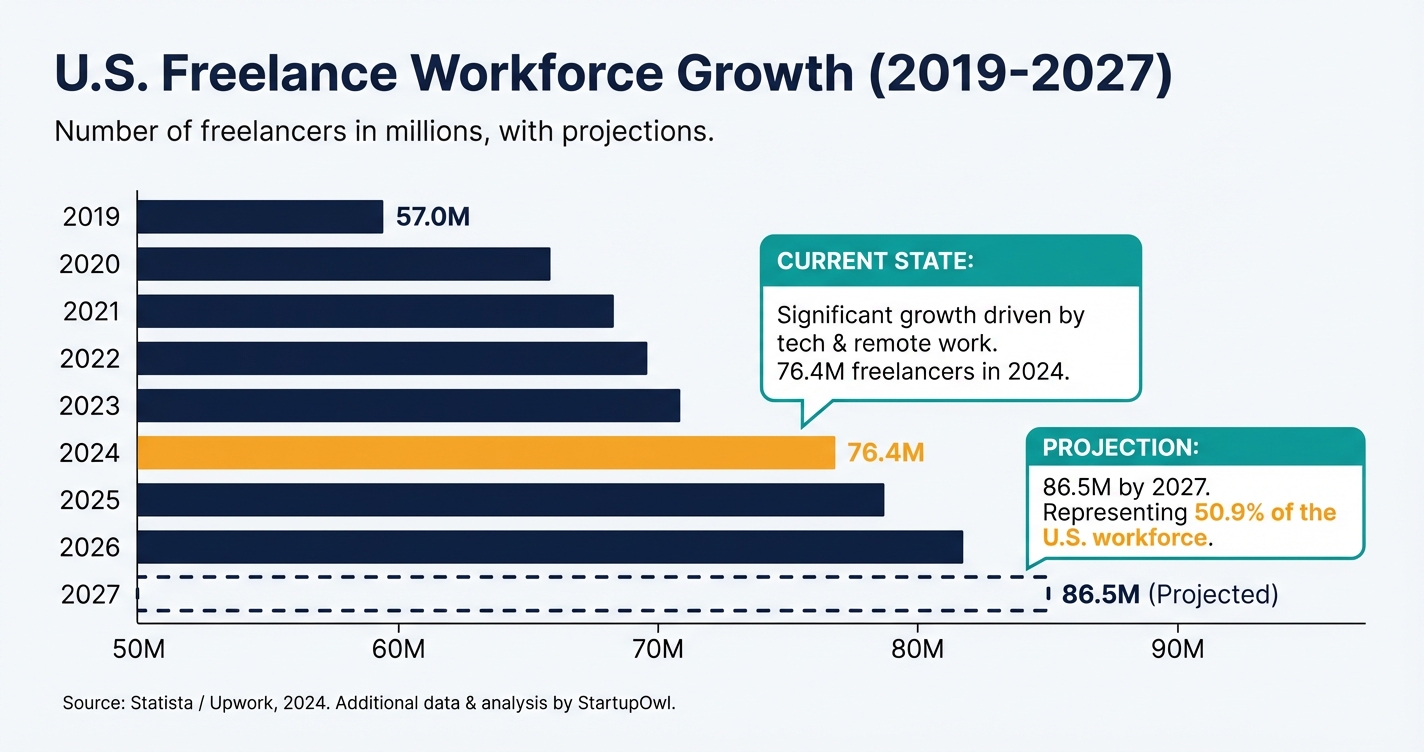
Over 76.4 million Americans freelance as of 2024, according to Upwork and Statista. That number is projected to reach 86.5 million by 2027, when freelancers will make up more than half the U.S. workforce.
Yet most freelancers still operate as unregistered sole proprietors, with zero separation between personal assets and business liabilities. If you are earning real income from freelance work, this guide walks you through exactly when (and how) to form an LLC and protect yourself.
Why Freelancers Need to Think About Business Structure
When you freelance without a formal business entity, you are legally a sole proprietor by default. That means every client contract, every invoice dispute, and every potential lawsuit puts your personal bank account, your car, and your home on the line.
An LLC (Limited Liability Company) creates a legal wall between your freelance business and your personal assets. According to the IRS, a single-member LLC is taxed the same as a sole proprietorship by default, so you do not lose any tax simplicity by forming one.
The real question is not whether to formalize. It is when. The answer depends on your income, your client risk profile, and whether you are ready to operate like a business instead of a hobbyist.
How to Go From Freelancer to LLC (Step by Step)
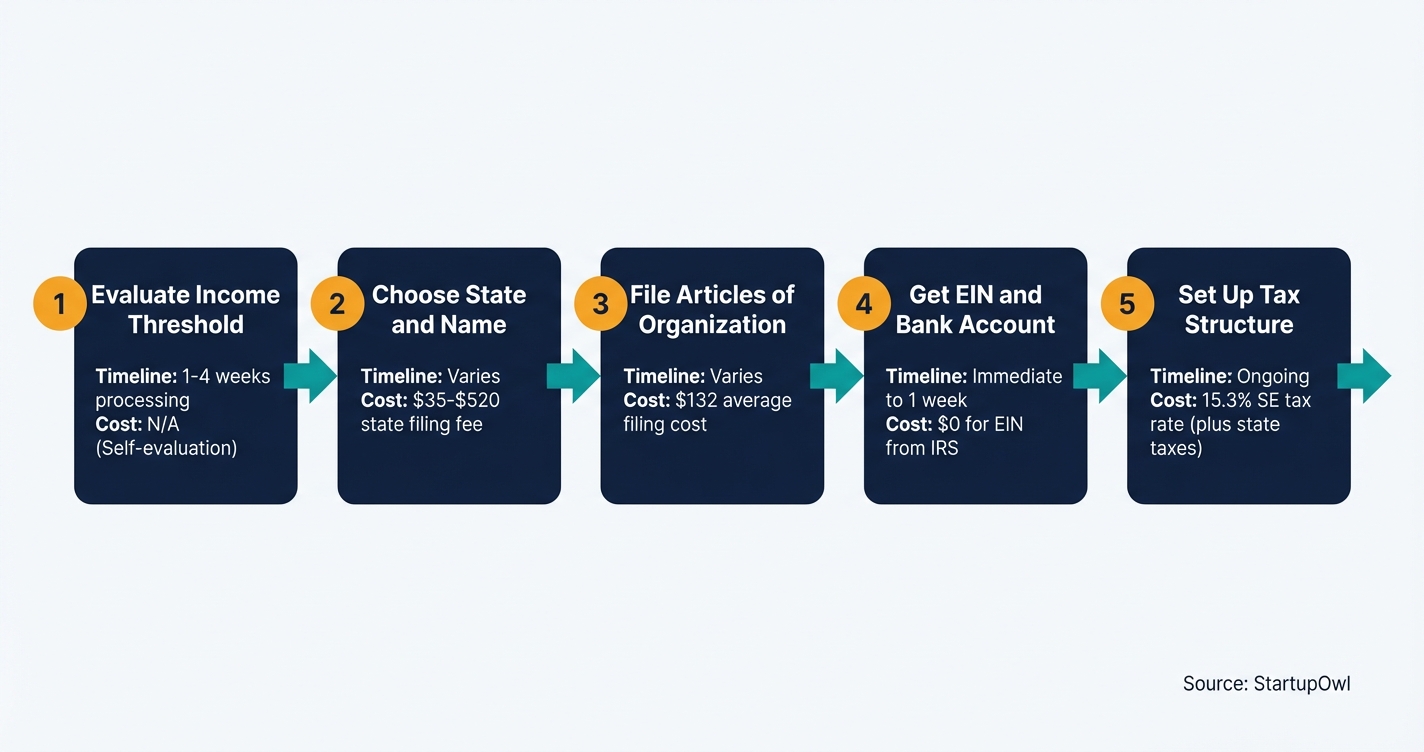
Converting your freelance operation into an LLC takes 1 to 4 weeks in most states. Filing fees run from $35 to $500. The national average filing fee is approximately $132 as of 2026, according to LLC University and SmallBizStatistics.com. Here is the full breakdown.
Know When You Have Crossed the Threshold
You should seriously consider an LLC once your freelance net profit consistently exceeds $30,000 per year. At that income level, the 15.3% self-employment tax you pay on all net earnings (per the IRS) starts generating enough liability that structuring your business properly becomes worth the cost.
Other triggers include signing your first five-figure contract, working with clients who require proof of insurance or business registration, or earning enough to worry about a client lawsuit.
File in Your Home State
For most freelancers, the best state to form an LLC is the state where you live and work. Filing in Wyoming or Delaware adds complexity without tax savings if you operate in a single state. You would need to register as a foreign LLC in your home state anyway, effectively paying two sets of filing and annual fees.
If you are unsure about which business structure is right for you, read our comparison of sole proprietorship vs LLC to see the differences in liability, taxes, and compliance.
File Your Articles of Organization
Your Articles of Organization (called Certificate of Formation in some states) is the document that officially creates your LLC. Filing fees range from $35 in Montana to $500 in Massachusetts. Four states charge $0 in annual fees. They are Arizona, Missouri, New Mexico and Ohio.
You can file directly through your state's Secretary of State website or use an LLC formation service. ZenBusiness offers formation starting at $0 plus state fees. Northwest Registered Agent charges $39 plus state fees and includes a free year of registered agent service.
Get Your EIN and Separate Your Finances
Your EIN (Employer Identification Number) is free from the IRS and takes about 10 minutes to obtain online. Use it instead of your Social Security Number on all client contracts, W-9 forms, and invoices.
Open a dedicated business bank account immediately. Mixing personal and business funds (called "commingling") is the most common way freelancers accidentally destroy their LLC's liability protection.
Set Up Your Tax Structure
A single-member LLC is a "disregarded entity" for tax purposes, meaning you still report business income on Schedule C of your personal return. You still owe the 15.3% self-employment tax (12.4% Social Security plus 2.9% Medicare) on net earnings, according to the IRS.
If your net profit exceeds roughly $50,000, ask a CPA about electing S-Corp tax status. With an S-Corp election, you pay yourself a reasonable salary (subject to payroll taxes) and take remaining profits as distributions that are not subject to self-employment tax. Keeper Tax estimates this can save roughly $2,000 at $30,000 net income and $3,000 or more at $40,000.
You should also take advantage of the Section 199A QBI deduction, which allows eligible freelancers and LLC owners to deduct up to 20% of qualified business income. The One Big Beautiful Bill Act (signed July 2026) made this deduction permanent and added a new $400 minimum deduction for taxpayers with at least $1,000 in QBI starting in 2026.
Recommended Tools for Your Freelancer-to-LLC Transition
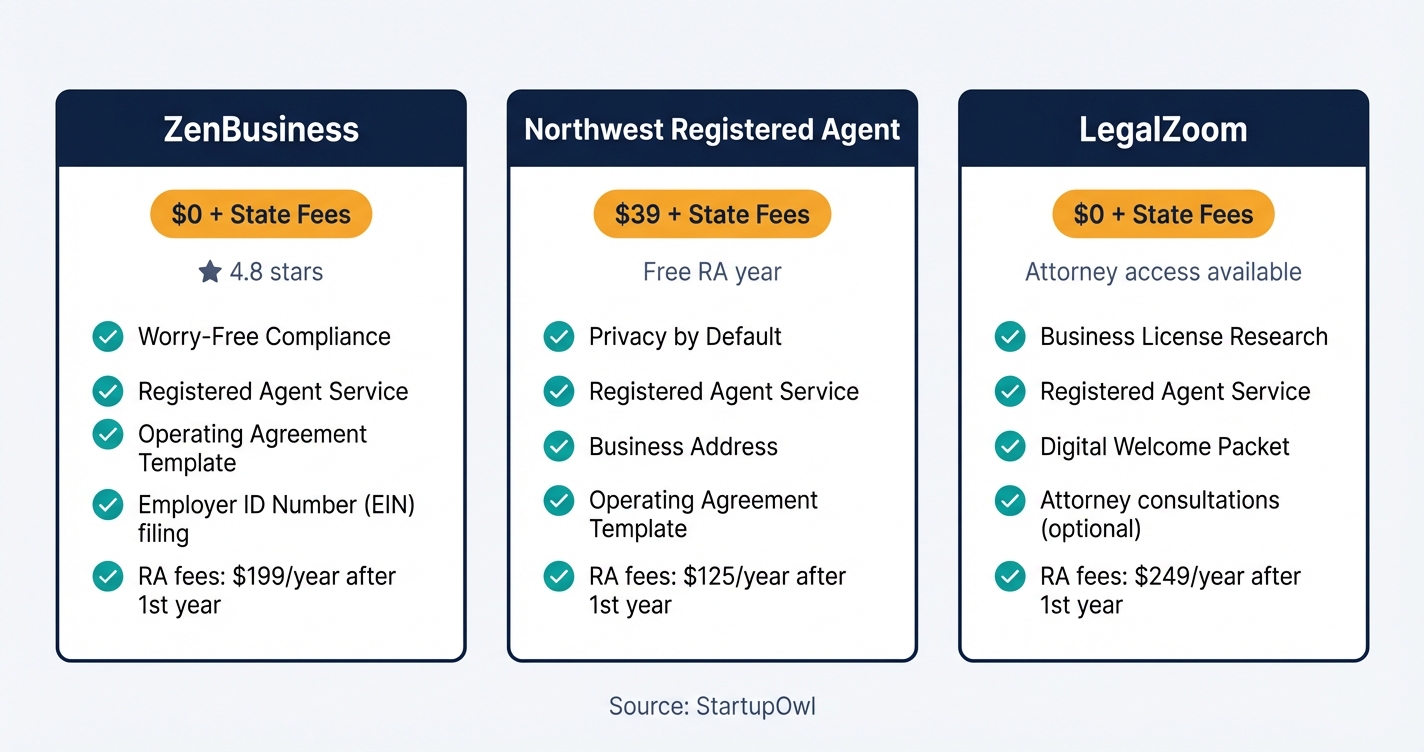
- The ZenBusiness Starter plan forms your LLC for $0 plus state fees and includes a free year of worry-free compliance (renews at $199/year). It has a 4.8-star Trustpilot rating from over 26,000 reviews.
- The Northwest Registered Agent charges $39 plus state fees for LLC formation and includes one free year of registered agent service ($125/year afterward). Northwest has operated since 1998.
- The LegalZoom Basic plan offers $0 plus state fees for LLC formation, with optional attorney consultations in paid tiers ($249 for Pro). Registered agent service costs $249/year, the highest among major providers.
- Use accounting software like QuickBooks Self-Employed (starting around $15/month) or FreshBooks to automate income tracking, expense categorization, and quarterly tax estimates.
Five Mistakes Freelancers Make When Forming an LLC
1. Waiting until a lawsuit to form an LLC. By then, your personal assets are already exposed. An LLC only protects you from liabilities that occur after the LLC exists. If you are earning more than $30,000 a year, the cost of formation is a fraction of what one legal dispute could cost you.
2. Commingling personal and business funds. If you deposit client payments into your personal checking account, a court can "pierce the corporate veil" and treat your LLC as if it does not exist. Open a separate business bank account on the day you receive your EIN.
3. Skipping the operating agreement. Most states do not require an operating agreement for single-member LLCs, but banks, investors, and courts expect one. Free templates are available from your LLC formation service or from your state's SBDC.
4. Electing S-Corp status too early. S-Corp tax treatment adds payroll processing costs (roughly $100/month for a payroll service) and requires you to pay yourself a "reasonable salary." If your net income is below $40,000, the payroll costs can wipe out any self-employment tax savings.
5. Ignoring annual compliance requirements. Most states require an annual report and fee to keep your LLC in good standing. The average annual fee is $91 as of 2026, according to LLC University. Miss the deadline and your state can dissolve your LLC, leaving you personally liable again.
Your Next Steps This Week
Start by calculating your freelance net income for the last 12 months. If it exceeds $30,000, you are leaving yourself unprotected by operating without an LLC. Form your LLC through your state's Secretary of State website or use an LLC formation service for as little as $0 plus your state fee.
Once your LLC is active, get your EIN, open a business bank account, and set up accounting software to track every dollar. If your net profit has crossed $50,000, consult a CPA about S-Corp election and the Section 199A QBI deduction.
If you want to avoid the common first-time founder mistakes that cost new business owners thousands, read that guide next. And if you are still on the fence about whether a solo business is right for you, our solopreneur guide breaks down the full path from idea to income.
Step-by-Step Process
- 1
Decide if your freelance income justifies an LLC
If your annual freelance net income consistently exceeds $30,000 to $40,000, the liability protection and potential tax savings of an LLC start to outweigh the formation and maintenance costs. You should also consider forming an LLC if you are signing client contracts with indemnification clauses or working in industries with litigation risk (consulting, design, development).
Tips
- Calculate your annual self-employment tax at 15.3% of net earnings to see what you currently pay.
- If you work with only one or two large clients, an LLC adds credibility and contract protection.
Common Mistakes
- Waiting until you are sued to form an LLC, when personal assets are already at risk.
- 2
Choose your state and check name availability
For most freelancers, you should form your LLC in the state where you live and work. Filing in another state (like Wyoming or Delaware) means you will likely need to register as a foreign LLC in your home state and pay two sets of fees. Search your state's Secretary of State website to confirm your desired business name is available.
Tips
- Some states require 'LLC' or 'Limited Liability Company' in the business name.
- Reserve your name if you are not ready to file immediately.
Common Mistakes
- Forming in a 'business-friendly' state like Wyoming when you only operate in one state, which doubles your filing fees and compliance burden.
- 3
File your Articles of Organization with the state
File your Articles of Organization (sometimes called Certificate of Formation) with your state's Secretary of State. State filing fees range from $35 in Montana to $500 in Massachusetts, with a national average of about $132. Massachusetts is the outlier. It charges $520 to file online or by fax, because it adds a $20 fee to electronic filings. Most states let you file online, and standard processing takes 1 to 4 weeks.
Tips
- Use an LLC formation service if you want to avoid paperwork errors. ZenBusiness starts at $0 plus state fees; Northwest Registered Agent charges $39 plus state fees.
- Some states like New York require newspaper publication after filing, which can cost $300 to $4,500.
Common Mistakes
- Forgetting to check whether your state requires publication (New York, Arizona, Nebraska).
- Skipping the operating agreement, which is your internal rulebook even if the state does not require it.
- 4
Get your EIN and open a business bank account
Apply for a free Employer Identification Number (EIN) from the IRS website. This takes about 10 minutes online and you receive the number immediately. Open a dedicated business bank account so your personal and business finances stay completely separate.
Tips
- Never use your personal Social Security Number on client contracts once you have an EIN.
- Choose a bank with no monthly fees for low-balance accounts.
Common Mistakes
- Continuing to deposit client payments into a personal checking account, which weakens your LLC's liability shield.
- 5
Set up your tax structure and quarterly estimated payments
By default, a single-member LLC is taxed as a sole proprietorship, meaning you still pay the 15.3% self-employment tax on all net earnings. If your net profit exceeds roughly $40,000 to $50,000, talk to a CPA about electing S-Corp tax status to split income into salary (subject to FICA) and distributions (not subject to SE tax). You may also qualify for the Section 199A QBI deduction, which lets you deduct up to 20% of qualified business income.
Tips
- The Section 199A QBI deduction was made permanent by the One Big Beautiful Bill Act in July 2026.
- Set aside 25-30% of each invoice for quarterly estimated tax payments.
Common Mistakes
- Electing S-Corp status before your income is high enough to offset the added payroll and accounting costs.
- Missing quarterly estimated tax payment deadlines, which triggers IRS underpayment penalties.
Frequently Asked Questions
State filing fees range from $35 (Montana) to $500 (Massachusetts). The average is about $132 as of 2026. You can also use an LLC formation service like ZenBusiness ($0 plus state fees) or Northwest Registered Agent ($39 plus state fees). Budget an additional $91 per year on average for annual report fees.
Not automatically. A single-member LLC is taxed identically to a sole proprietorship by default. You still pay the 15.3% self-employment tax on net earnings. The tax savings come if you elect S-Corp taxation (typically worth it above $50,000 net profit) or claim the Section 199A QBI deduction for up to 20% off qualified business income. Consult a CPA to run the numbers for your specific situation.
Consider forming an LLC once your freelance net income consistently exceeds $30,000 per year, when you start signing contracts with larger clients, or when you work in an industry with litigation risk. That $35 to $500 filing cost buys real protection. One client dispute could otherwise reach your personal assets.
Yes. A single-member LLC is a "disregarded entity" for federal tax purposes, which means you report all business income on Schedule C of your personal Form 1040 exactly as you did as a sole proprietor. The only difference is that your LLC provides legal liability protection that a sole proprietorship does not.
The Section 199A deduction lets eligible self-employed individuals and LLC owners deduct up to 20% of their qualified business income from their federal taxes. The One Big Beautiful Bill Act (signed July 2026) made this deduction permanent and added a $400 minimum deduction for those with at least $1,000 in QBI starting in 2026.
For most freelancers, no. If you live and operate in one state, forming in Wyoming or Delaware means you will still need to register as a foreign LLC in your home state and pay two sets of annual fees. Your home state will tax your income regardless of where the LLC was formed. Out-of-state formation only makes sense if you operate in multiple states or need specific privacy protections.
The information on this page is for educational purposes only and does not constitute financial, legal, or investment advice. Loan terms, interest rates, and eligibility requirements vary by lender and change frequently. Always consult with a qualified financial advisor before making funding decisions. StartupOwl may earn a commission if you click our links at no extra cost to you.
Sources & References
- Upwork Future Workforce Index 2026
- Statista: Number of Freelancers in the U.S. 2017-2028
- IRS: Self-Employed Individuals Tax Center
- IRS Topic No. 554: Self-Employment Tax
- IRS: Qualified Business Income Deduction (Section 199A)
- LLC University: LLC Filing Fees by State (2026)
- LLC University: LLC Annual Fees by State (2026)
- SmallBizStatistics: Average Cost of Forming an LLC by State (2026)
- SBA: Choose a Business Structure
- MBO Partners: State of Independence 2026
- TurboTax: A Freelancer's Guide to Taxes (2026)
About the Author
Editor, StartupOwl
Eliot leads StartupOwl's state data research. He maintains the site's fifty state records of LLC filing fees, annual costs, processing times, and small business grant programs, checking each figure against the state office that publishes it and logging the date it was verified. Based in New Jersey, he has spent his working life in and around small businesses, and he writes for the founder who wants the real number rather than the advertised one. Every figure under his byline traces to a named source, and when a state proves a number wrong, the correction is published, not buried.
Was this article helpful?
Questions about Freelancer to LLC
No comments yet. Ask the first question and a member of our team will answer.
Leave a comment