
Do I Need Business Insurance? A Decision Guide
Your LLC protects your assets, not your business. Here is what your state actually requires, and what the four carriers we track publish as a price, from $17 a month.

Your LLC does not do this job. An LLC keeps your house and savings out of a lawsuit. It does nothing about the claim itself. The business still pays that. Insurance fills the gap, and general liability starts at $17 a month. Got employees? Check your state first. Texas never asks a private employer to carry workers' comp. Georgia starts at 3 employees. Florida starts at 4, or at 1 on a building site. Do you meet clients, lease space, or sign contracts? General liability is the floor. Thimble puts its average at about $42 a month and starts at $17. Hiscox starts at $30.
Georgia says 3 employees. Florida says 4, unless you build, and then it says 1. Texas says never. You have read that workers' compensation starts the day you hire someone. In a lot of states that is not the rule. So the honest answer to this question is really two answers. One is what your state forces you to buy. The other is what your contracts and your own risk make worth buying. This guide separates the two, then prices both from what the carriers publish themselves.
Gather these before your first quote. It keeps the process short:
- Your EIN or Social Security Number. Carriers use this to verify your business identity. If you have not applied for an EIN yet, see our EIN application guide.
- Your business entity type. Sole proprietor, LLC, or S Corp changes your coverage options. Not sure which you are? Read our LLC vs S Corp comparison.
- Estimated annual revenue. Insurers use this to calculate your premium. A rough estimate is fine for quoting.
- Number of employees and total annual payroll. Workers' comp premiums are priced off your payroll. Count carefully. In Georgia, LLC members count toward the threshold even when they waive coverage on themselves.
- Your industry or NAICS code. This determines your risk classification. You can find your code at the Census Bureau NAICS lookup.
- Any contractual insurance requirements. Have your lease, client contracts, and loan agreements handy to check minimum coverage limits.

With these details ready, most online applications take under 10 minutes.
This part is quick. You answer a few questions. Business type, where you work, revenue, how many staff. ERGO NEXT says that takes about 10 minutes, then it quotes you. Thimble quotes online too. Hiscox quotes online or by phone with one of its agents.
One name changed recently. NEXT Insurance now trades as ERGO NEXT, part of the ERGO Group, a Munich Re company. Same quote flow, new branding, so do not be surprised when the logo does not match older reviews.
If your claims history is clean and your work is low risk, expect approval in minutes. Consulting, IT, and marketing all qualify. Higher risk trades may need a short underwriting review. Workers' comp adds a payroll audit at the end of the year. Your real payroll gets checked against your estimate. The premium then moves to match.
Your premium is not fixed forever. Carriers reset rates at renewal based on your claims history, your revenue, and market conditions. Budget for some increase each year. Shop your renewal instead of accepting it.
Step-by-Step Process
- 1
Identify Your Legal Insurance Requirements
Before you compare quotes, find out what your state actually requires. Workers' compensation is required in every state except Texas. The count of employees that triggers it is where the popular advice gets it wrong. It is not always your first hire. We checked these three states at their own agencies on September 9, 2026.
State Workers' comp required at Source Texas Never for private employers, it is optional Texas Department of Insurance Georgia 3 or more employees, and LLC members count State Board of Workers' Compensation Florida 4 or more employees, but 1 in construction Florida Department of Financial Services Texas is the real outlier. Its Department of Insurance says plainly that private employers can choose to carry coverage and it is not required in most cases. Texas employers without it must report that fact to the state. Your state may set a different number than any of these three. Look it up at the source. The NAIC directory lists every state regulator.
Then read your contracts. Landlords, lenders, and clients often require proof of general liability insurance at $1 million per occurrence and $2 million aggregate before they sign. That requirement is contractual, not legal, and it binds you just as tightly. Skip this step and you can lose a lease before you open.
Tips
- Search your state name plus 'workers compensation requirements' and click the state agency result, not the insurance blog above it.
- In Georgia, LLC members count toward the threshold even if they waive coverage on themselves. Count yourself. Two members plus one hire is 3 people, and 3 is the line.
- If you are a sole proprietor with no employees and no leased space, no law likely forces you to buy anything. Your contracts still might.
Common Mistakes
- Assuming the threshold is one employee everywhere. It is 3 in Georgia, and 4 in Florida for non construction work.
- Assuming Texas means no exposure. Texas employers who skip coverage must report it to the state and they lose the liability limits that coverage brings.
- Signing a commercial lease without reading the insurance clause, which can set specific limits and require naming the landlord.
- 2
Assess Your Business Risk Profile
Your industry drives your price more than anything else you control. ERGO NEXT publishes median monthly costs by industry from its own customer data, updated April 2026. Consulting runs $21 to $60 a month. Construction runs $36 to $160. Same coverage, different work, roughly triple the price.
Write down every way your business could hurt someone or something. Client visits. Physical products. Professional advice. Employee injuries. Customer data. Vehicles.
Then map each risk to a policy. Third party injury or property damage means general liability. Bad advice means professional liability, also called E&O. Employee injuries mean workers' comp. Equipment and inventory mean commercial property. Data breaches mean cyber liability. If you cannot place a risk, an independent agent will sort it with you at no charge, because carriers pay agents, not you.
Tips
- List every way a customer, employee, or passerby could be harmed by your work, then match each one to a policy type.
- If you hold customer names, emails, or card details, put cyber liability on the list now rather than later.
- Compare your industry to the ERGO NEXT medians before you quote, so you know whether a number is high for your trade.
Common Mistakes
- Skipping professional liability because the work feels low risk. Defense costs arrive whether the claim is fair or not.
- Forgetting commercial auto when you or an employee drive a personal car on business errands.
- 3
Choose the Right Coverage Types for Your Stage
You do not need every policy on day one. Start with what your state, your contracts, and your risk demand. Add the rest as you grow.
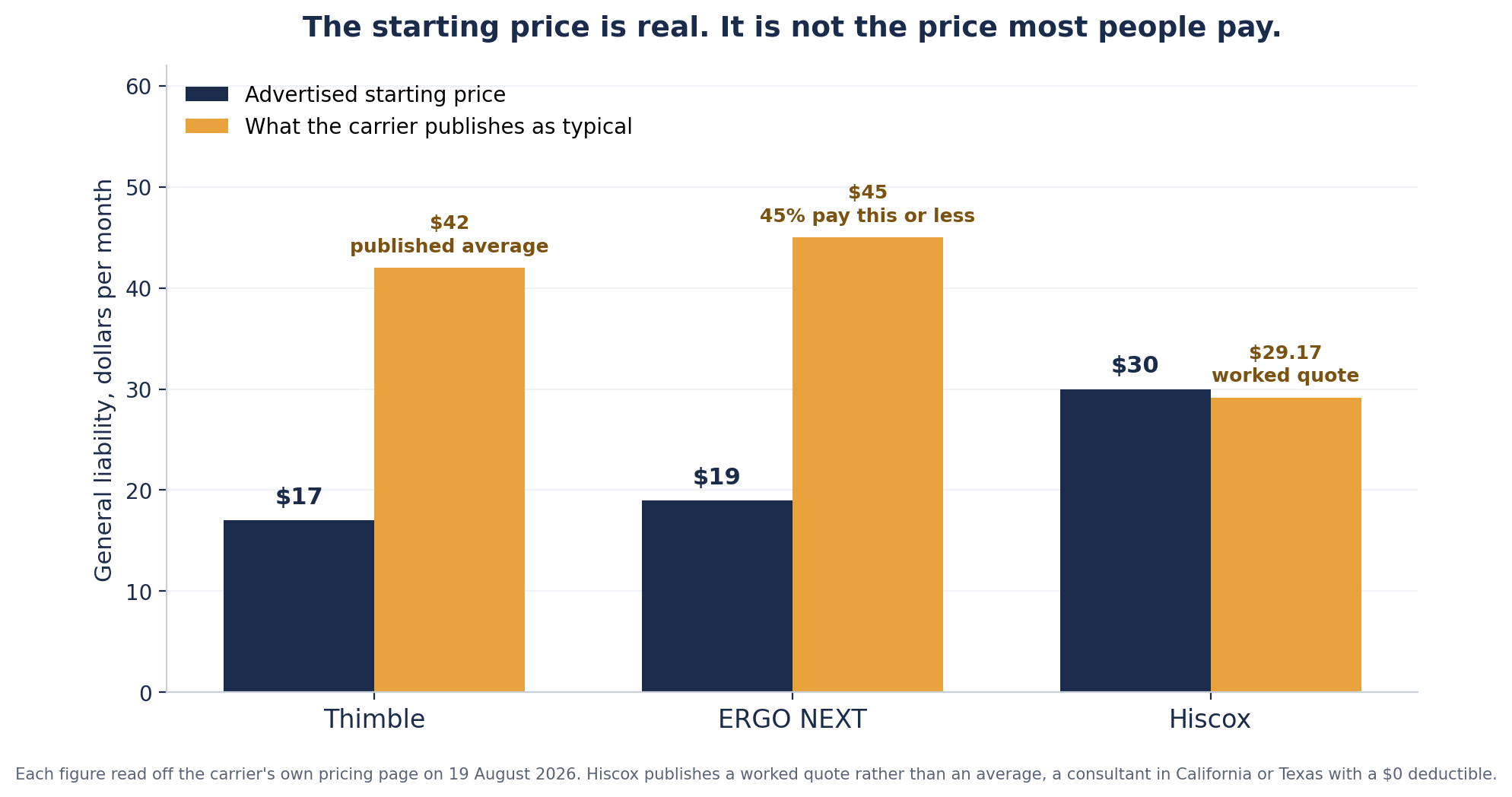
General liability is the foundation. Thimble puts its average at about $42 a month, or $504 a year, and starts at $17. Hiscox starts at $30. It publishes a worked example, a consultant in California or Texas at $29.17 a month, which is $350 a year. ERGO NEXT starts at $19. It says 45% of its customers pay $45 a month or less.
A Business Owner's Policy bundles general liability with commercial property. Price it first if you have a space or equipment. It usually beats buying the two apart.
Add professional liability if you advise or design for a living. ERGO NEXT starts that at $19 a month and says 73% of customers pay $45 or less. Add workers' comp when your state's threshold arrives, from $14 a month at ERGO NEXT, where 49% of customers pay $75 or less. Bundling helps, but modestly. ERGO NEXT publishes up to 10% off, Hiscox up to 5%. Anyone promising you 30% is not quoting a carrier's own number.
Tips
- Ask for the Business Owner's Policy quote first if you have a space or equipment, then compare it to general liability plus property bought separately.
- A solo freelancer with no employees and no inventory can usually start with general liability alone.
- Treat published starting prices as the floor for the lowest risk buyer in the cheapest state, not as your quote.
Common Mistakes
- Buying cyber liability before general liability is in place. Build the foundation first.
- Choosing the lowest limits to save a few dollars a month, then meeting a claim your policy cannot cover.
- 4
Get Quotes from at Least Three Providers
Quote three carriers before you buy. Identical coverage prices differently at every carrier. Each one rates your trade on its own loss history, and you cannot see that from outside.
ERGO NEXT quotes online in about 10 minutes. It lists a price floor for each policy type. Thimble sells month to month. That suits seasonal work. It publishes its average and its $17 floor. Hiscox writes in 49 states and Washington DC. Alaska is the gap. It shows a real consultant quote. CoverWallet runs one form past several carriers.
Look past the monthly premium. Check the deductible, because Thimble's run from $1,000 down to $0 and that spread moves the premium. Check the limits against what your contracts demand. Read the exclusions. Check the A.M. Best rating, since financial strength is what a claim actually collects from.
Tips
- Quote the same limits and the same deductible at every carrier, or you are comparing two different products.
- Ask about pay in full discounts. Carriers offer them, but the amount is quoted to you, not published.
- Check the A.M. Best rating for every carrier you shortlist, because financial strength is what pays a claim.
Common Mistakes
- Buying the first quote without comparing.
- Ignoring the deductible. A $1,000 deductible looks cheaper monthly and costs more the day you claim.
- 5
Purchase Your Policy and Get Your Certificate of Insurance
Once you pick a carrier you can buy most policies online and get the certificate of insurance right away. The COI proves your coverage is active. Landlords, clients, and general contractors will ask for it often. ERGO NEXT, Thimble, and Hiscox all issue one on the spot.
Check four things before you finalize. Your effective date should be today or the day coverage must start, never a future date that leaves you bare in between. Your per occurrence limit should match the contract that made you buy this, which usually means $1 million. Your deductible should be a number you could pay this week. And if a landlord or client must be named as an "additional insured," add that endorsement during checkout.
Tips
- Download the COI the moment you buy and put it in cloud storage, because someone will ask for it at an inconvenient time.
- Set a reminder 30 days before renewal so you can shop before auto renewal decides for you.
Common Mistakes
- Forgetting to add the landlord or client as an additional insured, which can breach the lease you bought the policy for.
- Setting a future effective date and working uninsured in the gap.
- 6
Schedule an Annual Policy Review
Your coverage should change when your business does. Put the review on the calendar now, because nothing else will remind you.
Four events change your answer. Hiring past your state's threshold makes workers' comp mandatory, and that number is 3 in Georgia and 4 in Florida outside construction. Buying a vehicle brings in commercial auto. Leasing space brings in property coverage. It usually brings a landlord's insurance clause too. Growing revenue raises the limits your contracts ask for.
Shop your renewal. Get two competing quotes before you accept the one your carrier sends. If you added staff, expect a workers' comp payroll audit against your real payroll.
Tips
- Compare your renewal against at least two other quotes every year.
- If you added employees mid year, your workers' comp premium will be audited and adjusted at renewal against real payroll.
- Re-check your state threshold when you hire, since Georgia counts LLC members toward it.
Common Mistakes
- Letting a policy auto renew without reading the limits, which leaves you underinsured as you grow.
- Not telling your insurer about new employees or a new location, which is how a claim gets denied.
Two things set your price. How many policies you carry, and how risky your trade is. Every number below comes from a carrier's own published pricing, checked on September 9, 2026.
Take the solo consultant first. Working from home, no employees, general liability alone. Hiscox publishes exactly this case, a consultant in California or Texas at $29.17 a month, which is $350 a year. Thimble's average across all its customers is $42 a month, or $504 a year. Add professional liability and ERGO NEXT starts that at $19 a month, which is $228 a year. Both policies together run from about $578 a year on the Hiscox worked example to about $732 if your general liability lands on Thimble's average.
Now add staff. A shop pays for more policies, not one bigger policy. Commercial property starts at $18 a month at ERGO NEXT, where 40% of customers pay $45 or less. Workers' comp starts at $14 a month there. 49% of its workers' comp customers pay $75 or less. Bundle liability and property into a Business Owner's Policy and ERGO NEXT publishes up to 10% off, Hiscox up to 5%.
Risk sets the ceiling. ERGO NEXT's own medians run $21 to $60 a month for consulting and $36 to $160 for construction. Restaurants run $36 to $130, cleaning $23 to $116, retail $32 to $89. Find your trade in that list before you decide a quote is unfair. For carrier by carrier detail, see our best business insurance comparison.
Cost Breakdown
| Item | Cost Range | Notes |
|---|---|---|
| General liability (per month) | $17 - $42 | Thimble starts at $17 and puts its own average at $42. Hiscox starts at $30. ERGO NEXT starts at $19 and says 45% of customers pay $45 or less. Verified at each carrier 2026-09-09. |
| General liability, worked example (per year) | $350 | Hiscox publishes this for an IT consultant in CA and a business consultant in TX, $1M/$2M limits, $0 deductible. Its own page, verified 2026-09-09. |
| Professional liability / E&O (per month) | From $19 | ERGO NEXT's published floor. It says 73% of its professional liability customers pay $45 a month or less. |
| Workers' compensation (per month) | From $14 | ERGO NEXT's published floor. 49% of its workers' comp customers pay $75 a month or less. Your rate is priced off your payroll and your class code. |
| Commercial property (per month) | From $18 | ERGO NEXT's published floor. 40% of its commercial property customers pay $45 a month or less. |
| Median all-in, by trade (per month) | $16 - $160 | ERGO NEXT customer medians, April 2026 data. Sports and fitness $16-$73, consulting $21-$60, cleaning $23-$116, beauty $26-$62, retail $32-$89, restaurants $36-$130, construction $36-$160. |
| Bundle discount | 5% - 10% | ERGO NEXT publishes up to 10%, Hiscox up to 5%. These are the carriers' own published figures, not an estimate. |
| Independent agent or broker fee | $0 | Agents are paid by the carrier. Their help costs you nothing. |
Your policy is active and the certificate is in hand. 5 things left:
- Send the COI to whoever asked for it. Your landlord, your key clients, any general contractor waiting on it.
- Log the premium as a business expense. Insurance premiums are a deductible business cost. If you have not set up books yet, see how to set up small business accounting.
- Store the full policy, not just the certificate. The COI proves coverage exists. The policy language decides what gets paid. Save both.
- Tick insurance off the setup list. It is one step in the complete business setup guide. Move to the next.
- Diary the triggers. Crossing your state's employee threshold means workers' comp, and that is 3 in Georgia and 4 in Florida. A vehicle means commercial auto. Customer data means cyber. A lease means property.

The Complete Checklist
- Check your state's workers' compensation requirements01
Determine the employee threshold that triggers mandatory coverage in your state.
10 minutes$0 - Review all contracts for insurance clauses02
Check leases, client agreements, and loan docs for minimum coverage requirements.
15 minutes$0 - List every risk your business faces03
Map client contact, professional advice, data handling, employee safety, and vehicle use to policy types.
15 minutes$0 - Decide on required policy types04
Select from general liability, professional liability, workers' comp, commercial property, cyber, and auto.
10 minutes$0 - Choose coverage limits and deductibles05
Landlords and clients usually ask for $1 million per occurrence and $2 million aggregate. Deductibles vary more. Thimble runs $1,000 down to $0, and the Hiscox example quote carries $0.
10 minutes$0 - Get quotes from at least three carriers06
Thimble, Hiscox and ERGO NEXT each quote online in minutes. CoverWallet runs one form past several carriers at once.
30-60 minutes$0 - Compare premiums, deductibles, and exclusions07
Look beyond the monthly price; check what is excluded and what your out-of-pocket cost would be at claim time.
15 minutes$0 - Purchase your policy online08
Buy through the carrier's website and download your certificate of insurance immediately. Month one lands between $16 and $160 for most trades, on ERGO NEXT customer medians.
10 minutes$16-$160 first month - Add additional insured endorsements09
Name your landlord, clients, or contractors as additional insureds if your contracts require it.
5 minutes$0-$50 - Schedule your annual policy review10
Set a calendar reminder 30 days before renewal to reassess limits, shop competitor quotes, and update coverage.
2 minutes$0
These are the carriers we track and the state pages worth a bookmark.
- ERGO NEXT. Formerly NEXT Insurance. Quotes online in about 10 minutes, and it publishes its price floors by policy type.
- Thimble. Month to month policies. General liability from $17 a month, with deductibles down to $0.
- Hiscox. General liability from $30 a month. Writes in 49 states and shows worked quote examples.
- CoverWallet. One set of questions, quotes from several carriers.
- SBA, Get business insurance. The federal view of what employers must carry.
- NAIC state regulator directory. Find your own state's rules here.
We only list carriers we have tested. For how they compare on price and service, see our best business insurance guide.
These are the mistakes that cost new owners the most, in the order we see them:

- Believing the LLC already covered it. This is the big one. An LLC separates your personal assets from the company's debts. It does not pay the claim. If a client sues your LLC and wins, the LLC's bank account pays, and if the account is short, the business is done. That is the gap general liability exists to fill.
- Trusting the 'first employee' rule. It is wrong in several states. Georgia starts at 3. Florida starts at 4 outside construction and 1 inside it. Read your own state's agency page. Count LLC members where the state counts them.
- Skipping workers' comp when it is required. States enforce this one. Penalties follow, and so does personal liability for an injury. Check your threshold at the state source, then diary the date you cross it. No employees yet, but a contractor still wants a workers' comp certificate? Read what a workers comp ghost policy does and does not cover before you buy one.
- Choosing the lowest limits to save a few dollars. Most contracts want $1 million per occurrence and $2 million aggregate. Buy under that and you can breach the lease that made you buy insurance at all. Read the clause first.
- Not reading the exclusions. Every policy lists what it will not pay for. Flood, intentional acts, and pollution are common surprises. Read that section before you need it, not after.
- Setting it and forgetting it. Coverage that fit a solo founder does not fit three employees and a van. Review once a year and after every hire.
Do you use AI in client work? One coverage question is worth raising at renewal, and our guide to business insurance types covers it.
Frequently Asked Questions
Yes, in almost every case. An LLC and a policy do two different jobs. The LLC keeps your personal house, car, and savings out of a lawsuit against the business. It does nothing about the business paying that claim from its own account. If a client sues your LLC and wins, the LLC pays, and if it cannot, the business closes. Insurance is what pays instead. The LLC protects you. The policy protects the company you built.
No law likely forces you, if you have no employees and no leased space. Your contracts still might. The bigger issue is the shield. A sole proprietor has none. A claim against the business is a claim against you personally. General liability starts at $17 a month at Thimble and $19 at ERGO NEXT. If you give professional advice, add E&O, which ERGO NEXT also starts at $19 a month.
Workers' compensation is required in every state except Texas, but the employee count that triggers it varies. Georgia starts at 3. Florida starts at 4 outside construction and 1 inside it. Commercial auto is required if you drive for the business. General liability is rarely required by law, yet landlords, lenders, and clients demand it in writing, which binds you the same way. Check your state agency, not a blog.
Thimble puts its general liability average at $42 a month, or $504 a year, and starts at $17. Hiscox starts at $30 and publishes a consultant example at $29.17 a month. ERGO NEXT starts at $19 and says 45% of its general liability customers pay $45 a month or less. Your trade moves it most. ERGO NEXT's own medians run $21 to $60 for consulting and $36 to $160 for construction.
$1 million per occurrence with $2 million aggregate is the standard limit most contracts ask for. It is also what the published starting prices describe. Hiscox publishes a business consultant in Texas at those limits for $29.17 a month, which is $350 a year, with a $0 deductible. Higher risk trades pay more. ERGO NEXT's construction median runs $36 to $160 a month.
A standalone general liability policy, bought online. Thimble starts at $17 a month, ERGO NEXT at $19, Hiscox at $30. Those floors describe the lowest risk buyer, so treat them as a starting point and not a quote. If you need property cover too, price a Business Owner's Policy before buying the two separately. Bundling saves up to 10% at ERGO NEXT and up to 5% at Hiscox.
Yes, premiums are deductible. Business insurance is generally a deductible business expense on your federal return. That covers general liability, professional liability, workers' comp, and commercial property. Track the premiums in your accounting software as you pay them. Reconstructing a year of payments in April is miserable. Ask a licensed CPA about your own situation.
General liability covers third party injury and property damage. A client slips in your office. Professional liability, also called E&O, covers claims that your work or your advice cost someone money. A client says your consulting sank their launch. Most service businesses need both, because the two do not overlap. ERGO NEXT starts each at $19 a month and takes up to 10% off when you bundle them.
Sources & References
- SBA - Get business insurance
- Texas Department of Insurance - Workers' compensation employer resources
- Florida Department of Financial Services - Workers' compensation coverage requirements
- Georgia State Board of Workers' Compensation - Insurance FAQs
- ERGO NEXT - How much does business insurance cost
- Thimble - General liability insurance cost
- Hiscox - General liability insurance cost
- NAIC - State insurance regulator directory
About the Author
Editor, StartupOwl
Eliot leads StartupOwl's state data research. He maintains the site's fifty state records of LLC filing fees, annual costs, processing times, and small business grant programs, checking each figure against the state office that publishes it and logging the date it was verified. Based in New Jersey, he has spent his working life in and around small businesses, and he writes for the founder who wants the real number rather than the advertised one. Every figure under his byline traces to a named source, and when a state proves a number wrong, the correction is published, not buried.
Was this article helpful?
Questions about Do I Need Business Insurance? A Decision Guide
No comments yet. Ask the first question and a member of our team will answer.
Leave a comment