
E-2 Visa Business Guide
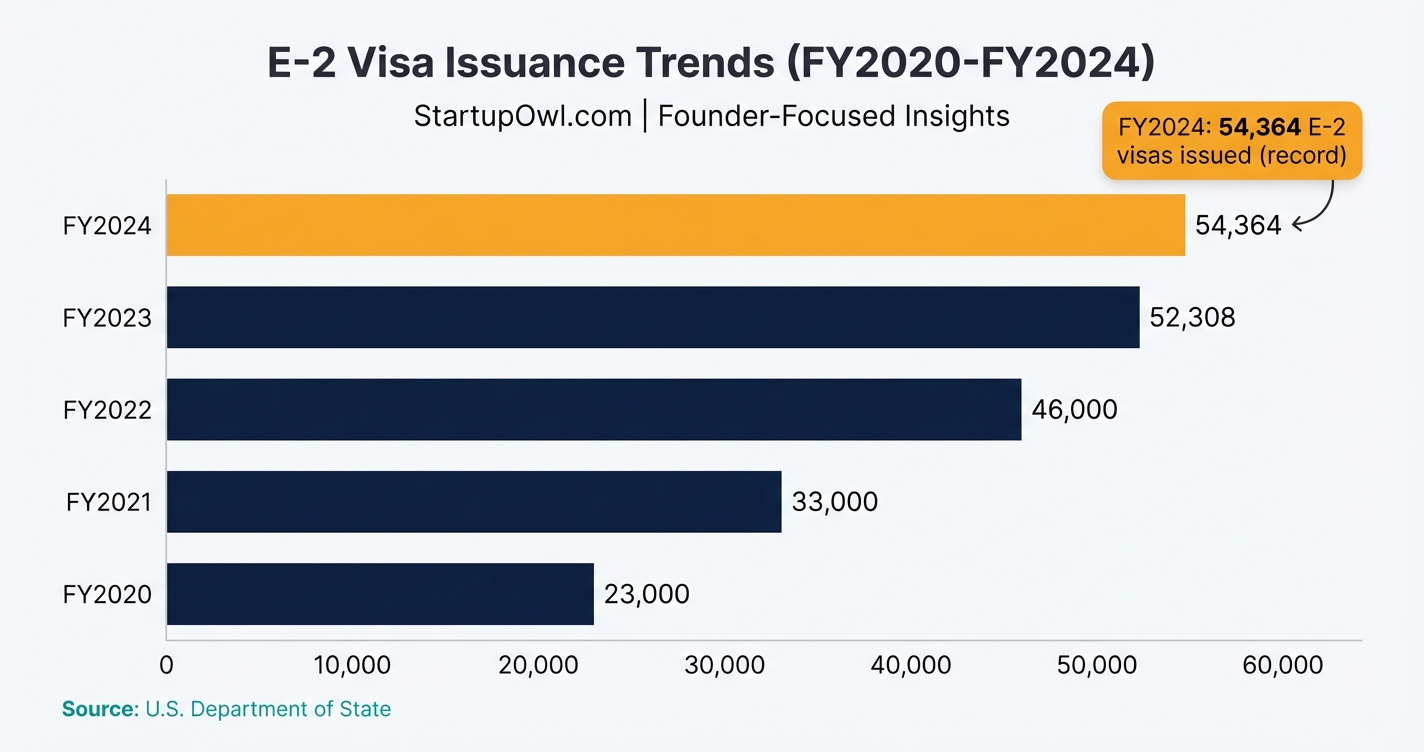
Learn how to start a U.S. business on an E-2 Treaty Investor Visa. Over 54,000 E-2 visas issued in FY2024 with 90%+ approval rates. Step-by-step guide inside.

StartupOwl may earn a commission when you use links on this page to sign up for business formation or banking services. This does not affect our editorial recommendations. All opinions are our own.
If you hold citizenship in one of the 80+ treaty countries and can invest a substantial amount in a real U.S. business, the E-2 visa lets you live, work, and grow your company on American soil. Your spouse gets work authorization, and your children under 21 can attend school.
This guide covers every requirement, cost, and timeline you need. If you are new to entrepreneurship in the U.S., also read our immigrant entrepreneur guide for a broader overview of your options.
What the E-2 Visa Actually Requires
The E-2 Treaty Investor Visa is a nonimmigrant visa created under the 1952 Immigration and Nationality Act. It allows nationals of treaty countries to invest in and manage a U.S. business without employer sponsorship.
To qualify, you must meet three core requirements set by USCIS. First, you must be a national of a treaty country. Second, you must invest (or be actively investing) a "substantial" amount of capital in a real, operating U.S. business. Third, you must be entering the U.S. solely to develop and direct that business.
Your investment must be "at risk," meaning the capital is subject to partial or total loss if the business fails. The business cannot be "marginal" (it must have the capacity to generate enough income to do more than just support you and your family within five years). You must also own at least 50% of the enterprise or hold operational control through a managerial position.
There is no legally defined minimum investment amount. However, immigration practitioners consistently recommend $100,000 or more for most business types. The lower the total cost of your business, the higher the percentage you need to invest for USCIS to consider it "substantial."
How to Get Your E-2 Visa Step by Step
The E-2 process has six major stages, from verifying your eligibility through filing your application. The total timeline typically runs 3 to 8 months depending on your preparation speed and chosen filing route.
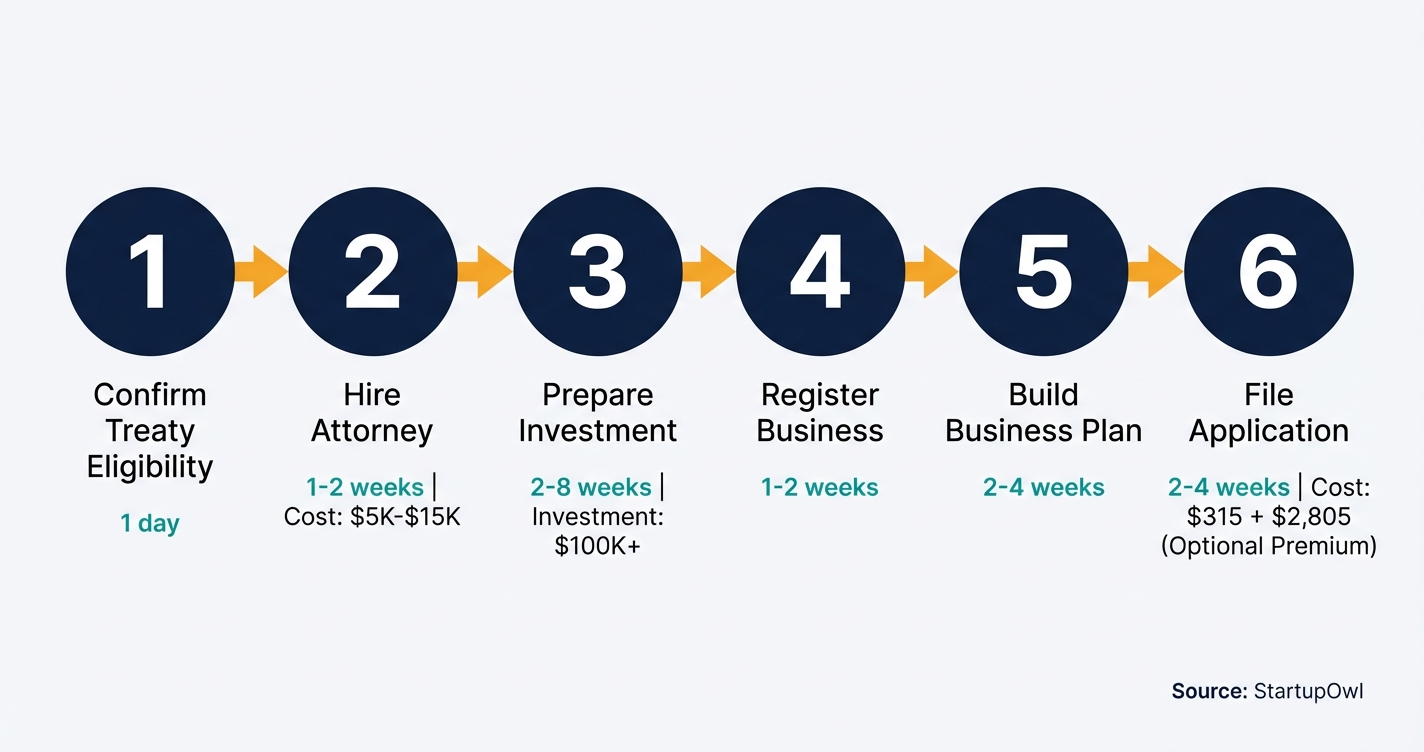
Each step is detailed below in the steps section. The most important thing to understand upfront is that you must commit your investment capital before receiving the visa (though escrow accounts can protect you if the application is denied).
Before you begin, form an LLC or C-Corp to house your investment. Most E-2 investors use an LLC for its liability protection and tax flexibility. Check our sole proprietorship vs LLC comparison if you are unsure which structure fits your situation.
The SBA business plan guide is a solid starting point for structuring your plan. You can also download our free business plan template to get organized quickly.
E-2 Visa Cost Breakdown (2026)
| Type / Provider | Rate | Notes |
|---|---|---|
| Visa Application Fee (DS-160) | $315 | Paid to the U.S. Department of State; non-refundable |
| Premium Processing (optional, USCIS only) | $2,805 | Guarantees 15-business-day response on Form I-129 |
| Immigration Attorney Fees | $5,000 to $15,000 | Varies by case complexity and attorney experience |
| Business Plan Preparation | $1,500 to $5,000 | Professional E-2 business plan writers; required for new businesses |
| LLC Formation (service + state fees) | $350 to $1,400 | Doola starts at $297 + state fees; state fees range from $50 to $500 |
| Business Investment (capital at risk) | $100,000 to $300,000+ | No legal minimum, but $100K+ is the practical floor for most business types |
| Business Setup Costs (rent, equipment, payroll) | $10,000 to $30,000 | First few months of operational costs |
| Total Estimated Budget | $120,000 to $350,000+ | Includes investment, all fees, and initial operating capital |
Recommended Tools for E-2 Business Founders
Setting up your U.S. business infrastructure before filing strengthens your E-2 application. Here are tools designed specifically for non-U.S. residents launching American businesses.
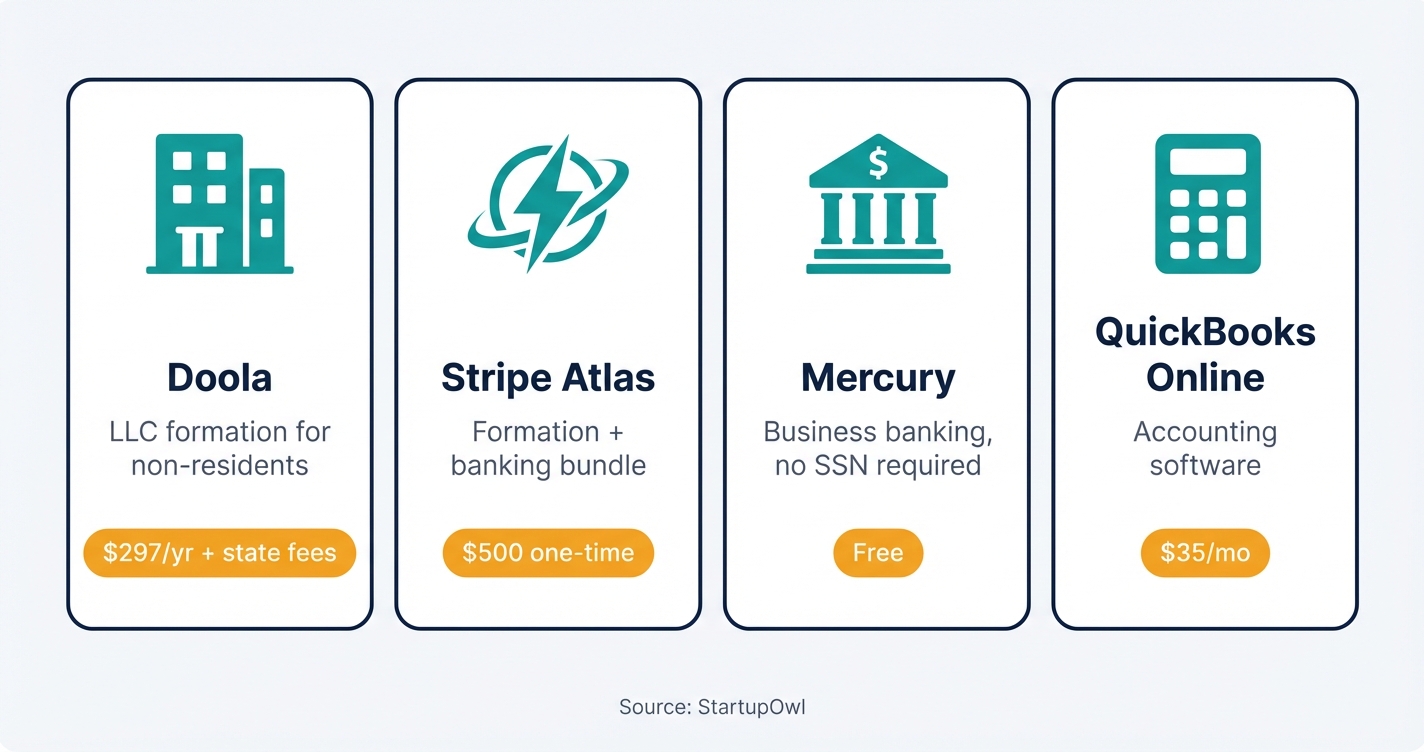
- The Doola platform handles LLC formation, EIN registration, and registered agent service for non-U.S. residents starting at $297 per year plus state fees. Their Total Compliance plan ($1,999/year) adds bookkeeping and tax filing.
- The Stripe Atlas service bundles Delaware C-Corp or LLC formation with a business checking account at Mercury and Stripe payments for $500 (one-time fee). It is popular with tech and e-commerce founders.
- For business banking, Mercury is the top choice for non-U.S. founders because it accepts applications without a Social Security Number. There is no monthly fee, and you can open an account remotely.
- Choose accounting software like QuickBooks Online (starting at $35/month) or Xero (starting at $29/month) to track expenses from day one. Clean books are essential for E-2 renewals.
Need legal services beyond immigration? Platforms like LegalZoom and Rocket Lawyer offer affordable contract templates and ongoing legal advice starting around $39/month.
5 Mistakes That Get E-2 Applications Denied
E-2 approval rates exceed 90% for well-prepared applications, but roughly 5,600+ denials occurred in FY2023 alone, according to Department of State data. Knowing the top reasons for denial helps you avoid them.
- Incomplete source-of-funds documentation. USCIS requires a clear, traceable paper trail proving your investment capital was legally obtained. Bank statements, tax returns, sale contracts, and gift letters must all connect. Gaps in documentation are the single most common reason for denials.
- Failing the marginality test. Your business must demonstrate the present or future capacity to generate income beyond a minimal living for you and your family. For new businesses, a five-year financial projection showing meaningful revenue growth and U.S. job creation is essential. A consulting business with no employees and modest revenue projections will raise red flags.
- Investing too little relative to business cost. While there is no legal minimum, investing $50,000 in a business that typically requires $200,000 to start signals a lack of commitment. The lower the total business cost, the higher the percentage you must invest.
- Not having capital "at risk" at filing. Money sitting in a personal bank account is not considered invested. Your funds must be irrevocably committed (or held in escrow conditioned solely on visa approval) before you file.
- Choosing the wrong business structure for your visa. Your entity choice (LLC vs. C-Corp) affects your tax situation and visa compliance. An S-Corp election, for example, has residency requirements that may conflict with your nonimmigrant status. Always consult both an immigration attorney and a CPA before choosing your structure. See our guide on sole proprietorship vs LLC for more context.
Important Legal and Tax Considerations
Immigration law disclaimer. The E-2 visa involves complex federal immigration regulations that change frequently. This guide provides general educational information only. You should consult a qualified immigration attorney before making any investment or filing decisions. Visa eligibility, treaty country status, "at risk" investment determinations, and marginality assessments all vary by individual circumstances.
Tax considerations. Entity structure selection (LLC, C-Corp, or S-Corp) and tax implications for nonimmigrant visa holders require review by a CPA or tax professional familiar with foreign national taxation. E-2 visa holders are generally considered U.S. tax residents for time spent in the country and may owe federal, state, and local taxes.
Changes to immigration policy can happen quickly. During the previous Trump administration, E-2 visa validity periods and fees changed for several countries (France, the Netherlands, Australia, and Israel among them). The approval rate itself remained above 88% throughout that period, but individual country terms shifted. Stay current by checking USCIS.gov and the State Department website regularly.
For broader startup funding options (including grants you may qualify for), read our guides on startup funding options and small business grants.
Your Next Steps This Week
Start by verifying your treaty country eligibility at travel.state.gov. Then schedule consultations with two or three immigration attorneys who specialize in E-2 cases. Do not invest any capital until you have professional counsel reviewing your plan.
While you wait to retain an attorney, begin building your business plan and documenting your sources of funds. Use our free business plan template and read through the common first-time founder mistakes guide so you avoid the pitfalls that trip up new entrepreneurs.
Once your attorney gives you the green light, register your business, set up a business bank account, and begin deploying your investment capital. The 90%+ approval rate means the odds are in your favor if you prepare thoroughly.
Mercury disclosure
Step-by-Step Process
- 1
Confirm Your Treaty Country Eligibility
Check the U.S. Department of State treaty country list to verify your nationality qualifies. Over 80 countries hold active treaties, including Japan, Canada, Germany, the UK, South Korea, and Spain. Major exclusions include China, India, Brazil, and Russia.
If your country is not listed, some investors obtain citizenship in a treaty country (such as Grenada or Turkey) through citizenship-by-investment programs, though this adds years and cost. Always verify current eligibility before committing funds.
Tips
- Dual nationals can use a treaty-country passport even if their birth country has no treaty
- Check the State Department reciprocity schedule for your country's visa validity period
Common Mistakes
- Assuming permanent residents of a treaty country qualify (you must be a national)
- Overlooking that the AMIGOS Act requires a 3-year holding period for citizenship-by-investment obtained after June 2022
- 2
Hire an Immigration Attorney
An experienced E-2 attorney reviews your investment plan, sources of funds documentation, and business structure before you commit capital. Attorney fees typically range from $5,000 to $15,000 depending on case complexity, as of 2026.
Your attorney will help you avoid the most common denial triggers, including insufficient source-of-funds documentation and marginality concerns. You can find qualified immigration lawyers through the American Immigration Lawyers Association (AILA).
Tips
- Ask for an attorney's E-2 approval rate and number of cases handled
- Request a flat-fee engagement letter so costs are predictable
Common Mistakes
- Skipping legal counsel and filing without professional review
- Hiring a general practice attorney who lacks E-2 experience
- 3
Prepare Your Substantial Investment
There is no legally defined minimum investment for the E-2 visa. However, most successful applications involve $100,000 or more, and USCIS requires the investment to be "substantial" in proportion to the total cost of the business.
Your capital must be irrevocably committed ("at risk") before your visa is approved. You can use an escrow account to protect funds while still demonstrating commitment. Borrowed funds qualify if you (not just the U.S. business) are personally liable for the debt.
$100,000+ (typical investment range is $100,000 to $300,000) 2 to 8 weeks to source and document funds uscis.govTips
- Maintain a clear paper trail showing every dollar's legal origin
- Higher investments relative to business cost strengthen your case
Common Mistakes
- Leaving funds in a personal bank account (not considered 'at risk')
- Failing to document the legal source of every invested dollar
- 4
Register Your U.S. Business Entity
You need a legally formed U.S. business before filing your E-2 petition. Most E-2 investors form an LLC or C-Corp. Your choice of entity type affects your tax obligations and visa compliance, so consult both your immigration attorney and a CPA.
You must own at least 50% of the enterprise to qualify as the principal investor. After forming your entity, obtain an Employer Identification Number (EIN) from the IRS. Services like Doola (starting at $297 plus state fees) specialize in helping non-U.S. residents form an LLC remotely.
Tips
- Wyoming and Delaware are popular formation states for non-residents due to low fees and privacy
- Open a U.S. business bank account immediately after receiving your EIN
Common Mistakes
- Choosing the wrong entity structure without consulting both an immigration attorney and CPA
- Failing to maintain at least 50% ownership as the treaty investor
- 5
Build a Detailed Business Plan
Your business plan is a critical piece of your E-2 petition. It must demonstrate that the business is not "marginal" (meaning it will generate income beyond just supporting you and your family within five years). Include market analysis, financial projections, and a hiring plan.
The plan should follow the Matter of Ho standard used by USCIS adjudicators. Specifically address how your business will create U.S. jobs, generate economic activity, and justify the investment as substantial relative to the business type.
Tips
- Include a 5-year hiring plan showing at least 2 to 3 U.S. employee positions
- Use StartupOwl's free business plan template to start structuring your plan
Common Mistakes
- Submitting generic financial projections with no local market data
- Not addressing the marginality test in the plan
- 6
File Your E-2 Visa Application
You can file through a U.S. consulate abroad (most common for first-time applicants) or through USCIS if you are already in the U.S. on another valid status. The visa application fee is $315 as of 2026. Premium processing (for USCIS filings) costs an additional $2,805 and guarantees a response within 15 business days.
Standard processing through USCIS takes 4 to 6 months. Consular processing varies but typically takes 2 weeks to 4 months depending on the location. Prepare for a personal interview at the U.S. embassy or consulate in your country.
$315 (visa fee) + optional $2,805 (premium processing) 2 weeks to 6 months depending on route travel.state.govTips
- Consular processing is often faster than USCIS for first-time E-2 applicants
- Bring organized source-of-funds documentation to your interview
Common Mistakes
- Submitting incomplete source-of-funds documentation (the top reason for denials)
- Waiting until the last minute to schedule a consular interview during peak season
Frequently Asked Questions
There is no legally defined minimum investment amount. However, most successful E-2 applications involve investments of $100,000 or more, according to immigration practitioners. The investment must be "substantial" in proportion to the total cost of purchasing or establishing the business.
Standard USCIS processing takes 4 to 6 months. Premium processing (available for Form I-129 filings) costs $2,805 and guarantees a response within 15 business days. Consular processing abroad typically takes 2 weeks to 4 months depending on the embassy location and appointment availability.
The E-2 visa approval rate was approximately 90.7% in FY2023, according to U.S. Department of State data. Approval rates have ranged between 87% and 93% over the past decade. Well-prepared applications with thorough documentation tend to perform above the average.
The E-2 visa does not directly lead to a green card. It is a nonimmigrant visa that can be renewed indefinitely as long as the business remains operational. Separate green card pathways exist, including the EB-5 investor program, EB-2 National Interest Waiver, EB-1A extraordinary ability, and family-based sponsorship.
Over 80 countries have E-2 treaties with the United States, including Japan, Canada, Germany, the UK, South Korea, France, Italy, and Spain. Major exclusions are China, India, Brazil, and Russia. Portugal was added as of March 2026. Check the full list at travel.state.gov.
Yes. E-2 dependent spouses can apply for an Employment Authorization Document (EAD), which gives them the right to work for any employer in the United States. Your unmarried children under 21 can also accompany you and attend school. Family members do not need to be from the same treaty country as the principal investor.
The information on this page is for educational purposes only and does not constitute financial, legal, or investment advice. Loan terms, interest rates, and eligibility requirements vary by lender and change frequently. Always consult with a qualified financial advisor before making funding decisions. StartupOwl may earn a commission if you click our links at no extra cost to you.
Sources & References
- U.S. Department of State Nonimmigrant Visa Statistics (FY2020-2024)
- USCIS E-2 Treaty Investors Official Requirements
- U.S. Department of State Treaty Countries List
- NBER Working Paper: Immigrant Entrepreneurship in the US (2024)
- American Immigration Council: Fortune 500 Immigrant Founders Report (2024)
- U.S. Census Bureau Working Paper: Are Immigrants More Innovative? (2023)
- Gusto: Immigrant Entrepreneur Report (2024)
- USCIS Premium Processing Information
About the Author
Editor, StartupOwl
Eliot leads StartupOwl's state data research. He maintains the site's fifty state records of LLC filing fees, annual costs, processing times, and small business grant programs, checking each figure against the state office that publishes it and logging the date it was verified. Based in New Jersey, he has spent his working life in and around small businesses, and he writes for the founder who wants the real number rather than the advertised one. Every figure under his byline traces to a named source, and when a state proves a number wrong, the correction is published, not buried.
Was this article helpful?
Questions about E-2 Visa Business Guide
No comments yet. Ask the first question and a member of our team will answer.
Leave a comment