
Single-Member vs Multi-Member LLC
A single-member LLC is a disregarded entity filing Schedule C. A multi-member LLC files Form 1065 as a partnership. Here is how the tax, liability, and compliance differences affect you.

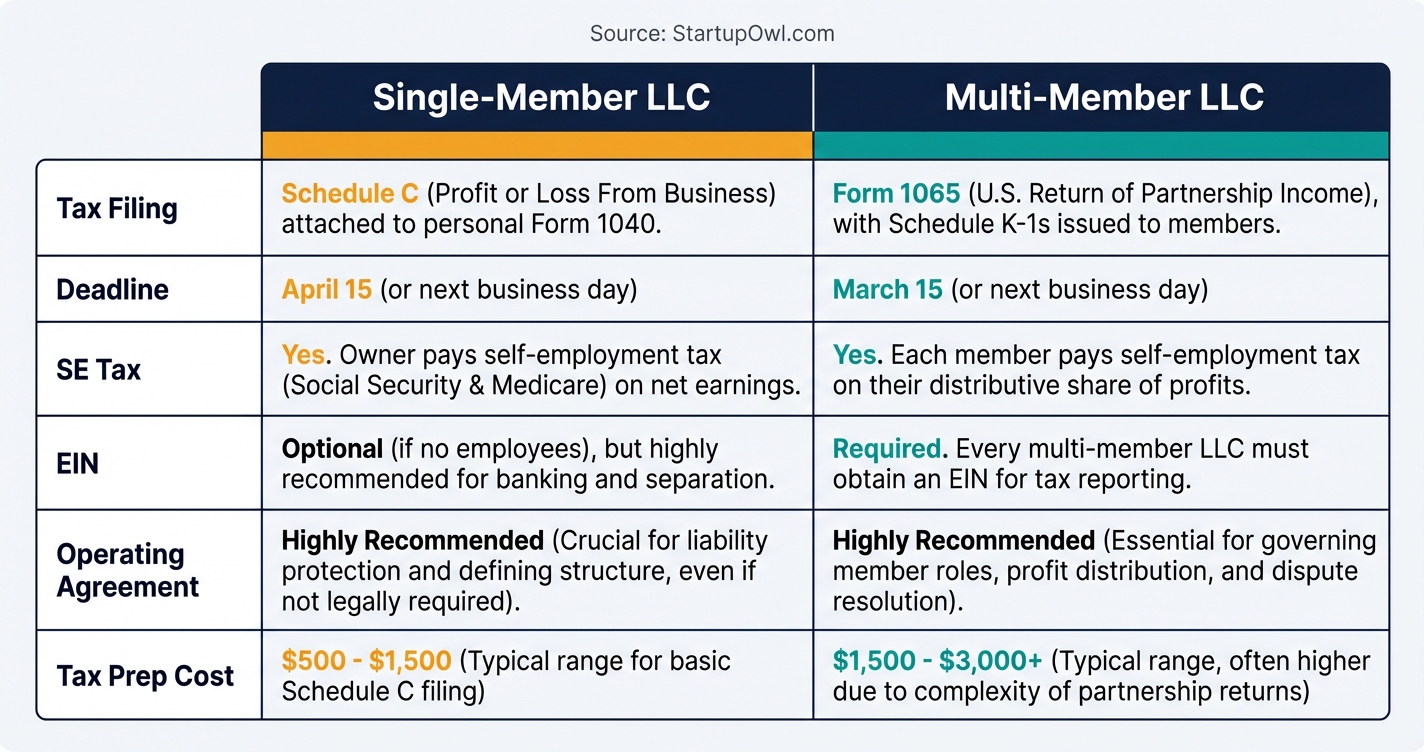
- Single-member LLCs file Schedule C on Form 1040; multi-member LLCs file Form 1065 with K-1s to each member.
- Both owners pay 15.3% SE tax on net earnings, but multi-member LLCs face $255/partner/month late-filing penalties.
- Formation costs are the same ($35 to $500 state filing fee), but multi-member LLCs need a detailed operating agreement.
- Converting from single to multi-member requires a new EIN and takes roughly 4 to 6 weeks.
A single-member LLC is a disregarded entity that reports profits on Schedule C of your personal return (due April 15). A multi-member LLC is taxed as a partnership, filing Form 1065 (due the 15th day of the third month after the tax year ends, March 15, 2027 for the 2026 tax year) and issuing each member a Schedule K-1. Both protect personal assets. Both can elect S Corp or C Corp taxation using Form 2553 or Form 8832.
The IRS treats your LLC completely differently depending on whether you have one owner or two or more. A single-member LLC files on Schedule C with your personal 1040, while a multi-member LLC files Form 1065 as a partnership and issues Schedule K-1s to every member. That difference alone changes your filing deadlines, tax prep costs, and how you report self-employment income.
Both structures protect your personal assets from business debts. But the compliance burden, management rules, and audit exposure are very different. If you are deciding between going solo or bringing on a partner (or spouse), this breakdown covers the real numbers.
Single-Member LLC vs Multi-Member LLC at a Glance
| Factor | Single-Member LLC | Multi-Member LLC |
|---|---|---|
| Tax Treatment | Disregarded entity. Profits reported on Schedule C of your personal Form 1040. | Partnership by default. LLC files Form 1065 and each member gets a Schedule K-1. |
| Liability | Full personal asset protection, but courts pierce the veil more often with commingled funds. | Full personal asset protection for all members. Stronger veil protection with multiple owners. |
| Formation Cost | State filing fee of $35 to $500. Average nationwide is $132. | Same state filing fee ($35 to $500) plus attorney-drafted operating agreement ($500 to $2,000). |
| Formation Complexity | Low. File Articles of Organization, get an EIN, and open a bank account. | Moderate. Requires operating agreement, EIN, capital contribution tracking, and profit-split terms. |
| Ongoing Compliance | Annual report ($0 to $300/yr) plus Schedule C on personal return. Tax prep $500 to $1,500. | Form 1065 (March 15, 2027 deadline), K-1s for each member, annual reports. Tax prep $1,500 to $3,000+. |
| Management | Sole owner makes all decisions. No votes, no required operating agreement in most states. | Member-managed or manager-managed. Major decisions typically require majority vote per operating agreement. |
| Ownership Limits | One owner only. Can be an individual, corporation, or another LLC. | Two or more members. No maximum. Members can be individuals, LLCs, corporations, or trusts. |
| Best For | Solo freelancers, consultants, and side-business owners wanting liability protection with simple taxes. | Partnerships, spouse-owned businesses, startups raising capital, and businesses with multiple co-founders. |
S-Corp Tax Savings by Income Level
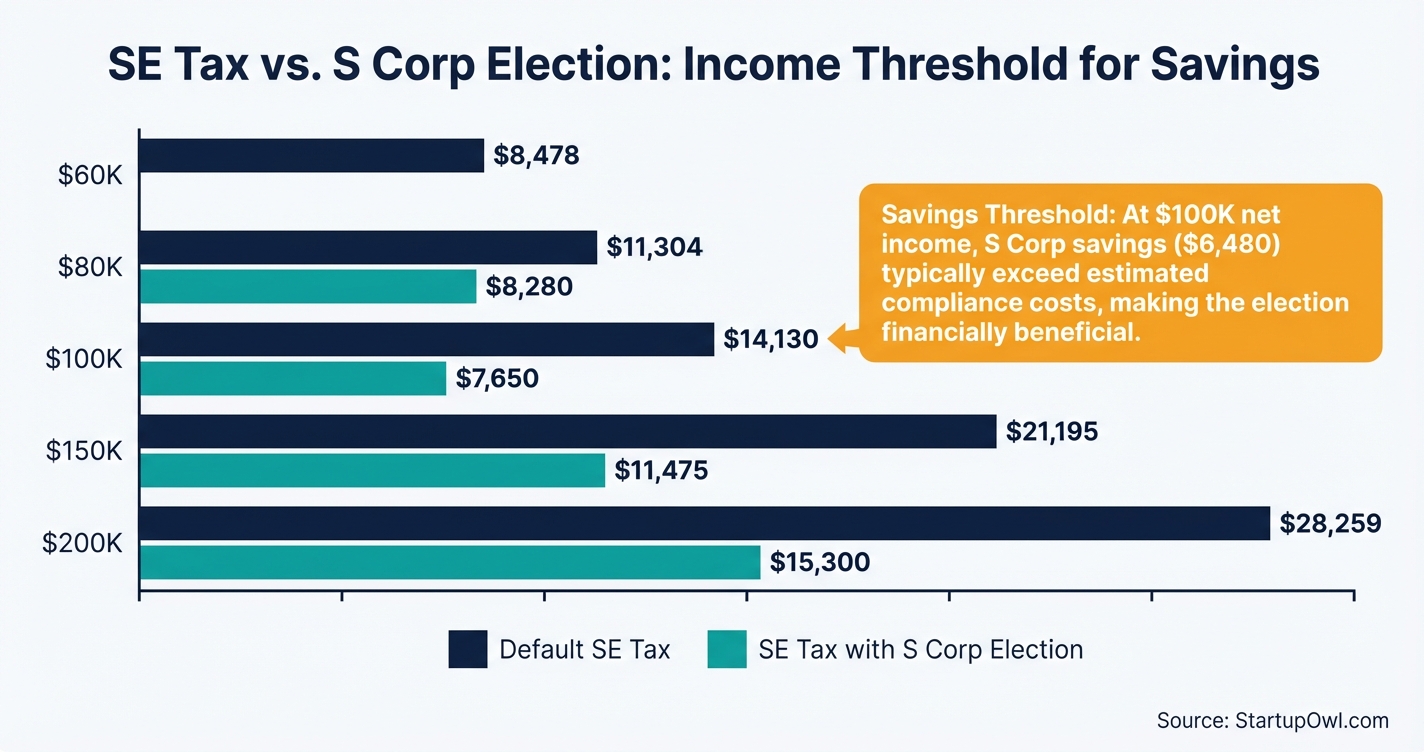
| Annual Income | LLC SE Tax | Est. S-Corp Savings |
|---|---|---|
| $60,000 | $8,478 | $0 (same SE tax if both members are active) |
| $80,000 | $11,304 | $0 (same SE tax if both members are active) |
| $100,000 | $14,130 | $0 (same SE tax if both members are active) |
| $100,000 (S Corp election, $50K salary) | $14,130 (no election) | $6,480 in SE tax savings with S Corp election |
| $150,000 | $21,194 | $9,719 with S Corp election |
| $200,000 | $28,234 | $12,934 with S Corp election |
A single-member LLC is a limited liability company with exactly one owner (called a "member"). It is the most popular business structure for solo entrepreneurs, freelancers, and consultants who want personal asset protection without the overhead of a corporation. You can form one in any state by filing Articles of Organization and paying the $35 to $500 state filing fee.
The IRS treats a single-member LLC as a disregarded entity for income tax purposes. That means your LLC does not file its own tax return. Instead, you report all business income and expenses on Schedule C of your Form 1040 personal return. You pay 15.3% self-employment tax on 92.35% of net earnings, plus your regular income tax rate.
Despite the simple tax filing, a single-member LLC is a separate legal entity from you. Your personal home, car, and bank accounts are shielded from business creditors (assuming you keep finances separated). If you are comparing this to no formal entity at all, see our sole proprietorship vs LLC guide.
A multi-member LLC is a limited liability company owned by two or more members. Members can be individuals, corporations, other LLCs, or trusts. There is no maximum number of members (unless you elect S Corp taxation, which caps owners at 100).
The IRS classifies a multi-member LLC as a partnership by default. The LLC files Form 1065 (U.S. Return of Partnership Income) each year, and each member receives a Schedule K-1 showing their share of income, deductions, and credits. Members then report K-1 amounts on their personal returns (Schedule E, Part II of Form 1040).
Multi-member LLCs offer flexibility that partnerships and corporations do not. You can allocate profits differently from ownership percentages (a 60/40 owner split with a 70/30 profit split, for example). But this flexibility requires a solid operating agreement that spells out every term. Without one, your state's default LLC act governs, and those defaults rarely match what you actually want.
The biggest difference is how the IRS sees your LLC. A single-member LLC is invisible to the IRS for income tax (it is a "disregarded entity"), while a multi-member LLC is a separate tax entity that must file its own informational return. Everything downstream (deadlines, penalties, forms, and costs) flows from that distinction.
Tax Filing and Deadlines
Your single-member LLC income goes on Schedule C, due with your personal 1040 by April 15, 2027 for the 2026 tax year. A multi-member LLC files Form 1065 by March 15, 2027 (one month earlier). Miss the Form 1065 deadline and the penalty is $255 per partner per month, for up to 12 months. A 3-member LLC filed 2 months late would owe $1,530 in penalties alone.
Self-Employment Tax
Active members of both entity types pay 15.3% self-employment tax on 92.35% of net earnings (12.4% Social Security up to $184,500 in 2026, plus 2.9% Medicare on all earnings). The Social Security wage base for 2026 is $184,500, up from $176,100 in 2025. Either structure can elect S Corp taxation via Form 2553 to split income between salary (subject to payroll tax) and distributions (not subject to SE tax).
Liability and Veil Piercing
Both structures provide personal asset protection. However, courts pierce the corporate veil more readily on single-member LLCs when owners commingle personal and business finances. Multi-member LLCs with properly maintained separate bank accounts and operating agreements get stronger protection in court. Open a dedicated business bank account from day one, regardless of structure.
Formation Complexity
Both structures file Articles of Organization with the same state fee ($35 to $500). The difference is that a multi-member LLC practically requires a detailed operating agreement covering ownership percentages, profit/loss allocation, voting rights, buyout provisions, and dispute resolution. Attorney-drafted operating agreements cost $500 to $2,000. Single-member LLCs can use a free template.
Ongoing Compliance Costs
Tax preparation for a single-member LLC typically runs $500 to $1,500 annually. Multi-member LLC tax prep costs $1,500 to $3,000+ because Form 1065, K-1 preparation, and capital account tracking add complexity. The average state annual report fee is $91 per year regardless of structure.
Single-Member LLC Advantages
- Simplest tax filing. No separate business return. Schedule C attaches to your personal Form 1040.
- Total control. You make every decision without votes, approvals, or partner negotiations.
- Lower compliance costs. Tax prep runs $500 to $1,500 per year versus $1,500 to $3,000+ for a multi-member LLC.
- No EIN required if you have no employees (though getting one is free and protects your SSN).
Single-Member LLC Disadvantages
- Higher veil-piercing risk. Courts have found single-member LLCs easier to disregard than multi-member entities.
- Full SE tax burden. 100% of net profit is subject to the 15.3% self-employment tax.
- Limited capital options. Without additional members, raising outside investment is harder.
Multi-Member LLC Advantages
- Flexible profit sharing. You can allocate profits and losses differently from ownership percentages.
- Investor-friendly. Members receive formal membership units and K-1 tax documents.
- Stronger legal protection. Multiple members with separate finances make veil piercing harder for creditors.
- Shared workload. Complementary skills and split responsibilities across members.
Multi-Member LLC Disadvantages
- Costly tax prep. Form 1065 plus K-1s for each member adds $1,000 to $2,000 to your annual accounting bill.
- Harsh late-filing penalties. The Form 1065 penalty is $255/partner/month for up to 12 months.
- Operating agreement is essential. Skipping it invites disputes over profits, decisions, and exits.
- Slower decisions. Major actions often require majority or unanimous member approval.
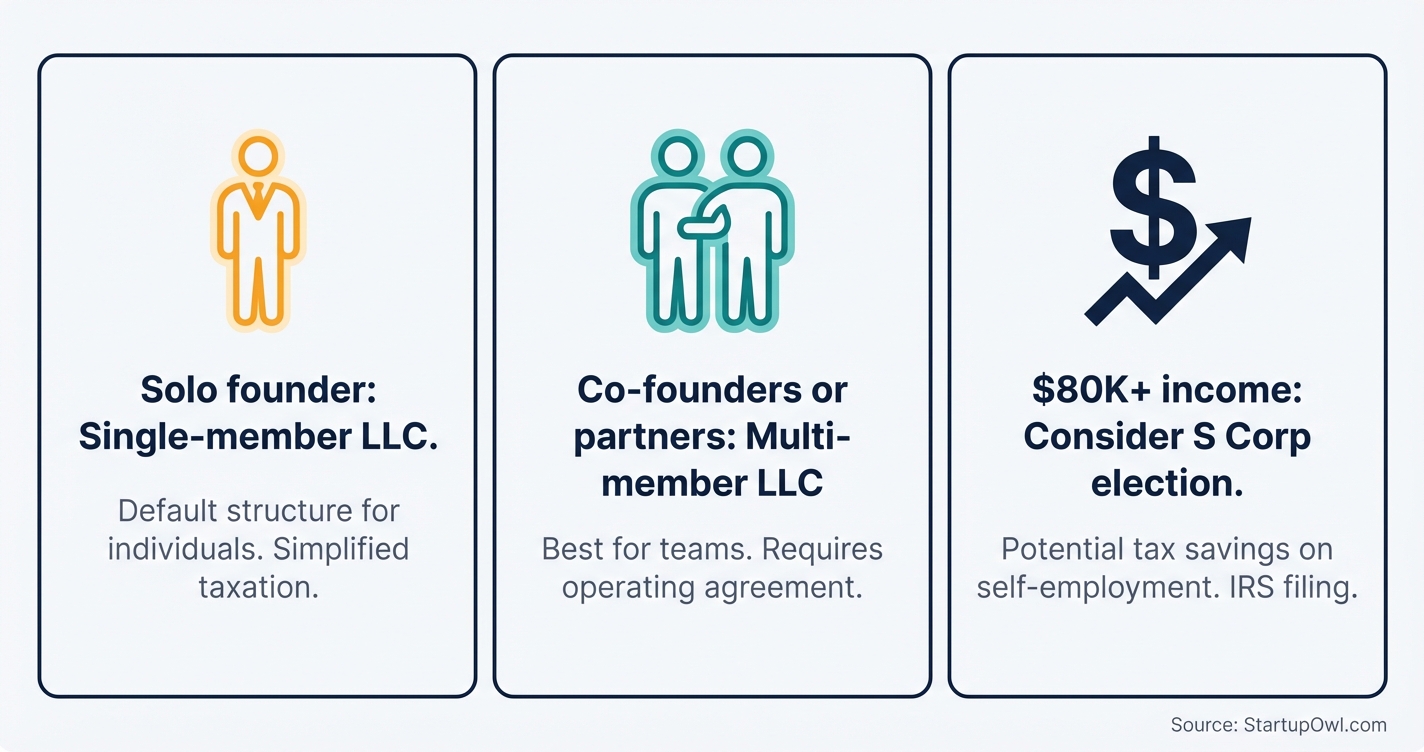
Your choice between a single-member and multi-member LLC comes down to one question: do you have (or plan to have) a co-owner? If yes, you have a multi-member LLC by definition. If no, your decision is purely about whether to stay solo or bring someone in.
If You Are a Solo Freelancer or Consultant
A single-member LLC is almost always the right call. You get liability protection with the simplest tax filing possible. Tax prep stays under $1,500/year. If you want to reduce SE tax as your income grows past $75,000 to $80,000, elect S Corp taxation instead of adding a member. See our LLC vs S Corp comparison.
If You Are Bringing On a Business Partner
You need a multi-member LLC and a detailed operating agreement. Cover profit splits, voting thresholds, buyout provisions, and what happens if a member dies or wants out. Budget $500 to $2,000 for a properly drafted agreement.
If You and Your Spouse Run a Business Together
In the 9 community property states (AZ, CA, ID, LA, NV, NM, TX, WA, WI), you may qualify for "qualified joint venture" treatment, letting you file as a single-member LLC (two Schedule Cs) instead of a partnership. This saves you the Form 1065 complexity. Check IRS qualified joint venture rules.
If You Plan to Attract Outside Investors
Investors generally prefer multi-member LLCs because they receive formal membership units, Schedule K-1s, and clear ownership stakes. A manager-managed structure keeps day-to-day control with you while giving investors the financial reporting they expect.
If You Want to Protect Valuable Personal Assets
Either structure works, but you must keep finances strictly separated. Open a dedicated business bank account, never pay personal bills from it, and maintain proper records. Multi-member LLCs generally get stronger veil protection, but a well-maintained single-member LLC protects you too.
Converting between single-member and multi-member status does not require dissolving your LLC. The process takes about 4 to 6 weeks and involves these steps.
Converting from Single-Member to Multi-Member LLC
- Draft or amend your operating agreement. Define the new member's ownership percentage, capital contribution, profit/loss allocation, voting rights, and buyout provisions. Budget $500 to $2,000 for attorney help.
- File Articles of Amendment with your state Secretary of State if your state requires listing members (fees typically $25 to $150). Some states only require you to update your internal operating agreement.
- Get a new EIN. The IRS requires a new Employer Identification Number when your tax classification changes from disregarded entity to partnership. Apply free at IRS.gov/EIN. It takes 15 minutes.
- Update bank accounts and contracts. Notify your bank, update your business bank account signers, and revise client contracts to reflect the new LLC structure.
- Switch tax filings. Your LLC will now file Form 1065 (partnership return) and issue K-1s to each member. If the conversion happens mid-year, you file Schedule C for the pre-conversion period and Form 1065 for the post-conversion period.
Converting from Multi-Member to Single-Member LLC
If a member exits (buyout, withdrawal, or death) and you are left as the sole member, your LLC automatically becomes a single-member LLC for tax purposes. File a final Form 1065 for the partnership period, then report income on Schedule C going forward. Update your operating agreement and file any required state amendments.
The EIN question in this direction is not settled, so do not assume. The IRS when to get a new EIN page tells partnerships to get a new number if you take over a partnership to operate as a sole proprietor, and it does not address an LLC that survives under state law while its partnership status ends. Publication 1635 does not either. One thing is settled. A single-member LLC is not disregarded for employment taxes, so payroll keeps running on the LLC's own number. Ask your accountant on the income tax side.
Where the exit is a buyout, the tax treatment splits by side and Revenue Ruling 99-6 governs it. See buying out a business partner in an LLC.
For a complete walkthrough on obtaining your tax ID, see our EIN application guide.
Using the Same EIN After Adding a Member
When you convert from a single-member LLC to a multi-member LLC, the IRS considers it a change in entity classification. You need a new EIN. Using the old one creates filing conflicts between your Schedule C and Form 1065 records.
Skipping the Operating Agreement
Roughly 70% of partnership disputes stem from unclear terms about profit splits, decision-making authority, or exit procedures. An operating agreement costs $500 to $2,000 upfront and can save you tens of thousands in legal fees later. Even single-member LLCs should have one to strengthen veil protection.
Missing the Form 1065 Deadline
Multi-member LLCs file Form 1065 by the 15th day of the third month after the tax year ends, so March 15, 2027 for the 2026 tax year. That is a full month before your personal return is due. The penalty for late filing is $255 per partner per month. A 5-partner LLC that files 3 months late owes $3,825 in penalties alone, even if the partnership owes zero tax. File Form 7004 for an automatic 6-month extension if you need more time. File late anyway and there is still a way out. The IRS presumes a small partnership had good reason to be late when it has 10 or fewer partners, all of them individuals, and every member put their share on a personal return filed on time. The rule is Revenue Procedure 84-35. Ask about it before you pay.
Commingling Personal and Business Funds
This is the number-one reason courts pierce the LLC veil. It applies to both structures, but single-member LLCs face higher scrutiny. Open a dedicated business bank account, pay yourself through documented draws or distributions, and never use the business account for personal expenses.
Ignoring State Annual Report Requirements
Most states require an annual or biennial report to keep your LLC in good standing. The average fee is $91 per year. Missing this filing can lead to administrative dissolution, meaning your LLC ceases to exist legally. California charges an $800 annual franchise tax regardless of income. Florida's annual report is due by May 1 each year. Check your state SOS website for your specific deadline.
Not Considering the S Corp Election for SE Tax Savings
Both single-member and multi-member LLCs can elect S Corp taxation using Form 2553. This election typically makes sense when net income exceeds $75,000 to $80,000. At $100,000 in net profit, the S Corp salary-distribution split can save you roughly $5,000 to $8,000 per year in SE tax, after accounting for additional payroll and compliance costs of $3,500 to $5,000.
Frequently Asked Questions
Sources & References
- IRS: Single Member Limited Liability Companies
- IRS: About Form 1065, U.S. Return of Partnership Income
- IRS: Self-Employment Tax (Social Security and Medicare Taxes)
- IRS: Instructions for Form 1065 (2026)
- IRS Publication 509 (2026), Tax Calendars
- Social Security Administration: If You Are Self-Employed (2026)
- SBA: Choose a Business Structure
About the Author
Editor, StartupOwl
Eliot leads StartupOwl's state data research. He maintains the site's fifty state records of LLC filing fees, annual costs, processing times, and small business grant programs, checking each figure against the state office that publishes it and logging the date it was verified. Based in New Jersey, he has spent his working life in and around small businesses, and he writes for the founder who wants the real number rather than the advertised one. Every figure under his byline traces to a named source, and when a state proves a number wrong, the correction is published, not buried.
Was this article helpful?
Questions about this guide
No comments yet. Ask the first question and a member of our team will answer.
Leave a comment