
Best Domain Registrars for Startups in 2026

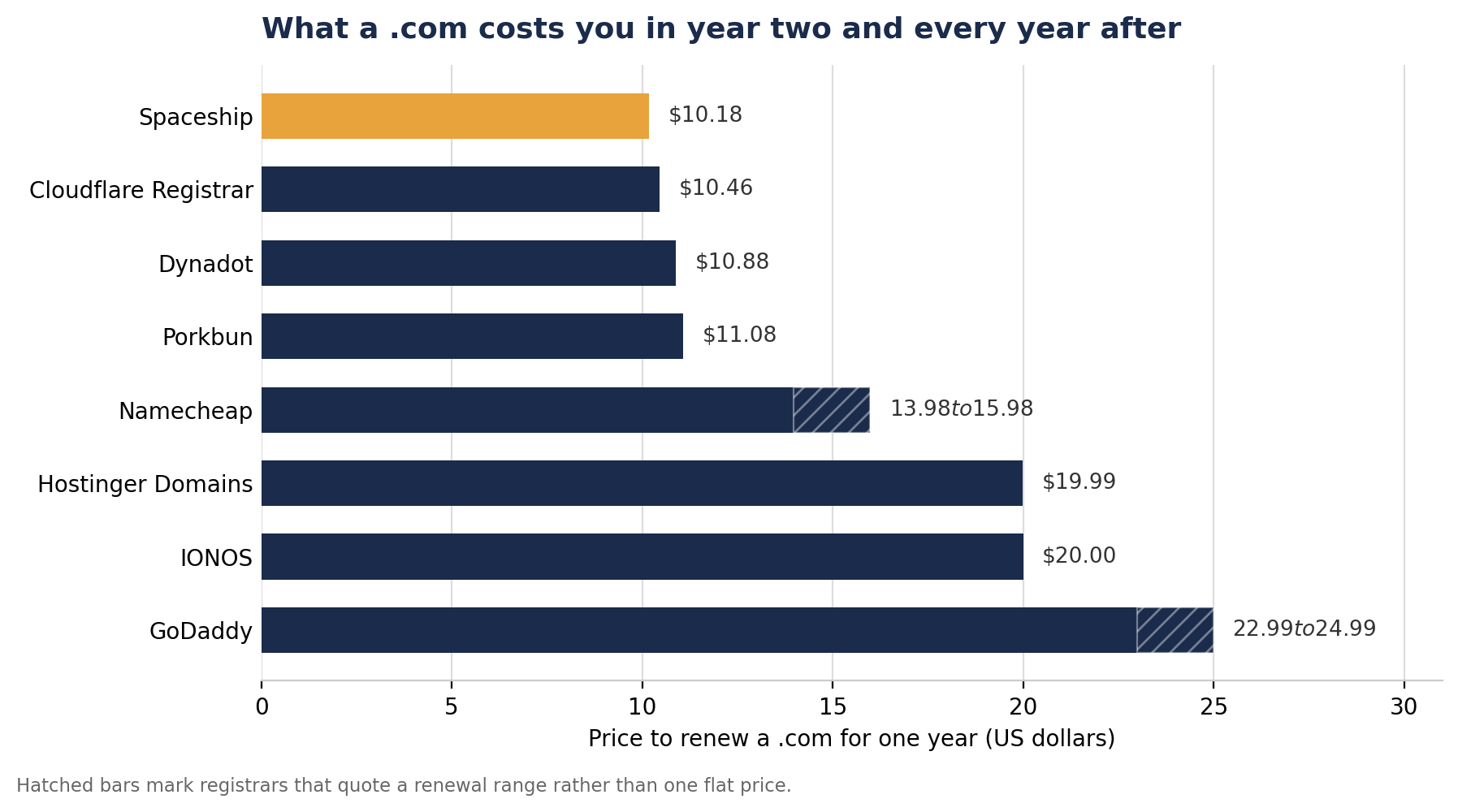
- A .com renews at $10.18 at Spaceship and $22.99 to $24.99 at GoDaddy. The first-year price is not the number that decides this.
- All eight registrars compared here include WHOIS privacy free. Being charged extra for it in 2026 means you picked the wrong registrar.
- Cloudflare Registrar is the cheapest long run. But it locks you to Cloudflare nameservers. That lock is why it ranks fifth here, not first.
- A new domain cannot transfer away for 60 days. That is an ICANN rule. Pick a registrar you can live with for at least a year.
Spaceship is where most founders should start. A .com renews there at $10.18, flat, with free WHOIS privacy and free DNSSEC. The checkout does not try to sell you five things you did not ask for. That holds for your first domain and your fifth.
Already on Cloudflare? Cloudflare Registrar renews cheaper. Want a phone number to call? GoDaddy and IONOS both staff one. The rest of this page explains when each of those calls makes sense.
We priced nine registrars at live checkout. Eight earned a place below. Four are the ones founders meet first, Spaceship, Namecheap, Cloudflare Registrar and GoDaddy. Four are the ones founders move to later, Dynadot, Porkbun, Hostinger and IONOS. Prices were checked in April 2026, and every rating here is sourced.

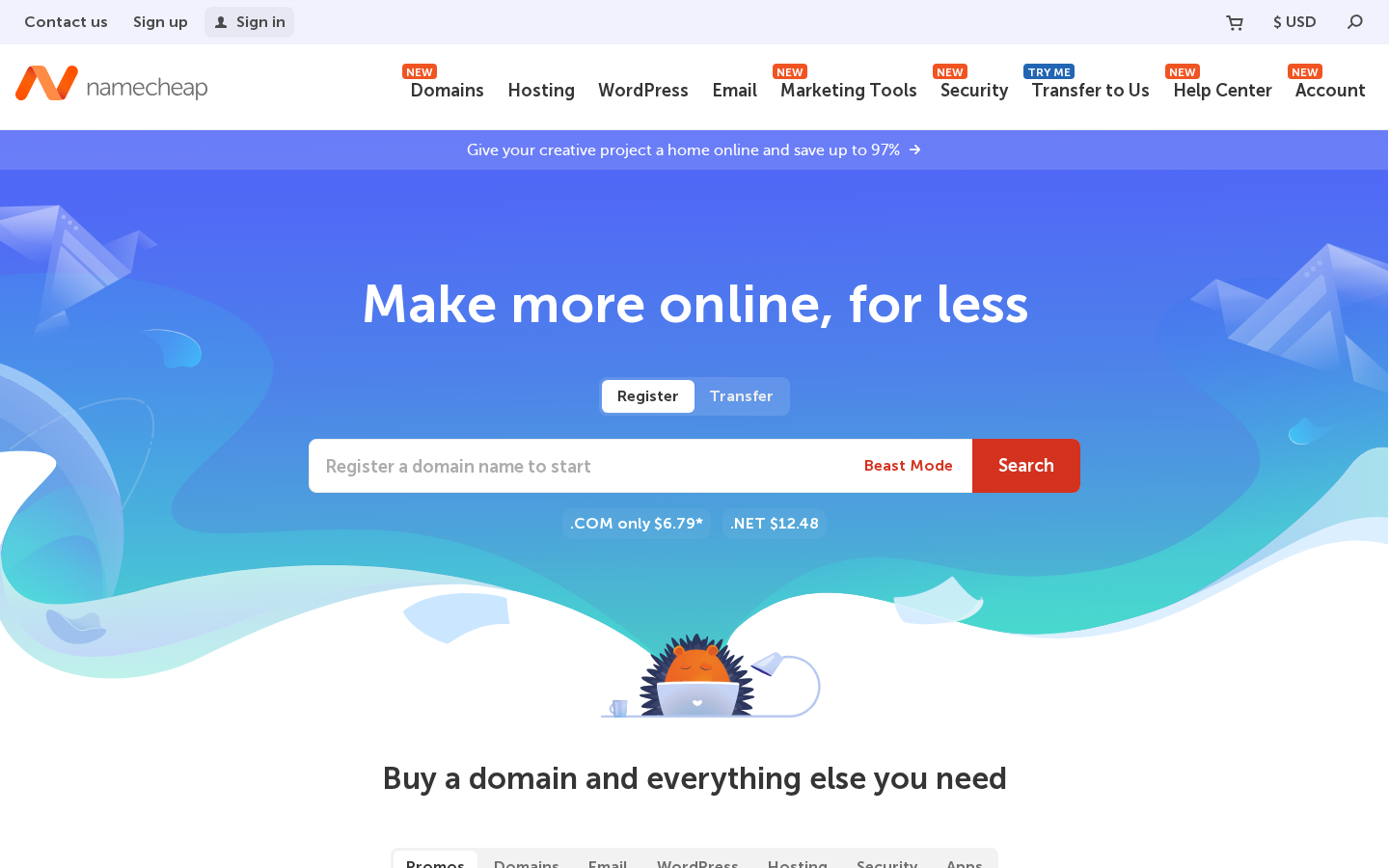
Spaceship
.com $9.98 renewal
Flat pricing for the TLDs a startup actually uses. Free privacy, free DNSSEC, a clean checkout, and a parent company that has been in this business since 2000 under the Namecheap name. If you want one decision that ages well, this is it.
Visit SpaceshipSide-by-Side Comparison
| Feature | |  |  |  |  |  |  |  |
|---|---|---|---|---|---|---|---|---|
| .com first year | about $9.08 | about $9.58 | $10.88 | $11.08 | $10.46 | $11.99 to $22.99 promo | $0.01 to $10.19 promo | $1 promo |
| .com renewal | $10.18 | $13.98 to $15.98 | $10.88 | $11.08 | $10.46 | $22.99 to $24.99 | $19.99 | $20 |
| .ai renewal | $68.98 | about $78 | $85.60 | $82.70 | $70.00 | $159.99 | $90 to $100 | $120 |
| Free WHOIS privacy | Yes | Yes | Yes | Yes | Yes | Yes | Yes | Yes |
| Free DNSSEC | Yes, on by default | Yes | Yes | Yes, on by default | Yes, on by default | Yes, off by default | Yes, on Hostinger NS | Yes |
| Custom nameservers allowed | Yes | Yes | Yes | Yes | No, Cloudflare DNS only | Yes | Yes | Yes |
| Phone support | No | No | Yes | Business hours Pacific | No | Yes, 24/7 | No, 24/7 live chat | Yes |
| Trustpilot | 4.4 on about 4,030 | 1.6 on about 16,000 | 4.5 on about 4,500 | 4.9 on about 23,300 | No public profile | 4.7 on about 244,000 | 4.6 on about 52,000 | 4.6 on about 39,000 |
Full Reviews
.com $9.98 renewal
A modern registrar with flat pricing, free privacy, and a checkout that does not try to sell you five things you did not ask for.
Pros
- Every price card shows the renewal. .com $8.88 then $9.98, .net $11.20 flat, .ai $79.98 flat.
- Free domain privacy on eligible domains, free email forwarding to 100 aliases per Spaceship's guide, DNSSEC settings in Advanced DNS.
- A public REST API at docs.spaceship.dev covering domain registration, renewal, restoration, DNS records and SellerHub.
- Redemption prices are published on 1 page, $41.40 for .com, .net, .org and .io.
- Trustpilot 4.3 from 4,244 reviews on 4 September 2026.
Cons
- No phone support. The contact page offers [email protected] and chat.
- Same corporate group as Namecheap, so 2 registrars with 1 owner.
- .ai is $79.98 a year and its redemption fee is $165.60, the steepest on Spaceship's list.
- .online is $0.98 in year 1 and $21.38 at renewal, a 21 times jump the card does print.
- Promo codes we listed in April are gone from the site today, so do not plan on them.
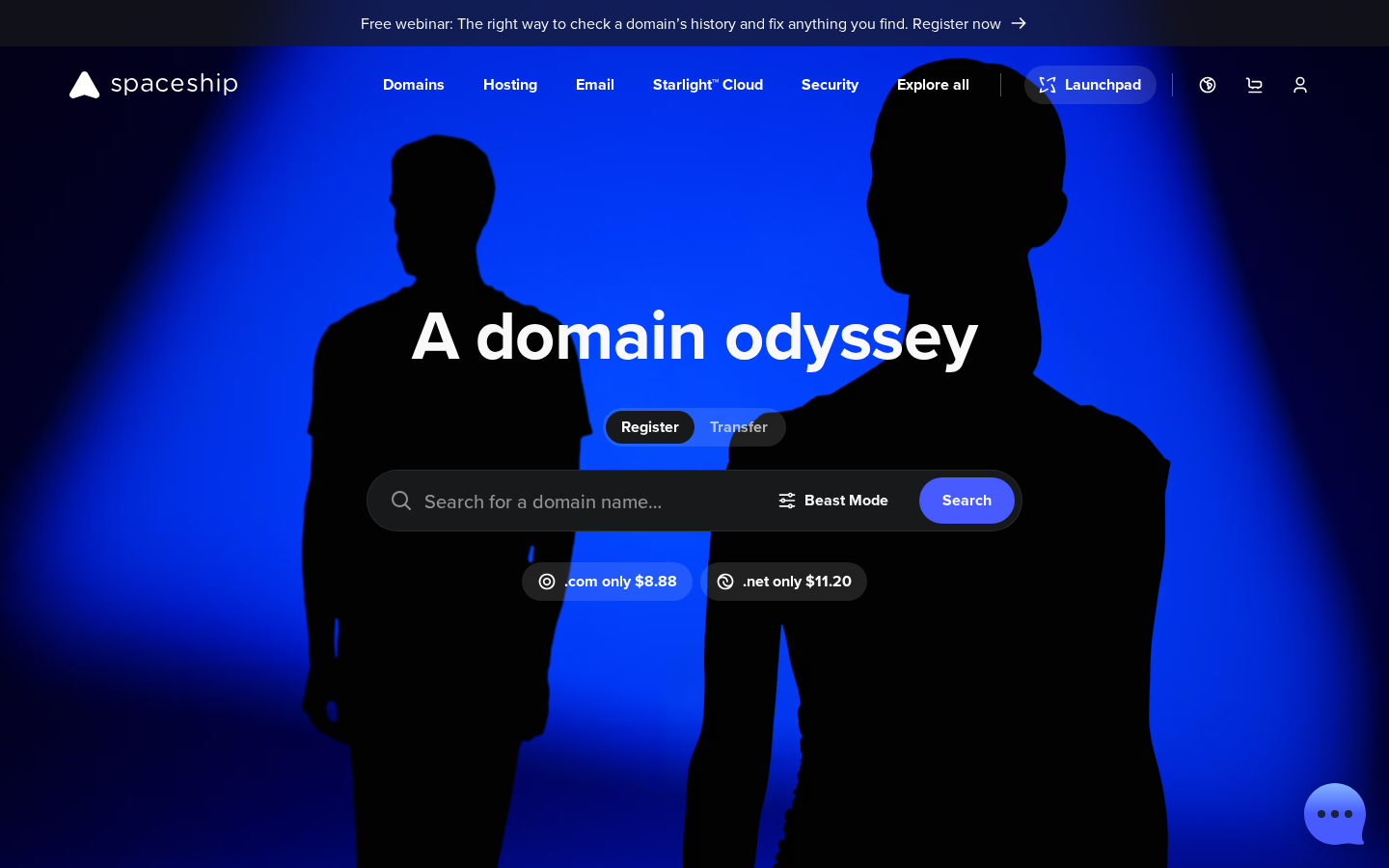
.com $18.48 renewal
Free lifetime WHOIS privacy and cheap first-year domains, but steep promotional-to-renewal price jumps and no phone support.
Pros
- Free WHOIS privacy protection for life on every eligible domain, saving $50+ per domain over five years compared to registrars that charge for it.
- Promotional first-year .COM pricing around $6.79 makes it one of the cheapest places to register a new domain.
- 24/7 live chat support with sub-two-minute response times in our testing.
- Supports over 1,000 TLD extensions, plus free DNSSEC and domain lock on every registration.
Cons
- Renewal pricing jumps from $6.79 in year one to $18.48/yr for .COM domains, nearly triple the promotional rate and higher than the $14.98 list price most reviews quote.
- BBB D- rating with 152 unanswered complaints. Multiple reports of aggressive account locking by the risk and fraud team with little recourse.
- No phone support at all. If live chat cannot resolve your issue, your only option is a support ticket.
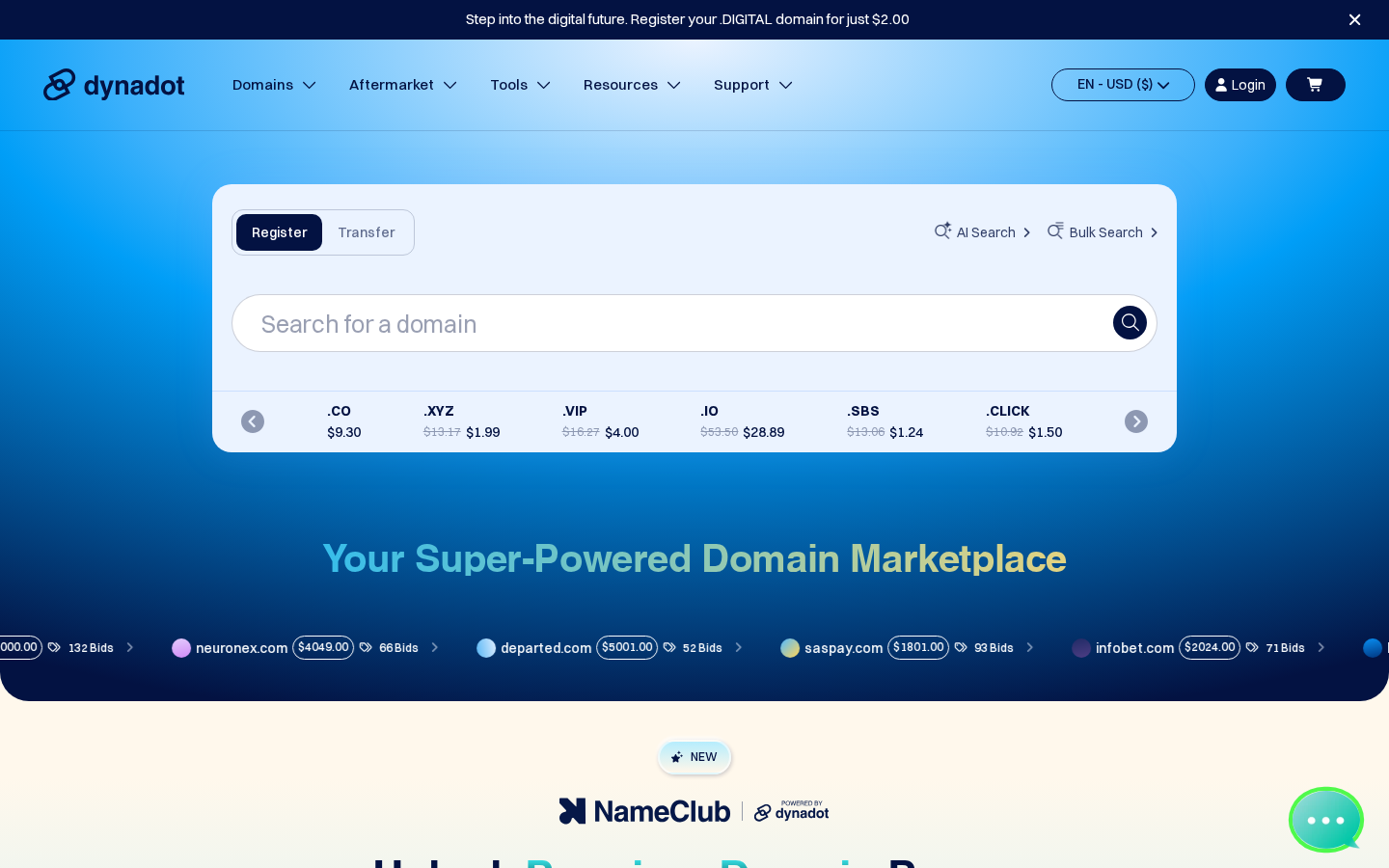
.com $10.88 flat
Flat .com pricing, free everything, and a dashboard that rewards founders who want to own their DNS.
Pros
- Flat .com pricing at $10.88 both years, no teaser rate
- All core features free, WHOIS privacy, DNS, email forwarding, SSL, DNSSEC, 2FA
- Checkout has no dark patterns, upsells are visible and uncoerced
- Full API plus new 2025 REST API with public sandbox
- Founder-owned and US-headquartered since 2002, A+ BBB, 4.5 Trustpilot
- Transparent transfer process, self-service EPP code, no transfer-out fee
Cons
- Dashboard is dense for absolute beginners, steeper learning curve than Porkbun
- Support can lag during busy periods, forum reports cite slow chat and email in late 2025
- .co and .ai have higher renewal than first-year register, not flat like .com
- DNSSEC does not work with Dynadot's own nameservers, requires third-party DNS
- No built-in hosting bundle, not a one-vendor domain plus hosting solution
.com $11.08 flat
The registrar with the strongest reputation in the industry, flat pricing, and the best free feature bundle in the comparison.
Pros
- Flat pricing on most common TLDs, register equals renewal
- Free Let's Encrypt SSL on the root plus up to 10 subdomains
- Free WHOIS privacy, DNSSEC, email forwarding up to 20, DNS hosting on Cloudflare anycast
- Trustpilot 4.9 over 23,000-plus reviews, the highest in the comparison set
- Phone support during business hours Pacific, 1-855-767-5286
- Cloudflare-powered anycast DNS with sub-50ms global propagation
Cons
- BBB F rating, driven by non-response on three complaints rather than systemic service failures
- Veriff third-party ID verification on some accounts, generated a February 2026 Hacker News backlash
- Dashboard is functional rather than polished, reviewers call it barebones
- No 24-hour phone SLA, phone is 9 AM to 5 PM Pacific only
- Brand recognition is thin outside of developer communities
$10.44
Wholesale domain pricing with no renewal markup, but you must use Cloudflare's nameservers and support is nearly nonexistent for free accounts.
Pros
- A .com is $10.44 a year to register and $10.44 to renew, with zero markup
- WHOIS privacy and DNSSEC are free on every domain, with no add on screens
- The checkout is clean, no pre-checked boxes and no surprise fees
- Tight integration with Cloudflare CDN, WAF and Workers if you already use them
Cons
- You must use Cloudflare nameservers. No outside DNS is allowed.
- Support is automated unless you pay for an enterprise plan
- Trustpilot sits at 1.5 from 1,189 reviews, and the BBB grade is D- on 122 complaints
- You cannot turn WHOIS privacy off, which some businesses need
$21.99
The most recognized name in domains, but you'll pay roughly double what competitors charge for the same .com registration.
Pros
- 24/7 phone and live chat support with human agents, a rarity among domain registrars
- Largest aftermarket domain marketplace for buying premium or expired names
- Free built-in WHOIS privacy, DNSSEC, and domain forwarding on every registration
- iOS app rated 4.8 stars for quick domain management on mobile
Cons
- True .com cost of $22.17/yr is roughly double Cloudflare at-cost ($10.44/yr) and well above Namecheap renewal ($18.48/yr)
- Checkout flow is packed with aggressive upsells that default to multi-year terms and pre-selected add-ons
- Ultimate Domain Protection quietly doubles from $14.99/yr to $29.99/yr at renewal
.com $0.01 year 1, $19.99 renewal
A cheap first year if you buy hosting at the same time, a pricier renewal, and a registrar experience that is clearly secondary to the hosting business.
Pros
- Free first year domain with 12 months of Premium or Business web hosting, per Hostinger's free domain page.
- A .com is $0.01 in year one on Hostinger's own .com page, .org is $8.99, .net is $11.99.
- A public REST API with PHP, Python and TypeScript SDKs, a CLI, an MCP server, an n8n node and a Terraform provider, all listed at developers.hostinger.com.
- Trustpilot 4.6 from 71,939 reviews on 4 September 2026, a very large sample.
- Free privacy protection on supported extensions, applied at registration.
Cons
- .com renews at $19.99 a year. Hostinger prints that beside the 1 cent offer.
- DNSSEC is not supported on Hostinger's own nameservers. Its help center says so. You can add DNSSEC records only when the domain points elsewhere.
- No phone support. The contact page offers Hostinger Agent, an AI, and chat.
- Transfer in for a .com is $9.99, so moving a domain here costs more than the 1 cent a new one does.
- .io renews at $74.99 a year after a $31.99 first year, one of the steepest jumps on its grid.
.com $1 welcome, $20 renewal
The $1 first year is a legitimate promo, the $20 renewal is where the story changes, and the cancellation flow is harder than it should be.
Pros
- 24 by 7 US phone support with a named Personal Consultant per account, rare at this price point
- Free wildcard SSL certificate included with every domain
- Aggressive $1 first-year promo on several common TLDs
- Publicly listed on Frankfurt Prime Standard, audited financial disclosure, EU legal jurisdiction
- Broad multilingual support across major European languages
- Sixth-largest registrar globally by gTLDs under management
Cons
- Renewal pricing is among the highest in this review set, .com at $20
- DNSSEC is a paid add-on at $15 per year after the first year, not free
- Auto-renew is on by default and cannot be disabled at checkout
- 12-month contract model can decouple from the ICANN registration clock
- Cancellation can require phone or written confirmation
- BBB complaint long tail, 211 in the last 12 months, 408 over 3 years
- Auth-code delivery on transfer-out can lag, with occasional refusal reports
- Mailbox email is paid, free forwarding only
- Dashboard is cluttered with promotional tiles
- 2026 price adjustment was communicated by individual emailed PDF, not a public price sheet
How to Choose
You are registering your first business .com and want it to cost the same in five years as it does today.
Flat renewal at $10.18, free privacy, and a clean checkout mean the total five-year cost is the lowest among mainstream registrars.
You already run Cloudflare for DNS, Workers, Pages, or Zero Trust.
At-cost renewal is the lowest long-run math, and the Cloudflare-only nameserver lock is not a new constraint if you are already on Cloudflare.
You specifically want phone support and a staffed help desk.
GoDaddy is the only major registrar with a real phone support team on the domain product, and it is the familiar choice most small business owners already trust.
You are a developer managing multiple domains via API or Terraform.
Mature API, strong DNS controls, and transparent renewal pricing make Dynadot the technical founder's pick.
You are buying Hostinger hosting anyway.
Free first-year domain with annual hosting plans makes Hostinger the cheapest year-one option, as long as hosting is part of the decision.
You want the best reputation and do not mind explaining the name.
Top Trustpilot score in the set. Free privacy, free DNSSEC, free email forwarding, and a flat renewal. The closest pick to Spaceship, and the right answer if reputation matters most to you.
How We Picked
Editorial fit comes first. We rank on fit over the life of a business domain. Not on what the homepage promos say. A provider ranking higher here than on a generic top-10 list earned it. On lifetime math, features, or reputation.
What we weigh, in order of importance.
- Honest pricing over the lifetime of the domain. First year plus three renewals, not the hero number on the homepage.
- Free WHOIS privacy and free DNSSEC. Paying extra for either in 2026 is a red flag.
- Nameserver freedom. If the registrar forces you onto their DNS and blocks external nameservers, that is a real lock-in.
- Checkout friction. How many upsells, how many pre-checked boxes, how hard is it to buy just the domain.
- Transfer friction. How long it takes to leave, whether EPP codes are self-serve, and what hidden fees appear.
- Reputation over the last 12 to 24 months. Trustpilot, BBB, Reddit, Hacker News, all weighted by recency.
- Dashboard and support quality.
- Developer ergonomics. API, Terraform, DNS record types. Matters more for technical founders, less for everyone else.
This comparison is editorially independent. Rankings reflect our research, not commercial relationships.
Who Needs This
This guide is for you if you are registering your first or second business domain. You are US based. You have already picked the name. You are price aware, but you are not chasing a $0.99 teaser. You want to know what you are paying for before you hand over a card.
Registering a domain for a side project? Any of the top four works. Domain investors should skim Spaceship SellerHub and Dynadot instead, which is a different job from this one.
In-Depth Comparison
Five things decide whether a registrar is the right one for your business domain.
Lifetime cost, not the teaser. Most registrars will sell you a .com for under ten dollars in year one. The number that matters is what you pay in year two and every year after. GoDaddy's renewal on a .com sits between $22.99 and $24.99. IONOS renews at $20. Hostinger renews at $19.99. Cloudflare Registrar renews at $10.46. Spaceship renews at $10.18. Over five years that gap is the price of a good meal.
Free privacy. Every registrar here offers it free. WHOIS privacy swaps your personal details for a proxy contact in the public record. In 2026 this is standard. Paying extra for it means paying for something that should be free. Pick a different registrar.
Free DNSSEC. This is a layer of cryptographic signing on your DNS records that prevents spoofing. Enabled by default at Cloudflare, Spaceship, and Porkbun. Available but off-by-default at most others. If you care about your domain's deliverability and your brand's reputation, turn it on.
Nameserver freedom. Some registrars sell you the domain, then force you onto their DNS. Move your site elsewhere and you are stuck. Cloudflare Registrar is the one example of this in the comparison. Every other provider on this page lets you set custom nameservers (point the domain at Cloudflare, AWS Route 53, Vercel, wherever you want).
Transfer friction. Leaving a registrar should be easy. You unlock the domain, retrieve the EPP code (sometimes called an Auth-Code), and start the transfer at the new registrar. Any registrar that makes that hard is a registrar you do not want to be stuck at. The ones that do it cleanly are Cloudflare Registrar, Spaceship, Namecheap, Dynadot, and Porkbun. The ones where people report friction most often are GoDaddy and IONOS, usually because of lock timers or email-based authorization loops.
What to Avoid
A few places where our ranking deliberately differs from what a pure-pricing spreadsheet would say.
Cloudflare Registrar is genuinely the cheapest long-run .com on this page. We still rank it 5th. The reason is the nameserver lock. Say you want to move your DNS off Cloudflare. Maybe for reliability, maybe to a DNS built into your hosting, maybe just to spread the risk. You cannot do that and keep the domain at Cloudflare Registrar. That is a lock-in that pure-pricing ranking misses, and the Cloudflare outages in late 2025 and early 2026 made the tradeoff more visible.
Porkbun has the best Trustpilot score in this list and a spotless reputation. We still rank it 4th, not 1st. Spaceship has a broader product range and support through Spacemail. Its parent company has 25 years behind it. That tips the call for a generalist first pick. The gap between them is small, and if you weigh reputation more heavily than ecosystem, Porkbun is the reasonable swap.
Hostinger sits in the main list, not in a separate situational box. That was deliberate. It is the right answer for one founder, the one already buying Hostinger hosting, and carving it off would have made it easy to skip. Its writeup runs longer than the pure registrars because the domain product is secondary to the hosting business.
GoDaddy stays at rank 6 despite the 2025 FTC settlement and the aggressive upsell habit. It is here because millions of founders expect to see it. A guide that left it out would look rigged. Ranking it any higher would be dishonest. Ranking it any lower would be cosmetic.
Alternatives Worth Considering
None of the 8 is right for every situation. Three cases sit just outside this comparison.
You want the domain and the site in one place. The trade is real. Buying the domain at your site builder saves a DNS step, and costs you the ability to change hosts without a transfer. If that suits you, our guide to building a business website covers what each builder charges for a bundled domain.
You need real email on the domain. Most registrars here sell forwarding only. Forwarding passes mail on to an address you already have. A mailbox you can send from is a separate purchase, and the two platforms worth comparing sit in our business email comparison.
The name you want is taken. That is an aftermarket buy, not a registration. The price is whatever the holder accepts. GoDaddy runs the largest aftermarket of the eight, which is a fair reason to keep an account there.
Our Methodology
How this ranking was built. We priced nine registrars at live checkout in April 2026. Eight earned a place. We cross-referenced renewals against third-party trackers (tldspy, tldes, domcomp), pulled Trustpilot ratings with exact review counts in the week of publish, and checked BBB ratings and complaint counts. Each provider got its own research dossier first. The comparison came after.
We refresh this page quarterly. Pricing gets re-checked at live checkout. Trustpilot counts get refreshed, and provider news from the prior quarter gets worked into the writeups.
Spot a price that no longer matches? Email [email protected] and we will fix it.
Frequently Asked Questions
About the Author
Editor, StartupOwl
Eliot leads StartupOwl's state data research. He maintains the site's fifty state records of LLC filing fees, annual costs, processing times, and small business grant programs, checking each figure against the state office that publishes it and logging the date it was verified. Based in New Jersey, he has spent his working life in and around small businesses, and he writes for the founder who wants the real number rather than the advertised one. Every figure under his byline traces to a named source, and when a state proves a number wrong, the correction is published, not buried.
Was this article helpful?
Questions about Best Domain Registrars for Startups in 2026
No comments yet. Ask the first question and a member of our team will answer.
Leave a comment